
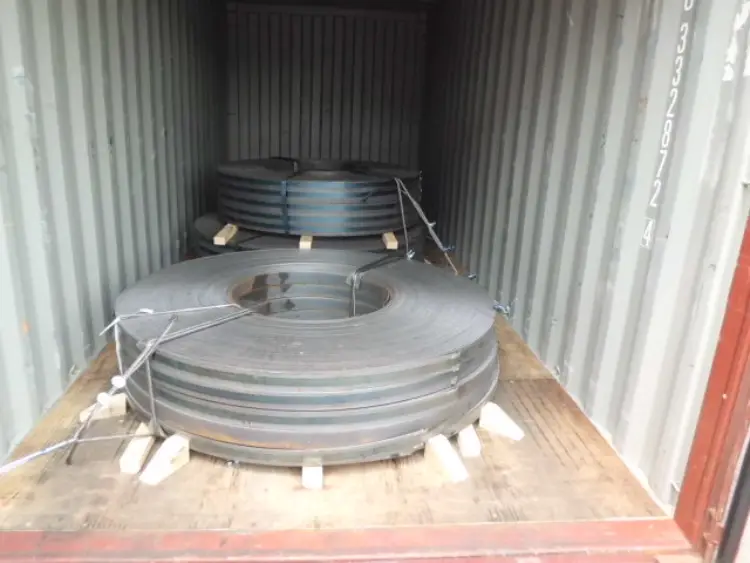
LR DH69 Shipbuilding Steel Coil
LR DH69 Shipbuilding Steel Coil: High-Strength Quenched & Tempered Marine Plate
LR DH69 is a quenched and tempered high-strength shipbuilding steel with minimum yield strength 690 MPa, excellent low-temperature toughness at -20°C, designed for demanding marine and offshore structures.
Welding, thermal cutting, cold forming, machining, bend forming
- Phone : +8618037372205
- Email : [email protected]
- WhatsApp: Contact via Whtsapp
- WeChat: +8618037372205
LR DH69 Shipbuilding Steel Coil Introduction
LR DH69 is a high-yield structural steel grade certified by Lloyd's Register (LR) for shipbuilding and offshore applications. As part of the LR high-strength steel family (AH69-DH69-EH69-FH69), DH69 is supplied in the quenched and tempered (Q&T) condition, offering a minimum yield strength of 690 MPa and tensile strength in the range 770–940 MPa. The 'D' designation guarantees adequate impact toughness at -20 °C, making it suitable for critical low-temperature service. Typical delivery forms include hot-rolled coils and heavy plates, which are further processed into structural components for hulls, decks, and offshore platforms. The steel exhibits good weldability when proper preheating and low-hydrogen procedures are followed, and its high strength-to-weight ratio enables lighter, more efficient designs. Typical thicknesses range from 6 mm up to 100 mm, with chemical composition and carbon equivalent strictly controlled to ensure consistent mechanical properties and reliable through-thickness performance.
LR DH69 Shipbuilding Steel Coil Chemical Composition
The chemical composition of LR DH69 is controlled to ensure deep hardenability and excellent strength-toughness balance after quenching and tempering. The specification sets maximum limits for residual elements and enforces minimum grain-refining additions, such as aluminium. A maximum carbon equivalent (CE) is often imposed to guarantee reliable field weldability. Typical tight control of P, S, N enhances ductility and impact properties.
| Element | Standard Value | Remarks |
|---|---|---|
| Carbon (C) | ≤ 0.20 | |
| Silicon (Si) | 0.10 – 0.55 | |
| Manganese (Mn) | 0.90 – 1.70 | |
| Phosphorus (P) | ≤ 0.025 | |
| Sulfur (S) | ≤ 0.025 | |
| Copper (Cu) | ≤ 0.55 | |
| Chromium (Cr) | ≤ 1.50 | |
| Nickel (Ni) | ≤ 2.00 | |
| Molybdenum (Mo) | ≤ 0.70 | |
| Niobium (Nb) | ≤ 0.06 | |
| Vanadium (V) | ≤ 0.12 | |
| Titanium (Ti) | ≤ 0.05 | |
| Aluminium (Al, total) | ≥ 0.020 | Grain refining |
| Nitrogen (N) | ≤ 0.020 | |
| Carbon Equivalent (CE) | ≤ 0.62 (typical) | Depending on thickness |
LR DH69 Shipbuilding Steel Coil Thermal and Electrical Physical Properties
Physical properties are not prescribed by LR rules but are provided here as typical values for a quenched and tempered 690 MPa grade steel. These data help in design calculations for heat transfer, thermal expansion, and electrical resistance. Actual values may vary slightly depending on the specific heat treatment and composition.
| Property | Typical Value | Unit | Test Condition |
|---|---|---|---|
| Density (ρ) | 7850 | kg/m³ | 20 °C |
| Elastic Modulus (E) | 210 | GPa | 20 °C |
| Shear Modulus (G) | 80 | GPa | 20 °C |
| Poisson's Ratio (ν) | 0.3 | – | 20 °C |
| Thermal Expansion Coeff. (α) | 12.0 | 10⁻⁶/K | 20–100 °C |
| Thermal Conductivity (λ) | 42 | W/(m·K) | 20 °C |
| Specific Heat Capacity | 460 | J/(kg·K) | 20 °C |
| Electrical Resistivity (ρ_e) | 0.25 | μΩ·m | 20 °C |
LR DH69 Shipbuilding Steel Coil Mechanical Properties
The following values are based on LR Rule requirements for DH69 quenched and tempered steel, tested on standard tensile and Charpy V-notch specimens taken from finished products. Impact toughness is guaranteed at -20 °C for longitudinal samples; transverse values are typically 70 % of the longitudinal minima. Bending tests shall not show cracks or defects.
| Property | Standard Requirement | Unit | Test Condition |
|---|---|---|---|
| Yield Strength (ReH) | ≥ 690 | MPa | Room temperature, t ≤ 100 mm |
| Tensile Strength (Rm) | 770 – 940 | MPa | Room temperature |
| Elongation (A, 5.65√So) | ≥ 14 | % | Longitudinal, gauge length 50 mm (typical) |
| Impact Energy (KV) | ≥ 69 (longitudinal) | J | -20 °C, V-notch, average of 3 tests |
| Impact Energy (KV, transverse) | ≥ 48 (transverse) | J | -20 °C, V-notch, average of 3 tests |
| Bend Test (180°) | No cracks | – | Bend diameter = 4 × thickness (t ≤ 25 mm) |
LR DH69 Shipbuilding Steel Coil Fully Equivalent Material Standards and Replaceable Grades
| Country/Region | Standard | Grade | Remarks |
|---|---|---|---|
| International | LR Rules | DH69 | Base specification |
| Europe | EN 10025-6 | S690QL | Very close chemical and mechanical requirements; Q&T delivery; often used as direct replacement |
| USA | ASTM A514/A514M | Grade Q | Similar 690 MPa Q&T steel; check impact test temperature class |
| Norway/Germany | DNV GL Rules | NV D690 | DNV equivalent for D grade (-20 °C) 690 MPa shipbuilding steel |
| USA | ABS Rules | DH69 | Identical grade designation; same demanding properties |
| France | BV Rules | DH69 | Bureau Veritas equivalent |
| China | CCS Rules | DH69 | China Classification Society equivalent |
| South Korea | KR Rules | DH69 | Korean Register equivalent |
| Japan | NK Rules | KD69 | Nippon Kaiji Kyokai equivalent; similar grade with K designation for high strength |
| Italy | RINA Rules | DH69 | RINA equivalent |
| Russia | RS Rules | DH69 | Russian Maritime Register of Shipping equivalent |
LR DH69 Shipbuilding Steel Coil Application Introduction
LR DH69 steel is designed for critical load-bearing components in marine and offshore environments, where high strength, good weldability, and excellent low-temperature toughness are essential. Typical applications are listed below.
Product Applications: Hull plates (bottom, side, deck) for large container ships, bulk carriers, and tankers, Jack-up rig legs and chords, Offshore platform decks and substructures, Transition pieces and monopile foundations for wind turbines, Heavy-duty crane booms and gantries, Reinforcement nodes and brackets in seismic-resistant structures
Processed into products: Ship frames, stiffeners, and girders, Deck house structural members, Mooring brackets and winch foundations, Wind turbine tower flanges, Bridge box girders, Heavy-lift offshore crane pedestals, Pressure hull components for submersibles, Mining equipment structural parts
Application industries: Shipbuilding (military and commercial), Offshore oil & gas platforms, Renewable energy (offshore wind turbine foundations), Heavy machinery and crane manufacturing, Bridge construction, Pressure vessel and storage tank fabrication
LR DH69 Shipbuilding Steel Coil Similar or Comparable Alternative Steel Grades
| Country/Region | Standard | Grade | Remarks |
|---|---|---|---|
| Europe | EN 10025-6 | S690Q | Same as S690QL but without specific low-temperature impact guarantee; only S690QL is fully equivalent to DH69's -20 °C requirement |
| USA | ASTM A709/A709M | Grade 690W | Structural steel for bridges, with weathering option; similar strength level but different impact requirements |
| USA | ASTM A514/A517 | Grades B, H, F | Q&T plates with 690 MPa yield, but impact classes and chemistry may differ slightly |
| Germany | DIN EN 10137-2 | S690Q/QL | Historic designation for 690 MPa Q&T plate; now superseded by EN 10025-6 |
| Japan | JIS G 3128 | SHY 685 | High yield strength steel for welded structures; 685 MPa YS, close to DH69, but check toughness class |
Notes:
- Welding: Preheating (typically 100–150 °C) and interpass temperature control are essential; low hydrogen consumables (e.g., AWS E11018-M) are recommended to avoid cold cracking.
- Crack Tip Opening Displacement (CTOD) tests may be specified for critical offshore joints; DH69 can pass CTOD requirements at -10 °C when correctly welded.
- Through-thickness properties (Z-grade) are available upon request, e.g., Z25 or Z35 per EN 10164.
- Corrosion protection: In marine environments, protective coatings or cathodic protection are required; the steel itself has no inherent seawater corrosion resistance.
- Surface condition: The product is normally shot-blasted and shop-primered to prevent rust during construction.
- Share



