
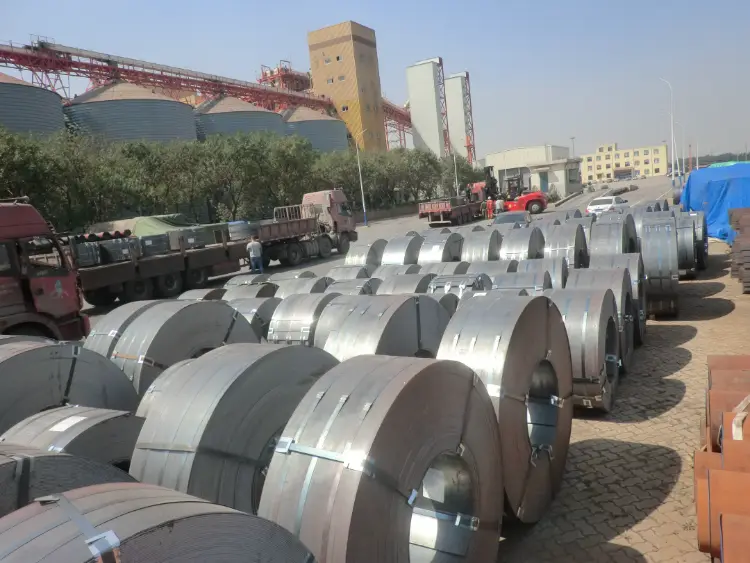
LR FH46 Shipbuilding Steel Coil
LR FH46 High Strength Shipbuilding Steel Coil: Full Specs, Equivalents & Applications
Complete data sheet for LR FH46 shipbuilding steel coil per Lloyd's Register rules, detailing chemical composition, mechanical properties, thermal/electrical physical properties, international equivalents, and typical applications in marine and offshore construction.
Hot rolling, TMCP (Thermo-Mechanical Controlled Process), Normalizing, Welding, Cutting, Forming
- Phone : +8618037372205
- Email : [email protected]
- WhatsApp: Contact via Whtsapp
- WeChat: +8618037372205
LR FH46 Shipbuilding Steel Coil Introduction
LR FH46 is a high-strength, fine-grain shipbuilding structural steel classified under Lloyd's Register (LR) rules with a minimum yield strength of 460 MPa. The 'F' designation indicates guaranteed impact toughness down to -60 °C, making it suitable for critical ship structures exposed to low temperatures and ice environments. It is primarily supplied in the thermo-mechanically controlled processed (TMCP) or normalized condition. The steel offers an excellent combination of
- High strength-to-weight ratio for lighter vessel designs
- Superior weldability due to controlled carbon equivalent and microalloy additions
- Outstanding low-temperature toughness for Arctic and cryogenic service
- Good ductility and formability for complex hull shapes
Typical delivery forms include coils, plates, and strips used in hulls, decks, bulkheads, and offshore platform components.
LR FH46 Shipbuilding Steel Coil Chemical Composition
The chemical composition of LR FH46 is tightly controlled to ensure high strength, excellent low-temperature toughness, and good weldability. Microalloying elements such as niobium, vanadium, and titanium are used for grain refinement and precipitation strengthening. The limits below are based on LR Rules with typical ranges, and the carbon equivalent value (CEV) is usually restricted to guarantee weldability.
| Element | Weight % (max or range) | Remarks |
|---|---|---|
| Carbon (C) | ≤ 0.18 | Ladle analysis |
| Manganese (Mn) | 0.90 – 1.60 | |
| Silicon (Si) | ≤ 0.50 | |
| Phosphorus (P) | ≤ 0.025 | |
| Sulfur (S) | ≤ 0.025 | |
| Chromium (Cr) | ≤ 0.20 | |
| Nickel (Ni) | ≤ 0.40 | |
| Molybdenum (Mo) | ≤ 0.08 | |
| Copper (Cu) | ≤ 0.35 | |
| Aluminium (Al, total) | ≥ 0.015 | Usually acid soluble |
| Niobium (Nb) | ≤ 0.05 | Microalloy |
| Vanadium (V) | ≤ 0.10 | Microalloy |
| Titanium (Ti) | ≤ 0.02 | Microalloy |
| Nitrogen (N) | ≤ 0.009 | If applicable |
LR FH46 Shipbuilding Steel Coil Thermal and Electrical Physical Properties
The following physical properties are typical for LR FH46 steel at room temperature. These values are based on general structural steel data and are provided for engineering calculations such as thermal stress analysis, heat transfer, and electrical resistance. They are not mandatory per LR material rules but are representative of this alloy group.
| Property | Typical Value | Unit | Test Condition |
|---|---|---|---|
| Density (ρ) | 7.85 | g/cm³ | at 20 °C |
| Elastic modulus (E) | 207 | GPa | at 20 °C |
| Shear modulus (G) | 79.3 | GPa | at 20 °C |
| Poisson's ratio (ν) | 0.30 | — | at 20 °C |
| Thermal expansion coefficient (α) | 12.5 | 10⁻⁶/K | 20 – 100 °C |
| Thermal conductivity (λ) | 52 | W/(m·K) | at 20 °C |
| Specific heat capacity (c) | 486 | J/(kg·K) | at 20 °C |
| Electrical resistivity (ρ_e) | 0.22 | μΩ·m | at 20 °C |
LR FH46 Shipbuilding Steel Coil Mechanical Properties
Mechanical test values for LR FH46 depend on product thickness and specimen orientation. Transverse tensile testing is standard for plates and coils. The low-temperature impact test at -60 °C verifies the 'F' grade toughness. Bend tests ensure formability without cracking. Values below represent minimum requirements; actual values may be higher.
| Property | Value (min or range) | Unit | Test Condition |
|---|---|---|---|
| Yield Strength (ReH) | ≥ 460 | MPa | t ≤ 50 mm, transverse |
| Yield Strength (ReH) | ≥ 440 | MPa | 50 < t ≤ 70 mm, transverse |
| Yield Strength (ReH) | ≥ 420 | MPa | 70 < t ≤ 100 mm, transverse |
| Tensile Strength (Rm) | 570 – 720 | MPa | t ≤ 100 mm, transverse |
| Elongation after fracture (A) | ≥ 17 | % | Gauge length 5.65√So, t ≤ 100 mm, transverse |
| Bend Test (180°) | d = 3a | — | t ≤ 25 mm (a = specimen thickness) |
| Bend Test (180°) | d = 4a | — | t > 25 mm |
| Impact Energy (KV, -60 °C) | ≥ 41 (average) | J | Longitudinal, t ≤ 50 mm |
| Impact Energy (KV, -60 °C) | ≥ 28 (individual) | J | Longitudinal, t ≤ 50 mm |
| Impact Energy (KV, -60 °C) | ≥ 27 (average) | J | Transverse, t ≤ 50 mm |
| Impact Energy (KV, -60 °C) | ≥ 19 (individual) | J | Transverse, t ≤ 50 mm |
LR FH46 Shipbuilding Steel Coil Fully Equivalent Standards and Substitutable Grades
| Country/Region | Standard / Classification Society | Grade | Remarks |
|---|---|---|---|
| United Kingdom | LR Rules | FH46 | Original grade |
| Norway | DNV Rules | NV F460 | Fully equivalent, -60 °C impact |
| USA | ABS Rules | FH46 | Fully equivalent |
| France | BV Rules | FH46 | Fully equivalent |
| China | CCS Rules | FH46 | Fully equivalent |
| Japan | NK Rules | NK FH46 | Fully equivalent |
| South Korea | KR Rules | KR FH46 | Fully equivalent |
| Italy | RINA Rules | RINA FH46 | Fully equivalent |
LR FH46 Shipbuilding Steel Coil Application Introduction
LR FH46 is a premium choice for severe marine environments. Its high strength reduces structural weight, while the -60 °C notch toughness guarantees safety in ice-class vessels and Arctic operations. The grade is readily weldable using standard procedures with low-hydrogen consumables, and its TMCP delivery condition minimizes residual stresses. Typical processing includes thermal cutting, cold forming, and welding, making it suitable for a wide variety of shipbuilding and offshore components.
Product Applications: Ship hulls and superstructures, Decks, bulkheads, and shell plating, Offshore platform jackets and topsides, Ice-strengthened vessel frames, Heavy-lift cargo vessels and barges
Processed into products: Hull plates and shell strakes, Longitudinal stiffeners and girders, Transverse frames and web plates, Brackets and deep beams, Deck stringer plates, Fatigue-critical structural nodes, Reinforcing pads for openings
Application industries: Shipbuilding (icebreakers, LNG carriers, naval vessels), Offshore Oil & Gas (jack-up rigs, FPSO structures), Marine Engineering (port cranes, floating docks), Arctic and Polar Infrastructure, Renewable Energy (offshore wind turbine substructures)
LR FH46 Shipbuilding Steel Coil Closely Matched / Similar Alternative Materials
| Country/Region | Standard / Classification Society | Grade | Remarks |
|---|---|---|---|
| Shipbuilding | LR / DNV / ABS etc. | EH46 | Same 460 MPa strength, impact at -40 °C (lower toughness class) |
| Shipbuilding | LR / DNV / ABS etc. | DH46 | 460 MPa, impact at -20 °C |
| China | GB/T 1591-2018 | Q460E | Similar minimum yield, -40 °C impact; not a direct ship grade substitute |
| Europe | EN 10025-4 | S460ML | Thermomechanically rolled, -50 °C; close chemistry but offshore/structural, not classified for ships |
| USA | ASTM A572 / A709 | Grade 65 (450 MPa) | Slightly lower strength; need qualification for substitution |
| Fixed Offshore | EN 10225:2009 | S460G14+M | Offshore structural steel, 460 MPa, -40 °C; chemistry and toughness comparable |
Notes:
Additional information:
- Carbon equivalent value (CEV) is typically controlled to ≤ 0.45% (depending on thickness) to ensure good weldability without preheating.
- TMCP plates must not be subjected to heat treatments that alter the mechanical properties beyond LR approved procedures.
- For thicknesses above 100 mm, special agreement with the classification society is required for mechanical property acceptance.
- Ultrasonic testing per LR rules is normally mandatory for products with thickness ≥ 20 mm.
- Supplementary impact testing may be taken at lower temperatures for certain Arctic applications.
- Share



