
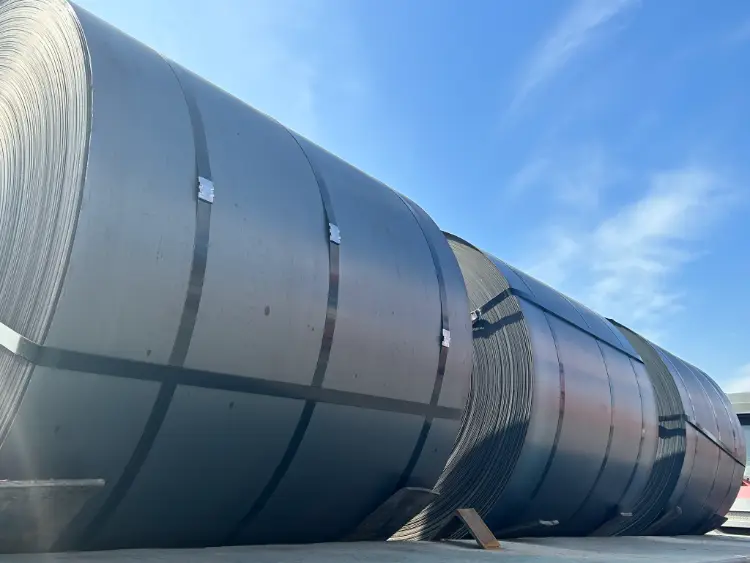
LR FH36 Shipbuilding Steel Coil
LR FH36 Shipbuilding Steel Coil - High Strength & Low Temperature Toughness
Detailed technical data for LR FH36 shipbuilding steel coil, including chemical composition, mechanical properties, physical properties, international equivalents, and application guidance for marine and offshore structures.
Thermo-mechanical controlled rolling (TMCP), normalizing, cutting, welding, cold forming, machining
- Phone : +8618037372205
- Email : [email protected]
- WhatsApp: Contact via Whtsapp
- WeChat: +8618037372205
LR FH36 Shipbuilding Steel Coil Introduction
LR FH36 is a high-strength hull structural steel certified by Lloyd's Register, designed for critical shipbuilding applications requiring excellent low-temperature toughness. This thermo-mechanically controlled rolled (TMCP) or normalized steel offers a minimum yield strength of 355 MPa and guaranteed impact energy of 34 J at -60°C. Typical applications include cargo hold frames, outer shell plating, and offshore platform components. The material is available in coil and plate form, offering good weldability and formability for heavy fabrication. Its fine-grain structure provides consistent mechanical properties and excellent resistance to brittle fracture in Arctic and sub-Arctic service conditions.
LR FH36 Shipbuilding Steel Coil Chemical Composition of LR FH36 Shipbuilding Steel
The chemical composition of LR FH36 is controlled to ensure high strength, excellent weldability, and low-temperature toughness. Fine-grain elements such as niobium, vanadium, and titanium are added, and the carbon equivalent (Ceq) is limited according to delivery condition (≤0.40% for TMCP, ≤0.42% for normalized). All values are based on the ladle analysis as per Lloyd's Register rules.
| Chemical Element | Standard Value (max unless range given) | Remarks |
|---|---|---|
| Carbon (C) | ≤0.16% | Key hardenability element; kept low for weldability |
| Manganese (Mn) | 1.00 - 1.60% | Increases strength and toughness |
| Silicon (Si) | 0.10 - 0.50% | Deoxidizer, improves strength |
| Phosphorus (P) | ≤0.025% | Strictly limited to avoid embrittlement |
| Sulfur (S) | ≤0.025% | Kept low for formability and toughness |
| Aluminium (Al, acid soluble) | ≥0.015% | Grain refinement, deoxidation |
| Niobium (Nb) | ≤0.05% | Grain refinement, precipitation hardening |
| Vanadium (V) | ≤0.10% | Additional grain refinement |
| Titanium (Ti) | ≤0.02% | Grain boundary pinning |
| Copper (Cu) | ≤0.35% | Improves corrosion resistance |
| Chromium (Cr) | ≤0.20% | Residual element |
| Nickel (Ni) | ≤0.40% | Improves low-temperature toughness |
| Molybdenum (Mo) | ≤0.08% | Negligible if not specified |
| Nitrogen (N) | ≤0.012% | Controlled to avoid ageing effects |
LR FH36 Shipbuilding Steel Coil Thermal and Electrical Physical Properties
The physical properties listed below are typical for LR FH36 steel at room temperature (unless otherwise noted) and are not mandatory requirements. These values are derived from standard carbon-manganese steel grades and are suitable for engineering calculations. Actual values may vary slightly with processing conditions.
| Property | Typical Value | Unit | Test Conditions |
|---|---|---|---|
| Density (ρ) | 7.85 | g/cm³ | Ambient (20°C) |
| Modulus of Elasticity (E) | 205 | GPa | Ambient, tension |
| Shear Modulus (G) | 80 | GPa | Calculated from E and ν |
| Poisson's Ratio (ν) | 0.3 | - | Elastic range |
| Thermal Expansion Coefficient (α) | 12.0 × 10⁻⁶ | /K | 20°C to 100°C |
| Thermal Conductivity (λ) | 50 | W/(m·K) | At 20°C |
| Specific Heat Capacity | 0.49 (490) | J/(g·K) / [J/(kg·K)] | Ambient |
| Electrical Resistivity (ρ_e) | 0.18 | μΩ·m | Ambient |
LR FH36 Shipbuilding Steel Coil Mechanical Properties of LR FH36
Mechanical properties are verified on standard test pieces taken in the transverse direction unless otherwise agreed. The material meets the Lloyd's Register requirements for yield strength, tensile strength, elongation, impact toughness at -60°C, and cold bending. Values depend on plate thickness; multiple rows indicate thickness-dependent requirements.
| Property | Standard Requirement | Unit | Test Conditions / Thickness Range |
|---|---|---|---|
| Yield Strength (ReH) | ≥355 | MPa | t ≤ 50 mm |
| Yield Strength (ReH) | ≥355 | MPa | 50 < t ≤ 70 mm |
| Yield Strength (ReH) | ≥355 | MPa | 70 < t ≤ 100 mm |
| Tensile Strength (Rm) | 490 - 630 | MPa | All relevant thicknesses |
| Elongation (A, 5.65√S0) | ≥21 | % | t ≤ 50 mm, gauge length 5.65√S0 |
| Elongation (A, 5.65√S0) | ≥19 | % | 50 < t ≤ 70 mm |
| Elongation (A, 5.65√S0) | ≥18 | % | 70 < t ≤ 100 mm |
| Impact Energy (KV, longitudinal) | ≥34 | J | -60°C, 10×10 mm Charpy V-notch |
| Bend Test (180°) | d = 3a | - | t ≤ 50 mm, no cracks |
| Bend Test (180°) | d = 4a | - | 50 < t ≤ 70 mm, no cracks |
| Bend Test (180°) | d = 5a | - | 70 < t ≤ 100 mm, no cracks |
LR FH36 Shipbuilding Steel Coil Equivalent Standards and Substitute Grades for LR FH36
The following international shipbuilding steel grades are functionally equivalent to LR FH36, featuring the same yield strength class and impact test temperature of -60°C. They can be used as direct substitutes, subject to approval by the relevant classification society. All listed grades are high-strength hull structural steels with TMCP or normalized delivery.
| Country / Region | Standard / Classification Society | Grade Designation | Remarks |
|---|---|---|---|
| United Kingdom / International | Lloyd's Register | LR FH36 | Original specification |
| Norway / Germany | DNV GL | DNV FH36 | Fully equivalent, -60°C impact |
| France | Bureau Veritas | BV FH36 | Fully equivalent, -60°C impact |
| USA | American Bureau of Shipping | ABS FH36 | Fully equivalent, -60°C impact |
| China | China Classification Society | CCS FH36 | Fully equivalent Chinese marine steel |
| Japan | Nippon Kaiji Kyokai (ClassNK) | NK FH36 | Equivalent, -60°C impact |
| South Korea | Korean Register | KR FH36 | Equivalent, -60°C impact |
| Russia | Russian Maritime Register | RS FH36 | Equivalent, -60°C impact |
| Italy | RINA | RINA FH36 | Equivalent, -60°C impact |
| International | ASTM A131 / A131M | ASTM FH36 | Identical strength and toughness class |
LR FH36 Shipbuilding Steel Coil Application Introduction
LR FH36 is primarily designed for the shipbuilding and offshore industry where high strength combined with outstanding toughness at very low temperatures is essential. Its excellent weldability and formability make it suitable for complex structural components. Common applications include:
Product Applications: Hull shell plates and side shell, Deck plates and main deck stringers, Transverse bulkheads and longitudinal girders, Bottom plates and bilge keels, Ship frames, stiffeners, and brackets, Offshore jacket legs and bracing members, Transition pieces and monopile reinforcement
Processed into products: Welded beams, T-profiles, and bulb flats, Cut and formed shipyard parts (e.g., brackets, floors), Heavy-duty brackets and padeyes, Reinforced inserts around mooring points and hatches, Rolled and welded tubular sections for offshore structures, Flanges and web plates for box girders
Application industries: Shipbuilding (cargo ships, tankers, bulk carriers, container ships, LNG carriers), Offshore oil & gas (jack-up rigs, semi-submersibles, floating platforms), Offshore wind energy (turbine foundations, transition pieces), Bridge construction (heavy steel bridges in cold climates), Pressure vessel and boiler components (low-temperature service), Heavy machinery (crane booms, mining equipment exposed to cold)
LR FH36 Shipbuilding Steel Coil Similar or Alternative Material Grades to LR FH36
The following grades provide comparable strength but may differ in impact test temperature or steelmaking practice. They are suitable for applications where full FH36 certification is not mandatory or when design conditions permit a less stringent toughness requirement. Always check with the classification society before substitution.
| Country / Region | Standard / Classification Society | Grade Designation | Remarks |
|---|---|---|---|
| International | Various (ABS, DNV, etc.) | EH36 | Same strength; impact at -40°C instead of -60°C |
| European Union | EN 10025-4 | S355ML | Yield 355 MPa; -50°C impact; TMCP; structural steel, not specifically marine-certified |
| European Union | EN 10225 | S355G10+M | Offshore structural steel, -40°C; similar strength |
| Germany | DIN 17102 | TStE355 | Obsolete standard; used in older constructions |
| Japan | JIS G 3106 | SM490YB | 490 MPa tensile; 0°C impact; only for general structural use, not marine |
Notes:
Delivery and additional requirements: LR FH36 steel is typically supplied in the TMCP (thermo-mechanical control process) condition, which provides an optimal combination of strength and toughness without the need for full normalizing. Surface condition can be hot-rolled, pickled and oiled, or shot-blasted and shop-primed as per project specification. Weldability: The carbon equivalent (Ceq < 0.40%) ensures good weldability with low preheat. Testing: Material certificates include chemical analysis, tensile and bend tests, and Charpy V-notch impact at -60°C. Ultrasonic testing per EN 10160 or equivalent may be specified. Certification: Each delivery is accompanied by a Lloyd's Register inspection certificate (3.1 or 3.2).
- Share



