
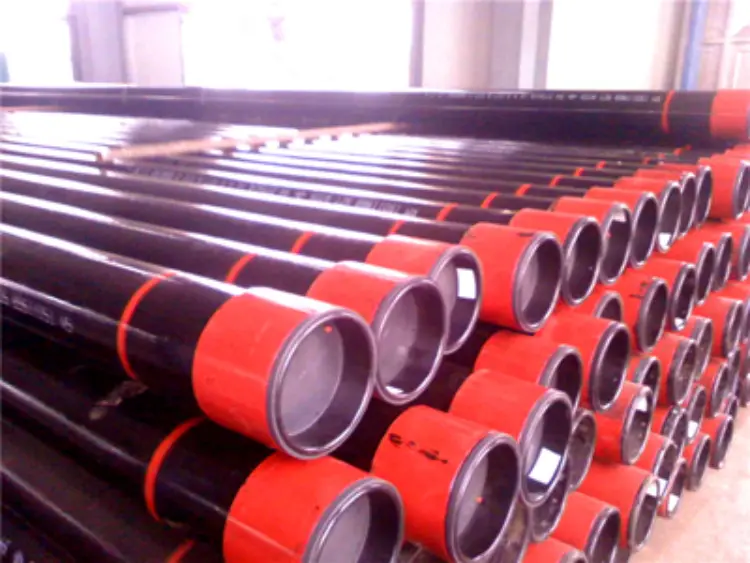
ASME SA312 TP304L Stainless Steel Pipe
ASME SA312 TP304L Stainless Steel Pipe: Composition, Properties & Global Equivalents
In-depth technical profile of ASME SA312 TP304L austenitic stainless steel pipe, covering chemical composition, mechanical properties, physical data, equivalent grades, and application areas.
Hot working, cold working, machining, welding (all common methods), bending, flaring
- Phone : +8618037372205
- Email : [email protected]
- WhatsApp: Contact via Whtsapp
- WeChat: +8618037372205
ASME SA312 TP304L Stainless Steel Pipe Introduction
ASME SA312 TP304L is a low-carbon austenitic stainless steel pipe grade widely specified for welded and seamless constructions. Its reduced carbon content (≤0.035%) minimizes carbide precipitation during welding, which safeguards intergranular corrosion resistance without post-weld annealing. The alloy combines excellent formability, good toughness at cryogenic temperatures, and high resistance to a broad range of corrosive media. Typical applications span chemical process equipment, food and beverage tubing, heat exchangers, and pressure vessels operating in moderate corrosive environments. The material is readily available in multiple delivery conditions and complies with US and international pressure piping codes.
ASME SA312 TP304L Stainless Steel Pipe Chemical Composition
The alloying limits prescribed by ASME SA312/SA312M for TP304L ensure consistent corrosion resistance and mechanical integrity. A tight control on carbon (≤0.035%) distinguishes the L-grade from standard 304, preventing sensitization in the heat-affected zone during welding. All values represent ladle analysis; product analysis may vary slightly per the standard.
| Element | Standard Value (%) | Remarks |
|---|---|---|
| Carbon (C) | ≤0.035 | Low carbon for improved welding resistance |
| Manganese (Mn) | ≤2.00 | Austenite stabilizer, aids hot workability |
| Phosphorus (P) | ≤0.045 | Maximum allowed; excess may harm toughness |
| Sulfur (S) | ≤0.030 | Controlled for machinability and corrosion resistance |
| Silicon (Si) | ≤1.00 | Deoxidizer, improves oxidation resistance |
| Chromium (Cr) | 18.0–20.0 | Essential for passivity and corrosion resistance |
| Nickel (Ni) | 8.0–12.0 | Stabilizes austenitic structure and toughness |
| Nitrogen (N) | ≤0.10 | Residual element; higher levels increase strength |
| Iron (Fe) | Balance | Remainder |
ASME SA312 TP304L Stainless Steel Pipe Thermal and Electrical Physical Properties
Representative physical constants at ambient condition and over typical service ranges. These values align with standard reference data for wrought 304L (UNS S30403) used in engineering analysis. Actual values may vary with product form and slight composition differences within the specification.
| Property | Typical Value | Unit | Test Condition / Temperature |
|---|---|---|---|
| Density (ρ) | 8000 | kg/m³ | 20 °C |
| Modulus of Elasticity (E) | 193 | GPa | 20 °C |
| Shear Modulus (G) | 77 | GPa | 20 °C |
| Poisson's Ratio (ν) | 0.30 | 20 °C | |
| Thermal Expansion Coefficient (α) | 16.0 | μm/m·°C | 20–100 °C |
| Thermal Expansion Coefficient (α) | 17.3 | μm/m·°C | 20–300 °C |
| Thermal Expansion Coefficient (α) | 18.3 | μm/m·°C | 20–500 °C |
| Thermal Conductivity (λ) | 15.1 | W/m·K | 20 °C |
| Specific Heat Capacity (Cp) | 500 | J/kg·K | 20–100 °C |
| Electrical Resistivity (ρ_e) | 0.72 | μΩ·m (ohm·mm²/m) | 20 °C |
ASME SA312 TP304L Stainless Steel Pipe Mechanical Properties
Mechanical performances are based on the solution-annealed condition tested at room temperature. The standard specifies minimum values for tensile strength, yield strength, and elongation; actual mill test results commonly exceed these minima. For pressure-boundary design, ASME B31.3 and Section II Part D provide allowable stresses that incorporate these properties.
| Property | Required Value | Unit | Test Condition |
|---|---|---|---|
| Tensile Strength (Rm) | ≥485 | MPa | Room temperature, longitudinal strip/round specimen |
| Yield Strength (ReH/Rp0.2) | ≥170 | MPa | 0.2% offset method |
| Elongation (A) | ≥35 | % | Gauge length 50 mm (2 in) or 4D for tubular products |
| Hardness (Rockwell B / Brinell) | Not specified by standard | Typical values: ≤90 HRB, ≤200 HBW for annealed condition |
ASME SA312 TP304L Stainless Steel Pipe Fully Equivalent Material Standards & Substitutable Grades
| Country/Region | Standard | Grade | Remarks |
|---|---|---|---|
| USA | ASTM A312 | TP304L | Identical chemistry and mechanical requirements |
| USA | UNS | S30403 | Unified Numbering System – primary identifier for 304L |
| European Union | EN 10028-7 / EN 10216-5 / EN 10217-7 | 1.4307 (X2CrNi18-9) | Equivalent for pressure purposes, slight upper carbon limit difference (≤0.030%) |
| Japan | JIS G3459 / G3463 | SUS304LTBS / SUS304LTB | Comparable composition and tensile properties for piping |
| China | GB/T 14976 / GB/T 12771 | 022Cr19Ni10 (old 00Cr19Ni10) | Matched low-carbon 18Cr-10Ni stainless steel pipe |
| International | ISO 9329 / ISO 9330 | X2CrNi18-9 / 4307-304-03-I | Harmonized international designations |
| Australia | AS 2837 | 304L | Wrought stainless steel tubes |
ASME SA312 TP304L Stainless Steel Pipe Application Introduction
ASME SA312 TP304L stainless steel pipe offers an optimal balance of corrosion resistance, fabricability, and toughness in demanding welded structures. It is the material of choice when mild chemical environments, cleanability, and low-temperature performance must coexist without the need for post-weld heat treatment. Below are typical industry sectors, final products, and specific manufactured components.
Product Applications: Process piping systems (ASME B31.3), Heat exchanger and condenser tubes, Sanitary tubing for food/dairy/brewery, Cryogenic transfer lines, Architectural handrails and balustrades, Instrument and hydraulic tubing, Water filtration and RO membrane housings, Fuel and lubricant lines for OEM equipment
Processed into products: Pipe spools and fittings (elbows, tees, reducers, flanges), Tube-in-tube heat exchangers, Orifice plates and flow elements, Expansion joints and bellows, Sanitary clamp ferrules and gaskets, Bent pipe sections (cold bending), Manifolds and headers, Hydraulic cylinder tubes (non-pressure boundary)
Application industries: Chemical and Petrochemical Processing, Food and Beverage Production, Pharmaceutical and Biotechnology, Water Treatment and Desalination, Architecture and Construction, Cryogenics and LNG Equipment, Pulp and Paper, Marine and Offshore (splash zone, non-immersion), Power Generation (balance-of-plant piping)
ASME SA312 TP304L Stainless Steel Pipe Similar / Closely-Related Substitute Materials
| Country/Region | Standard | Grade | Remarks |
|---|---|---|---|
| USA | ASTM A312 | TP304 (UNS S30400) | Higher carbon (≤0.08%); may require post-weld anneal for corrosion resistance |
| USA | ASTM A312 | TP316L (UNS S31603) | Added molybdenum (2.0–3.0%) for better pitting corrosion resistance; slightly higher strength |
| European Union | EN 10217-7 / EN 10216-5 | 1.4301 (X5CrNi18-10) | Standard 304 grade, carbon ≤0.07%; less resistant to intergranular corrosion after welding |
| China | GB/T 14976 | 06Cr19Ni10 (304) | Corresponding Chinese 304 grade, requires careful welding to avoid sensitization |
| Japan | JIS G3459 | SUS304TP | Japanese standard 304 pipe; comparable mechanical properties but higher carbon |
Notes:
- Dimension range: ASME SA312 covers pipes from NPS 1/8 (DN 6) to NPS 30 (DN 750) in various wall schedules. The standard includes both seamless and welded construction.
- Welding: TP304L is readily welded by GTAW, GMAW, SMAW, and SAW processes with matching or slightly over-alloyed filler metals (e.g., ER308L). No post-weld heat treatment is normally required.
- Corrosion testing: Intergranular corrosion resistance per ASTM A262 Practice E is often specified for the L-grade; TP304L typically passes without sensitization.
- Pressure-temperature ratings are derived from ASME B31.3/ASME B31.1 using allowable stresses listed in ASME II Part D for SA-312 TP304L.
- Surface finish: Standard mill finish, pickled and passivated, or bright annealed is available. For high-purity services, polished internal surfaces (Ra ≤0.5 μm) can be supplied.
- Share



