
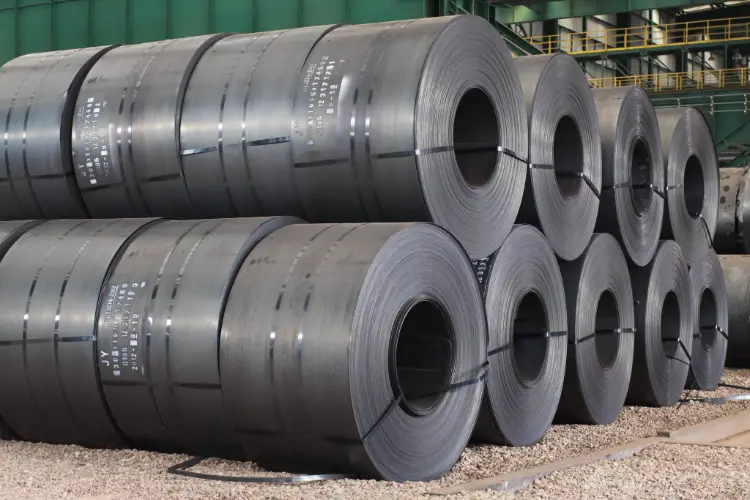
LR EH36 Shipbuilding Steel Coil
LR EH36 Shipbuilding Steel Coil: High-Strength Marine Steel with Outstanding Low-Temperature Toughness
Explore LR EH36 steel coil, a high-strength shipbuilding plate certified by Lloyd's Register. It offers minimum yield strength of 355 MPa, excellent weldability, and guaranteed impact energy at -40°C for critical marine and offshore structures.
Hot rolling, normalizing, TMCP, welding, bending, cutting, forming
- Phone : +8618037372205
- Email : [email protected]
- WhatsApp: Contact via Whtsapp
- WeChat: +8618037372205
LR EH36 Shipbuilding Steel Coil Introduction
LR EH36 is a high-strength structural steel coil intended for ship and marine construction, certified in accordance with the rules of Lloyd's Register (LR). It belongs to the EH36 grade within the internationally recognized high-strength shipbuilding steel family, offering a minimum yield strength of 355 MPa. The E designation indicates guaranteed impact toughness down to -40°C, making it suitable for cold-climate and Arctic service.
- Controlled chemical composition ensures excellent weldability and formability.
- Typically supplied in normalized or thermo-mechanically controlled rolled (TMCP) condition.
- Widely used in hull structures, decks, and offshore platform components.
- Equivalent to grades certified by other IACS members such as ABS EH36, DNV EH36, and BV EH36.
LR EH36 Shipbuilding Steel Coil Chemical Composition
Representative ladle analysis in accordance with LR Rules. The values below are typical maximum or range limits for EH36. Fine-grain practice and micro-alloying elements (e.g., Nb, V, Ti) may be added at the discretion of the manufacturer to achieve required mechanical properties.
- Carbon equivalent (CE) is usually controlled to ensure weldability.
- Aluminum or other grain-refining elements are required to achieve fine austenitic grain size.
| Chemical Element | Standard Value | Remarks |
|---|---|---|
| Carbon (C) | ≤ 0.18 | Ladle analysis |
| Silicon (Si) | ≤ 0.50 | Ladle analysis; typical 0.10–0.50 |
| Manganese (Mn) | 0.90 – 1.60 | Ladle analysis |
| Phosphorus (P) | ≤ 0.035 | Ladle analysis |
| Sulfur (S) | ≤ 0.035 | Ladle analysis |
| Aluminum (Al) total | ≥ 0.015 | Acid soluble; for fine-grain practice |
| Niobium (Nb) | ≤ 0.05 | Optional micro-alloying |
| Vanadium (V) | ≤ 0.10 | Optional micro-alloying |
| Titanium (Ti) | ≤ 0.02 | Optional micro-alloying |
| Chromium (Cr) | ≤ 0.20 | Residual element |
| Nickel (Ni) | ≤ 0.40 | Residual element |
| Copper (Cu) | ≤ 0.35 | Residual element |
| Molybdenum (Mo) | ≤ 0.08 | Residual element |
| Carbon equivalent (CE) | ≤ 0.38 (typical) | Based on IIW formula, for product thickness ≤ 50 mm, may vary |
LR EH36 Shipbuilding Steel Coil Thermal and Electrical Physical Properties
Typical physical properties at ambient temperature unless otherwise noted. These values are generic for carbon-manganese structural steels and may vary slightly depending on exact composition and processing.
- Thermal conductivity and specific heat capacity are essential for welding heat input calculations.
- Electrical resistivity is useful for pre-heating and induction applications.
| Property | Standard Value | Unit | Test Condition |
|---|---|---|---|
| Density (ρ) | 7850 | kg/m³ | At 20°C |
| Modulus of elasticity (E) | 205 | GPa | Ambient temperature, static |
| Shear modulus (G) | 80 | GPa | Calculated approx. from E and ν |
| Poisson's ratio (ν) | 0.3 | - | Ambient temperature |
| Thermal expansion coefficient (α) | 12.0 × 10⁻⁶ | K⁻¹ | From 20°C to 100°C |
| Thermal expansion coefficient (α) | 13.0 × 10⁻⁶ | K⁻¹ | From 20°C to 200°C |
| Thermal expansion coefficient (α) | 13.8 × 10⁻⁶ | K⁻¹ | From 20°C to 300°C |
| Thermal conductivity (λ) | 50 | W/(m·K) | At 20°C |
| Thermal conductivity (λ) | 47 | W/(m·K) | At 200°C |
| Thermal conductivity (λ) | 43 | W/(m·K) | At 400°C |
| Specific heat capacity (cp) | 460 | J/(kg·K) | At 20–100°C |
| Specific heat capacity (cp) | 510 | J/(kg·K) | At 200°C |
| Specific heat capacity (cp) | 550 | J/(kg·K) | At 400°C |
| Electrical resistivity (ρ_e) | 0.20 – 0.25 × 10⁻⁶ | Ω·m | At 20°C |
LR EH36 Shipbuilding Steel Coil Mechanical Properties
Mechanical properties as required by LR Rules for EH36. Tensile testing is performed in transverse direction unless otherwise specified. Impact test temperature is -40°C and absorbed energy must meet minimum requirements for thickness ranges.
- For thicknesses above 100 mm, properties may be specially agreed.
- Elongation is measured on a gauge length of 5.65√So (proportional test piece).
| Property | Standard Required Value | Unit | Test Condition |
|---|---|---|---|
| Yield strength (ReH) | ≥ 355 | MPa | Room temperature, transverse, all thicknesses up to 100 mm |
| Tensile strength (Rm) | 490 – 620 | MPa | Room temperature, transverse |
| Elongation (A) | ≥ 21 | % | 5.65√So gauge, transverse, thickness ≤ 50 mm |
| Elongation (A) | ≥ 20 | % | 5.65√So gauge, transverse, thickness > 50 – 100 mm |
| Charpy V-notch impact energy (KV) | ≥ 34 (longitudinal) / ≥ 24 (transverse) | J | At -40°C, thickness ≤ 50 mm |
| Charpy V-notch impact energy (KV) | ≥ 34 (longitudinal) / ≥ 24 (transverse) | J | At -40°C, thickness > 50 – 100 mm |
LR EH36 Shipbuilding Steel Coil Exact Equivalent Material Standards and Substitutable Designations
| Country/Region | Standard | Grade | Remarks |
|---|---|---|---|
| International (IACS) | UR W11 & W13 (based on LR Rules) | EH36 | IACS unified requirement for normal and high-strength hull structural steels |
| American Bureau of Shipping (ABS) | ABS Rules | ABS EH36 | Equivalent, same mechanical and chemical requirements |
| DNV (Norway/Germany) | DNV Rules | DNV EH36 | Identical grade, -40°C impact, 355 MPa yield |
| Bureau Veritas (France) | BV Rules | BV EH36 | Fully equivalent |
| China Classification Society | CCS Rules | CCS EH36 | Same specifications |
| ClassNK (Japan) | NK Rules | NK EH36 | Same specifications |
| Korean Register | KR Rules | KR EH36 | Same specifications |
| RINA (Italy) | RINA Rules | RINA EH36 | Same specifications |
| EN standard (informative) | EN 10025-4 | S355ML / S355G10+M (close but not exact; see similar) | S355ML requires -50°C impact, EH36 only -40°C; requires added conditions |
LR EH36 Shipbuilding Steel Coil Application Introduction
LR EH36 steel coil is engineered for demanding marine and offshore environments where a combination of high strength, excellent weldability, and guaranteed low-temperature toughness is essential.
- Its ship classification society certification ensures immediate acceptance in newbuilding and repair projects.
- Coil supply offers flexibility for subsequent cold forming, roll forming, and cut-to-length operations in shipyard production lines.
- The -40°C impact requirement makes it suitable for ice-class vessels and structures operating in cold seas.
Product Applications: Ship hulls and decks, Bulkheads and stiffeners, Superstructure components, Hatch covers, Helicopter decks, Offshore platform legs and bracings, Caissons and suction anchors, Ice-belt plating
Processed into products: Frames and longitudinals, Floor plates, Stringers, Bracket plates, Weld-in attachments (pad-eyes, padeyes), Stiffened panel assemblies, Pipe supports and equipment foundations, Cold-formed sections (angles, channels, bulb flats)
Application industries: Shipbuilding (commercial and naval), Offshore oil & gas (platforms, FPSO topsides), Renewable energy (offshore wind turbine foundations, substations), Marine engineering (dredgers, barges, pontoons), Arctic engineering (ice-breakers, ice-resistant platforms), Port and harbour construction (sheet piling, combi-walls)
LR EH36 Shipbuilding Steel Coil Similar / Alternative Materials Recommendation
| Country/Region | Standard | Grade | Remarks |
|---|---|---|---|
| International (IACS) | UR W11 | DH36 | Same strength, but impact test at -20°C instead of -40°C; suitable for less severe cold conditions |
| International (IACS) | UR W13 | FH36 | Higher toughness, -60°C impact; for extreme Arctic service |
| EN (Europe) | EN 10025-4 | S355G10+M (S355ML) | Thermo-mechanically rolled; yield 355 MPa, but impact at -50°C; requires validation for ship classification |
| EN (Europe) | EN 10025-3 | S355N | Normalized; 355 MPa yield, -20°C impact; not directly recognized by LR for hull but used in offshore structures |
| API (USA) | API 2H / 2W | Grade 50 | Offshore structural steel; yield 345-380 MPa; subject to class approval as alternative |
| JIS (Japan) | JIS G 3106 | SM490YA / SM490YB | Welding structural steel; similar strength (490 MPa tensile), but impact only -0°C or -10°C standard; may be upgraded with LR approval |
Notes:
Ordering information: When specifying LR EH36 steel coil, include thickness, width, coil weight limit, surface condition (as-rolled, descaled), and required survey options (e.g., LR survey for certification).
Welding: Preheating is usually not required for thicknesses below 30 mm; interpass temperature should be controlled. Low-hydrogen welding consumables are recommended to avoid cold cracking.
Formability: Cold flanging and bending to a minimum radius of 2t to 3t are generally safe for this grade in the normalized or TMCP condition; hot forming must be followed by normalizing unless TMCP with specific procedures.
Corrosion protection: Standard marine coatings perform well; surface preparation by blast cleaning to Sa 2½ is typical.
Availability: Coils are typically produced in width up to 2500 mm and thickness 6–20 mm; heavier plates are also available as discrete plates.
Certification: Mill test certificates (MTC) endorsed by Lloyd's Register are provided for each batch.
- Share



