
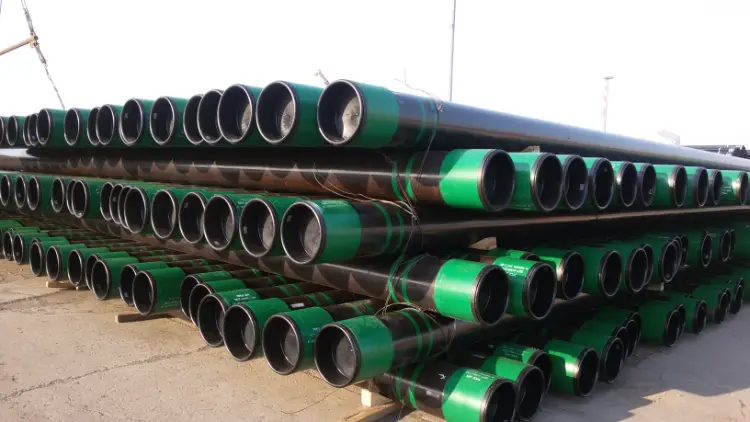
ASME SA312 TP309S Stainless Steel Pipe
ASME SA312 TP309S Stainless Steel Pipe: Properties, Equivalents & Applications
Comprehensive material data for ASME SA312 TP309S stainless steel pipe including chemical composition, mechanical properties, physical properties, international equivalents, and application guide.
Hot working, cold working, welding, machining, bending, forming
- Phone : +8618037372205
- Email : [email protected]
- WhatsApp: Contact via Whtsapp
- WeChat: +8618037372205
ASME SA312 TP309S Stainless Steel Pipe Introduction
ASME SA312 TP309S is an austenitic stainless steel pipe grade specified for high-temperature service. It belongs to the chromium-nickel steel family with a nominal composition of 23% Cr and 13% Ni, enhanced with low carbon content (max 0.08%) to improve weldability and resistance to intergranular corrosion. TP309S offers excellent oxidation resistance up to 1000°C and good strength at elevated temperatures, making it suitable for furnace parts, heat exchangers, and boiler tubes. Key features include:
- High creep strength at temperatures up to 1000°C
- Excellent resistance to scaling and oxidation
- Good ductility and toughness
- Superior weldability compared to higher carbon grades
- Resistance to sulfidation in some environments
The material is widely used in petrochemical, power generation, and thermal processing industries.
ASME SA312 TP309S Stainless Steel Pipe Chemical Composition
The chemical composition of ASME SA312 TP309S stainless steel pipe is governed by ASTM A312/A312M. The steel contains chromium (22.0-24.0%) and nickel (12.0-15.0%) to provide excellent oxidation resistance and high-temperature strength. Low carbon content minimizes carbide precipitation and enhances weldability. Other elements are controlled to ensure consistent mechanical properties and corrosion resistance.
| Element | Specification (wt%) | Remarks |
|---|---|---|
| Carbon, C | 0.08 max | |
| Manganese, Mn | 2.00 max | |
| Phosphorus, P | 0.045 max | |
| Sulfur, S | 0.030 max | |
| Silicon, Si | 1.00 max | |
| Chromium, Cr | 22.0 - 24.0 | |
| Nickel, Ni | 12.0 - 15.0 |
ASME SA312 TP309S Stainless Steel Pipe Thermal and Electrical Physical Properties
Physical properties of TP309S stainless steel are typical values at reference temperatures. These data assist in thermal and structural analysis. The high electrical resistivity is typical of austenitic stainless steels. Values are derived from published literature and can vary slightly depending on product form and heat treatment.
| Property | Typical Value | Unit | Temperature/Reference |
|---|---|---|---|
| Density, ρ | 8.0 | g/cm³ | 20°C |
| Elastic Modulus, E | 200 | GPa | 20°C |
| Shear Modulus, G | 77 | GPa | 20°C |
| Poisson's Ratio, ν | 0.30 | - | 20°C |
| Thermal Expansion Coefficient, α | 14.8 | 10⁻⁶/K | 20–100°C |
| Thermal Conductivity, λ | 15.0 | W/m·K | 100°C |
| Specific Heat Capacity, cp | 500 | J/kg·K | 20°C |
| Electrical Resistivity, ρe | 0.78 | µΩ·m | 20°C |
ASME SA312 TP309S Stainless Steel Pipe Mechanical Properties
Mechanical property requirements for TP309S pipes are per ASTM A312. Testing is conducted at room temperature on specimens machined from the finished pipe. The values represent minimum requirements; actual properties may exceed these values. The high elongation indicates excellent ductility. Hardness and impact testing are typically not specified for this austenitic grade.
| Property | Minimum Value | Unit | Test Condition |
|---|---|---|---|
| Tensile Strength, Rm | 515 | MPa (75 ksi) | Room temperature |
| Yield Strength, Rp0.2 | 205 | MPa (30 ksi) | Room temperature |
| Elongation, A (50 mm or 2 in.) | 35 | % | Longitudinal specimen |
ASME SA312 TP309S Stainless Steel Pipe Fully Equivalent Material Standards and Substitutable Grades
| Country/Region | Standard | Grade | Remarks |
|---|---|---|---|
| USA | ASTM A312/A312M | TP309S (UNS S30908) | Identical to ASME SA312 |
| China | GB/T 14976 | 06Cr23Ni13 (S30908) | Equivalent chemical and mechanical properties |
| Japan | JIS G3459 | SUS309S | Equivalent to TP309S |
| Korea | KS D3576 | STS309S | Equivalent to TP309S |
| International | ISO 15510 | X6CrNi23-13 | Close match; verify carbon ≤0.08% |
ASME SA312 TP309S Stainless Steel Pipe Application Introduction
ASME SA312 TP309S pipes are engineered for demanding high-temperature applications where oxidation resistance and structural integrity are critical. Their excellent weldability and forming characteristics facilitate fabrication into complex components. Common processing includes:
- Seamless tube drawing
- Welded pipe production
- Bending and coiling
- Machining of flanges and fittings
- Post-weld heat treatment
Product Applications: Seamless stainless steel pipes, Welded stainless steel tubes, Boiler and superheater tubes, Heat exchanger tubing, Furnace radiant tubes, Annealing boxes and muffles, Piping systems for high-temperature fluids
Processed into products: Pipe bends and elbows, Tube fittings, Flanges and connectors, Expansion joints, Tube sheets and supports, Manifolds and headers
Application industries: Oil & Gas (refinery piping, furnace coils), Chemical Processing (reactors, heat exchangers), Power Generation (boiler tubes, superheaters), Thermal Processing (furnace parts, radiant tubes), Food & Beverage (high-temperature processing equipment)
ASME SA312 TP309S Stainless Steel Pipe Similar / Substitute Material Recommendations
| Country/Region | Standard | Grade | Remarks |
|---|---|---|---|
| USA | ASTM A312 | TP309 (UNS S30900) | Higher carbon (0.20 max) for higher strength; reduced weldability |
| USA | ASTM A312 | TP310S (UNS S31008) | Higher Cr (24-26) and Ni (19-22) for superior oxidation resistance |
| Europe | EN 10216-5 | 1.4833 (X12CrNi23-13) | Higher carbon (0.15 max); not fully identical |
| China | GB/T 14976 | 06Cr25Ni20 (310S) | Higher Cr/Ni for more severe high-temperature environments |
Notes:
Note: ASME SA312 TP309S is often supplied in solution-annealed condition to maximize corrosion resistance. For welded pipes, post-weld annealing may be required depending on service conditions. The material should not be used at temperatures between 565°C and 815°C for prolonged periods due to potential sigma phase embrittlement. Always consult the latest ASTM/ASME standards and project specifications for precise requirements.
- Share



