
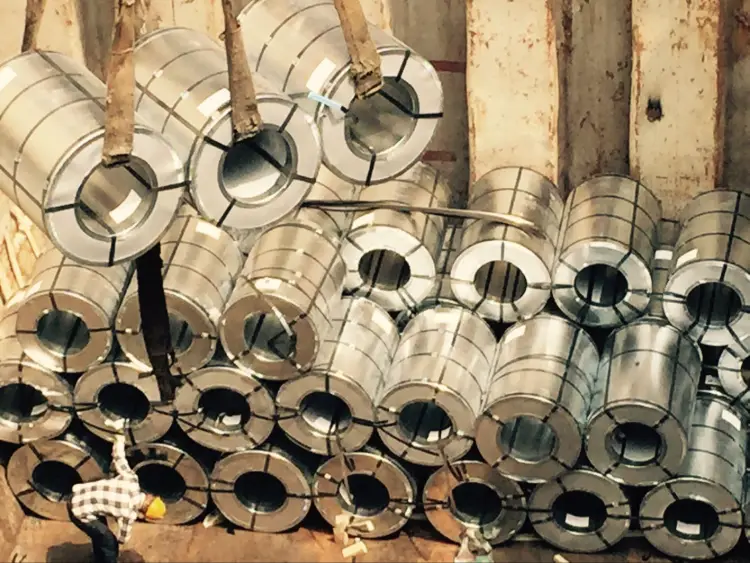
LR EH69 Shipbuilding Steel Coil
LR EH69 Shipbuilding Steel Coil: Ultra-High Strength Offshore & Marine Grade
Comprehensive technical data for LR EH69 shipbuilding steel coil. Chemical composition, mechanical properties, thermal and electrical physical properties, international equivalents, similar substitutes, and application guidance based on Lloyd's Register rules.
Cutting, cold forming, hot forming, welding (with preheating and post-weld treatment), machining
- Phone : +8618037372205
- Email : [email protected]
- WhatsApp: Contact via Whtsapp
- WeChat: +8618037372205
LR EH69 Shipbuilding Steel Coil Introduction
LR EH69 is an ultra-high strength shipbuilding steel grade certified by Lloyd's Register (LR) for marine and offshore structural applications. It belongs to the EH (extra high toughness) series with a minimum yield strength of 690 MPa. Typically supplied in coil form, it is produced through thermo-mechanical controlled processing (TMCP) or quenching and tempering (Q&T) to achieve the required mechanical properties. The steel offers excellent weldability, good low-temperature impact toughness down to -40°C, and high resistance to brittle fracture. It is primarily used in critical structural components such as jack-up rig legs, crane pedestals, and heavy ship frames where weight reduction and high load-bearing capacity are essential.
LR EH69 Shipbuilding Steel Coil Chemical Composition
The chemical composition of LR EH69 is controlled to ensure high strength and excellent weldability. Typical ladle analysis limits are in accordance with LR Rules. Microalloying elements such as Nb, V, and Ti are added for grain refinement and precipitation strengthening. The carbon equivalent (CEV) is usually restricted to guarantee field weldability.
| Element | Standard Value (wt%) | Remarks |
|---|---|---|
| Carbon (C) | ≤ 0.20 | Depending on thickness |
| Silicon (Si) | ≤ 0.50 | - |
| Manganese (Mn) | 0.90 – 1.60 | May be adjusted for strength |
| Phosphorus (P) | ≤ 0.025 | - |
| Sulfur (S) | ≤ 0.020 | - |
| Aluminium (Al) total | ≥ 0.015 | Fine grain practice |
| Niobium (Nb) | ≤ 0.05 | - |
| Vanadium (V) | ≤ 0.10 | - |
| Titanium (Ti) | ≤ 0.05 | - |
| Chromium (Cr) | ≤ 1.50 | - |
| Nickel (Ni) | ≤ 2.00 | For improved toughness |
| Molybdenum (Mo) | ≤ 0.50 | - |
| Copper (Cu) | ≤ 0.30 | - |
| Nitrogen (N) | ≤ 0.020 | Higher levels with sufficient Al |
| Boron (B) | ≤ 0.002 | When added for hardenability |
LR EH69 Shipbuilding Steel Coil Thermal and Electrical Physical Properties
Physical properties are estimated for a quenched and tempered condition at room temperature unless noted. Thermal conductivity and specific heat vary with temperature. These values are not part of LR specification but are provided for engineering design reference.
| Property | Typical Value | Unit | Test Conditions |
|---|---|---|---|
| Density (ρ) | 7850 | kg/m³ | 20°C |
| Modulus of Elasticity (E) | 205 | GPa | 20°C |
| Shear Modulus (G) | 80 | GPa | 20°C |
| Poisson's Ratio (ν) | 0.3 | - | 20°C |
| Thermal Expansion Coeff. (α) | 11.5 × 10⁻⁶ | K⁻¹ | 20 – 100°C |
| Thermal Expansion Coeff. (α) | 12.0 × 10⁻⁶ | K⁻¹ | 20 – 200°C |
| Thermal Conductivity (λ) | ~ 30 | W/(m·K) | 20°C |
| Specific Heat Capacity (c) | ~ 460 | J/(kg·K) | 20°C |
| Electrical Resistivity (ρ_e) | ~ 0.30 × 10⁻⁶ | Ω·m | 20°C |
LR EH69 Shipbuilding Steel Coil Mechanical Properties
Mechanical properties are determined on transverse specimens unless otherwise specified. LR EH69 exhibits high yield and tensile strengths with good ductility. Impact tests are performed at -40°C to guarantee low-temperature toughness. Test conditions and frequency follow LR survey requirements.
| Property | Standard Requirement | Unit | Test Conditions |
|---|---|---|---|
| Yield Strength (ReH) | ≥ 690 | MPa | Transverse, t ≤ 100 mm |
| Yield Strength (ReH) | ≥ 650 | MPa | Transverse, 100 < t ≤ 150 mm |
| Tensile Strength (Rm) | 770 – 940 | MPa | Transverse, t ≤ 100 mm |
| Tensile Strength (Rm) | 720 – 900 | MPa | Transverse, 100 < t ≤ 150 mm |
| Elongation (A5) | ≥ 14 | % | Longitudinal, t ≤ 100 mm |
| Elongation (A5) | ≥ 14 | % | Transverse, t ≤ 100 mm |
| Bend Test (Dia/thickness) | d = 3a (180°) | - | No cracks or defects |
| Impact Energy (KV2) | ≥ 50 (average) | J | Transverse, -40°C, t ≤ 100 mm |
| Impact Energy (KV2) - individual | ≥ 35 | J | Transverse, -40°C, t ≤ 100 mm |
LR EH69 Shipbuilding Steel Coil Completely Equivalent Material Standards and Replaceable Designations
| Country/Region | Standard | Grade | Remarks |
|---|---|---|---|
| International (American Bureau of Shipping) | ABS Rules | ABS EH69 | Identical mechanical and toughness requirements |
| Norway/Germany (DNV) | DNV Rules | DNV E690 | S690Q grade with -40°C impact |
| France (Bureau Veritas) | BV Rules | BV EH69 | Full equivalence |
| China (China Classification Society) | CCS Rules | CCS EH690 | Same yield class |
| South Korea (Korean Register) | KR Rules | KR EH69 | Equivalent |
| Japan (ClassNK) | NK Rules | NK KE69 | Ship structural high strength steel |
| Italy (RINA) | RINA Rules | RINA EH69 | Marine grade |
| Russia (Russian Maritime Register) | RS Rules | RS E690 | Cold-resistant shipbuilding steel |
| Europe (EN 10225) | EN 10225 | S690QL1 | Offshore structural steel, QT condition, similar requirements |
| USA (ASTM) | ASTM A514/A517 | Grade E or Q | Quenched & tempered alloy steel, comparable strength but different testing regime |
LR EH69 Shipbuilding Steel Coil Application Introduction
LR EH69 steel coil is used in demanding marine and offshore environments where high strength, toughness, and weldability are critical. Design allowances benefit from its 690 MPa yield strength, enabling lighter structures without compromising safety. Typical applications involve heavy plate components, often fabricated by welding and machining.
Product Applications: Jack-up rig leg chords and rack bars, Offshore crane slewing rings and masts, Ship hull stiffeners and deck stringers, Icebreaker bow and side shell plating, Drilling riser tensioner frames, Subsea manifold structures, Wind turbine monopile transition pieces
Processed into products: Welded box girders and columns, Machined pinion gears for jacking systems, Heavy-duty bearing supports, Flame-cut structural brackets and thick stiffeners, Butt-welded plate assemblies for panel lines, Bolted flange connections for modular structures
Application industries: Marine Shipbuilding (naval vessels, ultra-large container ships, icebreakers), Offshore Oil & Gas Platforms (jack-up rigs, semi-submersibles, FPSO modules), Renewable Energy (offshore wind turbine foundations, transition pieces), Heavy Lifting Equipment (crane booms, pedestals, structural frames), Bridge Construction (orthotropic decks, truss members), Pressure Vessel Manufacturing (high-pressure shells where high strength permits thinner walls)
LR EH69 Shipbuilding Steel Coil Similar/Alternative Material Recommendations
| Country/Region | Standard | Grade | Remarks |
|---|---|---|---|
| International | EN 10025-6 | S690QL | Quenched and tempered structural steel; CEV and toughness may differ; not certified by LR |
| USA | ASTM A514 | Grade H / P / F | High-yield-strength quenched and tempered alloy steel plates; primarily for structural applications, may require additional low-temperature testing |
| Japan | JIS G 3128 | SHY 685 | High yield strength steel plate for welded structures; impact toughness at lower temperatures may need verification |
| China | GB/T 16270 | Q690D / Q690E | High strength structural steel plates; E grade provides -40°C impact, but ship class certification must be obtained separately |
| International | API 2W | Grade 60 | Steel plates for offshore structures produced by TMCP; minimum yield 415-550 MPa, thus lower strength class, cannot replace EH69 directly. |
Notes:
Welding precautions: Low-hydrogen processes (SMAW, SAW, GMAW) are mandatory. Preheat temperatures typically range from 75°C to 200°C depending on thickness and carbon equivalent. Post-weld heat treatment (PWHT) may be required for thick sections. Certification: All coils must be stamped with LR surveyor's mark and accompanied by material certificates stating chemical analysis, mechanical test results, and the delivery condition. Corrosion protection: In marine environments, the steel is usually protected by paint systems, cathodic protection, or cladding, as it is not weather-resistant like weathering steels. Forging and hot forming: Re-heating above the tempering temperature may alter properties; manufacturer's procedure should be followed.
- Share



