
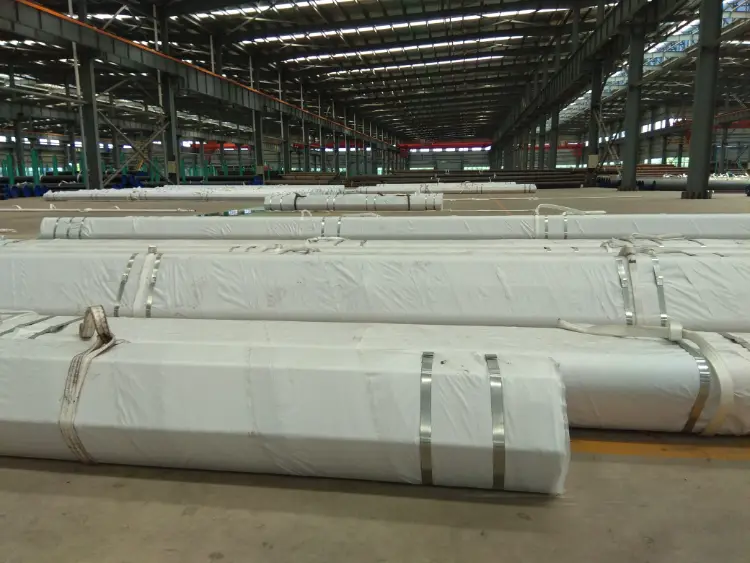
JIS G3459 SUS304LTP Stainless Steel Pipe
JIS G3459 SUS 304 LTP Stainless Steel Pipe: Low Carbon, Superior Weldability & Corrosion Resistance
Explore the comprehensive material data for JIS G3459 SUS 304 LTP stainless steel pipe, including chemical composition, mechanical properties, thermal and electrical characteristics, international equivalents, and application guidance.
Cold drawing, hot rolling, welding (TIG, laser, etc.), bending, flaring, flattening, flange processing
- Phone : +8618037372205
- Email : [email protected]
- WhatsApp: Contact via Whtsapp
- WeChat: +8618037372205
JIS G3459 SUS304LTP Stainless Steel Pipe Introduction
JIS G3459 SUS 304 LTP is a Japanese standard stainless steel pipe grade, essentially an ultra-low carbon version of SUS 304 (TP denotes Tube/Pipe). The low carbon content (max 0.030%) significantly reduces the susceptibility to intergranular corrosion after welding or in slow cooling conditions, making it ideal for fabricated structures. This austenitic chromium-nickel steel offers excellent corrosion resistance in a wide range of atmospheric, chemical, and food processing environments. It retains good mechanical properties, with a minimum tensile strength of 480 MPa and yield strength of 175 MPa. The material is non-magnetic in the annealed condition, but may become slightly magnetic after cold working.
- Key features: Excellent weldability without post-weld heat treatment, good toughness at cryogenic temperatures, and high ductility.
- Typical forms: Seamless and welded pipes for fluid transport, heat exchangers, and structural applications.
JIS G3459 SUS304LTP Stainless Steel Pipe Chemical Composition
Chemical requirements as per JIS G3459 standard for SUS 304 LTP. The ultra-low carbon content ensures resistance to sensitization during welding. All values are maximum unless a range is specified.
- Note: The composition is verified by ladle analysis; product analysis may have slight deviations as per standard.
| Element | Standard Value (wt%) | Remarks |
|---|---|---|
| Carbon (C) | ≤ 0.030 | Key for intergranular corrosion resistance |
| Silicon (Si) | ≤ 1.00 | |
| Manganese (Mn) | ≤ 2.00 | |
| Phosphorus (P) | ≤ 0.045 | |
| Sulfur (S) | ≤ 0.030 | |
| Nickel (Ni) | 9.00 – 13.00 | |
| Chromium (Cr) | 18.00 – 20.00 | Provides corrosion resistance |
| Iron (Fe) | Balance |
JIS G3459 SUS304LTP Stainless Steel Pipe Thermal and Electrical Physical Properties
Physical properties at room temperature and elevated temperatures. These are typical values for SUS 304L (1.4307) in the annealed condition, also applicable to JIS G3459 SUS 304 LTP. Values are based on published data for similar low-carbon austenitic stainless steels.
- Note: Properties may vary slightly depending on manufacturing process and exact composition.
| Property | Typical Value | Unit | Test Condition / Temperature |
|---|---|---|---|
| Density (ρ) | 7.93 | g/cm³ | 20 °C |
| Modulus of Elasticity (E) | 193 | GPa | 20 °C |
| Shear Modulus (G) | 74 | GPa | 20 °C (estimated) |
| Poisson's Ratio (ν) | 0.30 | 20 °C | |
| Thermal Expansion Coefficient (α) | 16.0 | 10⁻⁶ /K | 20 – 100 °C |
| Thermal Expansion Coefficient (α) | 16.5 | 10⁻⁶ /K | 20 – 200 °C |
| Thermal Expansion Coefficient (α) | 17.0 | 10⁻⁶ /K | 20 – 400 °C |
| Thermal Conductivity (λ) | 15.0 | W/(m·K) | 100 °C |
| Thermal Conductivity (λ) | 18.0 | W/(m·K) | 300 °C |
| Specific Heat Capacity | 500 | J/(kg·K) | 20 °C |
| Electrical Resistivity (ρ_e) | 0.72 | μΩ·m | 20 °C |
JIS G3459 SUS304LTP Stainless Steel Pipe Mechanical Properties
Mechanical properties at room temperature for solution-annealed condition as per JIS G3459. Test specimens are taken from the pipe wall in longitudinal direction. For pipes with wall thickness less than 8 mm, elongation is measured on a gauge length of 50 mm (or proportional). The following values are minima unless specified.
- Bend test: 180° bend around a mandrel with diameter equal to 4 times the pipe wall thickness for pipes with outside diameter up to 60.5 mm; no cracks permitted.
| Property | Standard Requirement | Unit | Test Condition |
|---|---|---|---|
| Tensile Strength (Rm) | ≥ 480 | MPa | Room temperature |
| Yield Strength (ReH, 0.2% offset) | ≥ 175 | MPa | Room temperature |
| Elongation (A) | ≥ 35 | % | Gauge length 50 mm, wall thickness <8 mm |
| Elongation (A) | ≥ 30 | % | Gauge length 50 mm, wall thickness ≥8 mm |
| Bend Test (180°) | No cracks | Mandrel dia. = 4 × wall thickness (for OD ≤ 60.5 mm) | |
| Hardness (HRB) | ≤ 90 | HRB | For reference, not always mandatory |
| Hardness (HB) | ≤ 200 | HB | For reference |
JIS G3459 SUS304LTP Stainless Steel Pipe Equivalent Material Standards and Replaceable Grades
| Country/Region | Standard | Grade | Remarks |
|---|---|---|---|
| USA | ASTM A312 | TP304L | Seamless/welded pipe, identical composition and mechanical limits |
| Europe | EN 10216-5 / EN 10217-7 | 1.4307 (X2CrNi18-9) | Seamless/welded tube for pressure purposes |
| International | ISO 1127 | D4-1.4307 | Stainless steel tubes |
| China | GB/T 14976 | 022Cr19Ni10 (S30403) | Seamless stainless steel pipe |
| Korea | KS D 3584 | STS304LTP | Equivalent to JIS G3459 |
| India | IS 6913 | SS 304L | Pipes for general engineering |
JIS G3459 SUS304LTP Stainless Steel Pipe Application Introduction
SUS 304 LTP pipes are extensively used where both corrosion resistance and reliability after welding are critical. The low carbon content makes it the preferred choice for welded structures that cannot be post-weld solution annealed. It is also suitable for a wide temperature range from cryogenic up to 450°C. Typical industries and applications include:
- Chemical & Petrochemical: piping systems for acids, alkalis, and organic chemicals; heat exchangers; pressure vessels.
- Food & Beverage: processing pipes, storage tanks, sanitary tubing.
- Pharmaceutical: high-purity water systems, clean steam piping.
- Cryogenics: transfer lines for LNG, liquid oxygen, nitrogen – thanks to excellent low-temperature toughness.
- Architecture & Construction: handrails, structural supports, water supply pipes in corrosive environments.
Product Applications: Seamless and welded pipes for fluid transport, Heat exchanger tubes, Cryogenic piping systems, Sanitary tubing for food/pharma, Boiler tubes, Instrumentation tubing, Structural hollow sections
Processed into products: Pipe spools and fittings (elbows, tees, reducers), Flanges (weld neck, slip-on), Valve bodies for low-temperature service, Pressure vessel shells and heads, Heat exchanger tube bundles, Cryogenic storage tank piping manifolds, Clean-in-place (CIP) spray pipes, Architectural railing components
Application industries: Chemical process, Oil & Gas (refineries, LNG), Food & Beverage, Pharmaceutical & Biotechnology, Water treatment & Desalination, Architecture & Civil Engineering, Power Generation (conventional & nuclear)
JIS G3459 SUS304LTP Stainless Steel Pipe Similar or Comparable Material Recommendations
| Country/Region | Standard | Grade | Remarks |
|---|---|---|---|
| Japan | JIS G3459 | SUS 304 TP (SUS304TP) | Higher carbon (≤0.08%), less suitable for heavy welding without post-weld treatment |
| Japan | JIS G3463 | SUS 304L TB | Boiler and heat exchanger tubes, similar low carbon content |
| USA | ASTM A269 | TP304L | Seamless and welded tube for general service |
| Europe | EN 10217-7 | 1.4307 | Welded tube; slight differences in dimensional tolerances |
| Sweden | SS 2352 | AFNOR Z2 CN 18-10 | High-purity version, sometimes used in demanding applications |
| Japan | JIS G4304 / G4305 | SUS304L (plate/sheet) | Not a pipe but similar composition for flat products |
Notes:
- JIS G3459 specifies dimensional tolerances and testing (hydrostatic or eddy current) in addition to chemical and mechanical requirements.
- SUS 304 LTP can be supplied in different surface finishes: pickled, bright annealed, or polished depending on application.
- For use at temperatures above 450°C, consult with the manufacturer due to potential sigma phase embrittlement.
- Welding consumables should match the low carbon grade (e.g., ER308L for TIG, E308L for SMAW).
- Although non-magnetic, cold-worked material may exhibit slight magnetism; this does not affect corrosion resistance.
- The material is not recommended for applications requiring high hardness or wear resistance, as it is austenitic and cannot be hardened by heat treatment.
- Always refer to the latest revision of JIS G3459 for mandatory requirements.
- Share



