
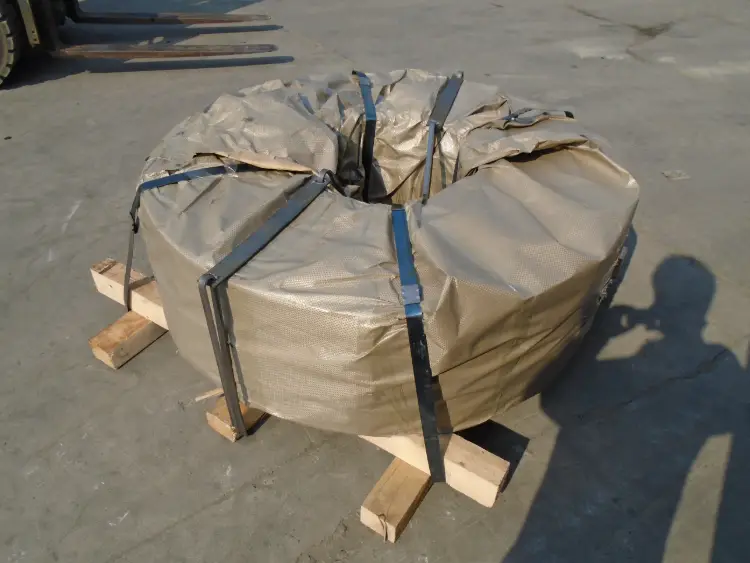
LR FH69 Shipbuilding Steel Coil
LR FH69 Shipbuilding Steel Coil - High-Strength Quenched & Tempered Marine Grade Steel
Detailed material data for LR FH69 quenched and tempered shipbuilding steel coil: chemical composition, mechanical and thermal properties, full international equivalents and application guide.
Thermomechanical rolling (TMCP) or quenched + tempered (Q&T), cutting, cold forming, welding
- Phone : +8618037372205
- Email : [email protected]
- WhatsApp: Contact via Whtsapp
- WeChat: +8618037372205
LR FH69 Shipbuilding Steel Coil Introduction
LR FH69 is a high-strength quenched and tempered steel grade governed by Lloyd's Register (LR) Rules for shipbuilding and offshore structures. With a minimum yield strength of 690 MPa, it belongs to the extra-high-strength category of marine steels and is designed for severe low-temperature service (impact tested at -60°C). Its fine-grained microstructure, achieved through controlled rolling and heat treatment, ensures excellent toughness, weldability, and resistance to brittle fracture under dynamic loading. FH69 is primarily used in critical structural components where weight reduction combined with high load-bearing capacity is essential.
LR FH69 Shipbuilding Steel Coil Chemical Composition
The chemical composition conforms to LR Rules for FH69 grade. Values are maximum unless a range is specified. The steel is fully killed and fine-grain treated (Al or other grain-refining elements). Typical CEV (Ceq) is controlled to ensure weldability, often <0.55% for thicknesses up to 50 mm. Tight control of residuals like Cu, Ni, Cr, Mo ensures the required mechanical properties after quenching and tempering.
| Element | Typical/Max Value (%) | Remarks |
|---|---|---|
| Carbon, C | ≤0.20 | For improved weldability, often 0.14–0.18 |
| Silicon, Si | ≤0.55 | Addition for deoxidation; common range 0.10–0.50 |
| Manganese, Mn | ≤1.70 | Contributes to strength; typical 1.00–1.60 |
| Phosphorus, P | ≤0.025 | Strict limit for low-temperature toughness |
| Sulfur, S | ≤0.025 | Control for inclusion shape and toughness |
| Chromium, Cr | ≤1.50 | Optional but often added up to 0.70 for hardenability |
| Nickel, Ni | ≤2.0 | Enhances toughness; residual or intentionally added up to 1.0 |
| Molybdenum, Mo | ≤0.70 | For hardenability and temper resistance; typical 0.20–0.50 |
| Copper, Cu | ≤0.50 | Residual limit; above may require Ni addition |
| Vanadium, V | ≤0.12 | Microalloying for grain refinement and precipitation strengthening |
| Niobium (Columbium), Nb | ≤0.06 | Grain refinement; typical 0.02–0.05 |
| Titanium, Ti | ≤0.05 | Deoxidation and grain refinement; if added, combined with Al |
| Aluminium, Al (total) | ≥0.015 | Required for fine-grain practice; often 0.020–0.050 |
| Nitrogen, N | ≤0.015 | Strict control to avoid aging effects |
| Boron, B | ≤0.005 | Optional for enhanced hardenability; if present, documented |
LR FH69 Shipbuilding Steel Coil Thermal and Electrical Physical Properties
Physical properties are not specified in LR Rules but are derived from general data for similar high-strength low-alloy steels with a density near 7850 kg/m³ and carbon equivalent around 0.50–0.55. Values are intended for engineering calculations and may vary slightly with exact composition and tempering temperature.
| Property | Typical Value | Unit | Test Condition |
|---|---|---|---|
| Density (ρ) | 7850 | kg/m³ | At 20 °C |
| Elastic Modulus (E) | 205 | GPa | At 20 °C |
| Shear Modulus (G) | 80 | GPa | Calculated from E and ν |
| Poisson's Ratio (ν) | 0.30 | - | Ambient temperature |
| Coefficient of Thermal Expansion (α) | 12.0 | ×10⁻⁶ /K | 20–100 °C; 13.2 for 20–200 °C, 13.9 for 20–300 °C |
| Thermal Conductivity (λ) | 40 – 45 | W/(m·K) | At 20 °C; decreases with temperature |
| Specific Heat Capacity (cp) | 460 – 480 | J/(kg·K) | At 20 °C |
| Electrical Resistivity (ρ_e) | 0.25 – 0.35 | Ω·mm²/m (µΩ·m) | At 20 °C |
LR FH69 Shipbuilding Steel Coil Mechanical Properties
Properties are valid for material thickness ≤ 50 mm unless otherwise noted. Tensile testing is performed on transverse specimens. Impact energy values are for longitudinal Charpy-V notch specimens at -60°C (FH grade). For thinner material supplied as coil (typically ≤12 mm), properties are guaranteed through representative sampling.
| Property | Specified Value | Unit | Test Condition / Remarks |
|---|---|---|---|
| Yield Strength (ReH) | ≥ 690 | MPa | Transverse, thickness ≤ 50 mm; for t >50 mm, min 690 MPa typically maintained but agreed upon |
| Tensile Strength (Rm) | 770 – 940 | MPa | Transverse, full thickness |
| Elongation (A) – gauge length 5.65√So | ≥ 14 | % | For t ≤ 50 mm; for t >50 mm, min 16% |
| Charpy Impact Energy (KV) at -60°C | ≥ 46 (longitudinal) | J | Average of 3 specimens; single min 31 J; for transverse ≥ 27 J average |
| Bend Test (folding) – 180° | d = 3a (for t ≤ 25 mm), d = 4a (for t >25 mm) | - | No cracks or defects; d = former diameter, a = specimen thickness |
| Hardness (Brinell or Vickers) | Typically 260–340 HBW | - | Informative; not mandatory by LR Rules; ensures tempered condition |
LR FH69 Shipbuilding Steel Coil Full Equivalent Material Standards and Designations
| Country / Region | Standard | Grade / Designation | Remarks |
|---|---|---|---|
| International | Lloyd's Register Rules | FH69 | Base grade; Q&T delivery, impact -60°C |
| European Union | EN 10225 | S690QL1 / S690QL2 | Weldable structural steels for fixed offshore structures; QL1: -40°C, QL2: -60°C – QL2 matches FH69 |
| United States | ASTM A514 / A517 | Grade Q | High-yield-strength quenched and tempered alloy steel plate; -20°C impact typically; supplementary -46°C possible |
| United States | ABS (American Bureau of Shipping) | EH69 | ABS equivalent to FH69; EH suffix denotes high-strength with -40°C impact; optional FH(-60°C) certification |
| Norway / Germany | DNV GL (now DNV) | E690 (formerly NV E690) | Shipbuilding and offshore grade with -40°C; FH690 option for -60°C |
| France | Bureau Veritas (BV) | EH69 / FH69 | Same naming as LR; FH denotes -60°C |
| Japan | ClassNK (Nippon Kaiji Kyokai) | KE690 | KA, KD, KE, KF suffix for different toughness levels; KF690 for -60°C |
| Italy | RINA | E690 | Similar to DNV; E for -40°C; F option for -60°C |
LR FH69 Shipbuilding Steel Coil Application Introduction
LR FH69 steel is chosen for ultimate strength-critical applications in offshore and marine engineering, where weight savings and structural integrity at low temperatures are paramount. Its excellent weldability with low hydrogen processes and proper preheat/interpass control makes it suitable for large welded fabrications. Post-weld heat treatment is generally not required. The material is predominantly supplied as hot-rolled coil, subsequently levelled and cut to plates or sheet for fabrication.
Product Applications: Ship hull plates and stiffeners, Self-elevating platform (jack-up) leg chords and rack plates, Deck beams and crane pedestals, Subsea frames and manifolds, Pressure shells for manned submersibles (additional certification)
Processed into products: Welded I-beams and built-up box sections, Cut and formed brackets and gussets, High-strength bolted connection plates, Lifting lugs and padeyes, Cold-formed longitudinal stiffeners
Application industries: Commercial and naval shipbuilding (hulls, decks, bulkheads), Offshore oil & gas platforms (jacket legs, topsides, helidecks), Wind energy (transition pieces, monopile components), Heavy lifting and transport (mobile crane booms, loader frames), Bridge engineering (long-span girders, orthotropic decks)
LR FH69 Shipbuilding Steel Coil Closely Related / Similar Substitute Materials
| Country / Region | Standard | Grade / Designation | Remarks |
|---|---|---|---|
| European Union | EN 10025-6 | S690Q / S690QL / S690QL1 | General structural steel, Q&T; not specifically for marine but often accepted with additional toughness requirements |
| United States | ASTM A709 | Grade HPS 690W | Bridge steel; similar strength level; may need extra low-temperature toughness qualification |
| European Union | EN 10225 | S700G2+M / S700QL2 | Higher strength (700 MPa) variant; needs careful adaptation for shipbuilding |
| Global | API 2W / 2Y | Grade 60 / 70 | Steel plates for offshore structures (60 ksi / 70 ksi yield); 70 ksi ~690 MPa; often produced to LR rules as well |
| Japan | JIS G 3106 | SM570 (TMC)/ SM570TMC | Lower strength 570 MPa grade; not a direct substitute but used in less demanding marine structures |
Notes:
All data complies with LR Rules Chapter 3 for FH69 grade (latest revision). CEV (Ceq) typically limited to 0.52–0.55 for thickness ≤50 mm to ensure optimum weldability. For thickness >50 mm, additional through-thickness testing (Z-quality) may be required per EN 10164. The steel is always supplied with 3.1 or 3.2 certification as per EN 10204. Surface condition: oiled or as-rolled with mill scale; coil internal diameter and maximum weight as per manufacturer. Processing: suitable for plasma, laser, and oxy-fuel cutting; cold forming minimum radius approx. 3t (tensile side).
- Share



