
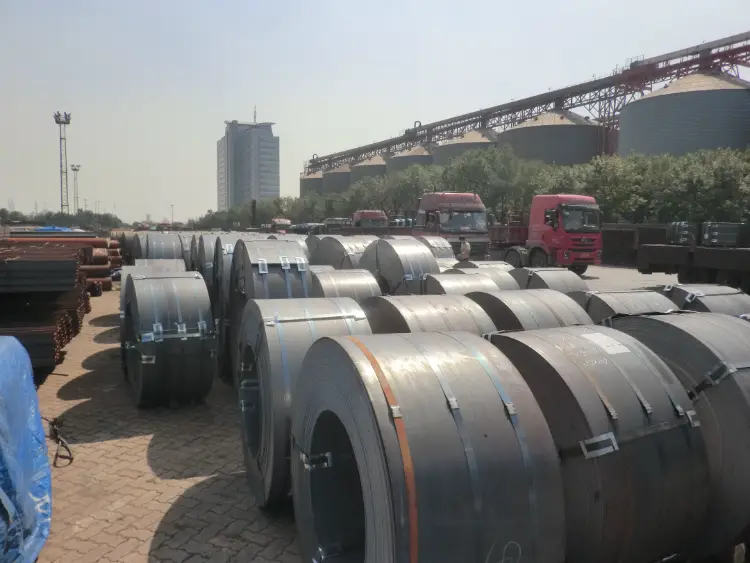
LR EH50 Shipbuilding Steel Coil
LR EH50 Shipbuilding Steel Coil - 500 MPa Yield Strength for Extreme Marine Environments
Detailed material data for LR EH50 shipbuilding steel coil, including chemical composition, mechanical & physical properties, international equivalents, and application guidance for marine and offshore constructions.
Welding, flame/plasma cutting, cold and hot forming, bending, machining
- Phone : +8618037372205
- Email : [email protected]
- WhatsApp: Contact via Whtsapp
- WeChat: +8618037372205
LR EH50 Shipbuilding Steel Coil Introduction
LR EH50 is a high-strength hull structural steel certified by Lloyd's Register (LR) according to its Rules for Materials. The designation "E" indicates guaranteed Charpy V‑notch impact toughness at -40 °C, while "50" reflects the minimum yield strength of 500 MPa (for thicknesses up to 50 mm). This grade is typically supplied in thermo‑mechanically controlled processed (TMCP) or normalized condition, offering an excellent combination of high strength, good weldability, and superior low‑temperature toughness. It is primarily used for highly stressed structural components in ships, offshore platforms, and other marine structures. Thanks to a low carbon equivalent and fine‑grained microstructure, EH50 provides reliable service even under severe dynamic loads and harsh sea environments.
- Minimum yield strength of 500 MPa
- Excellent notch toughness down to -40 °C
- Complies with IACS Unified Requirements for high‑strength steels
- Weldable with standard low‑hydrogen procedures
- Available as coils, plates, and cut‑to‑length sheets
LR EH50 Shipbuilding Steel Coil Chemical Composition
The chemical composition of LR EH50 steel complies with the requirements for Grade REH 50 in IACS UR W11. Maximum limits are set to ensure a fine‑grained structure and good weldability. Carbon equivalent (CEV) is typically ≤ 0.45 % for TMCP delivery, depending on thickness. Microalloying elements such as niobium, vanadium, and titanium are added for precipitation strengthening and grain refinement.
- Low phosphorus and sulfur contents improve cleanliness and toughness.
- Niobium, vanadium, and titanium are optionally added to obtain the required strength.
- Total aluminium provides fine‑grain practice.
| Element | Content (%) | Remarks |
|---|---|---|
| C (Carbon) | ≤ 0.20 | Ladle analysis |
| Mn (Manganese) | 0.90 – 1.80 | For product thickness dependent range |
| Si (Silicon) | ≤ 0.55 | Deoxidation element |
| P (Phosphorus) | ≤ 0.025 | Max. to ensure ductility |
| S (Sulfur) | ≤ 0.020 | Max. to ensure formability and weldability |
| Cr (Chromium) | ≤ 0.30 | Residual / intentional addition allowed |
| Ni (Nickel) | ≤ 0.60 | Often used for toughness enhancement |
| Cu (Copper) | ≤ 0.50 | Residual or added for corrosion resistance |
| Mo (Molybdenum) | ≤ 0.20 | For high‑temperature strength (optional) |
| Al (Aluminium), total | ≥ 0.020 | Minimum for fine‑grain practice (acid soluble) |
| Nb (Niobium) | 0.02 – 0.05 | Optional microalloy (ladle) |
| V (Vanadium) | 0.05 – 0.15 | Optional microalloy (ladle) |
| Ti (Titanium) | 0.007 – 0.05 | Optional microalloy (ladle) |
| N (Nitrogen) | ≤ 0.012 | For as‑rolled or TMCP products |
| CEV (Carbon equivalent) | ≤ 0.45 (typical for TMCP) | CEV = C + Mn/6 + (Cr+Mo+V)/5 + (Ni+Cu)/15 |
LR EH50 Shipbuilding Steel Coil Thermal and Electrical Physical Properties
The physical property data below are representative of low‑alloy high‑strength steels similar to EH50. Actual values may vary slightly depending on exact composition and heat treatment.
- Density, modulus of elasticity, and shear modulus are almost independent of minor composition changes.
- Thermal expansion and thermal conductivity influence distortion during welding and should be considered in design.
- Electrical resistivity is given for general reference.
| Property | Typical Value | Unit | Test Conditions |
|---|---|---|---|
| Density (ρ) | 7850 | kg/m³ | 20 °C |
| Modulus of Elasticity (E) | 210 | GPa | 20 °C, tensile |
| Shear Modulus (G) | 81 | GPa | 20 °C, calculated from E and ν |
| Poisson's Ratio (ν) | 0.3 | — | 20 °C, elastic range |
| Thermal Expansion Coefficient (α) | 12.5 | ×10⁻⁶ /K | 20 – 100 °C |
| Thermal Expansion Coefficient (α) | 13.5 | ×10⁻⁶ /K | 20 – 300 °C |
| Thermal Conductivity (λ) | 45 | W/(m·K) | 20 °C |
| Specific Heat Capacity (cₚ) | 460 | J/(kg·K) | 20 °C |
| Electrical Resistivity (ρₑ) | 0.25 | µΩ·m | 20 °C |
LR EH50 Shipbuilding Steel Coil Mechanical Properties
Mechanical properties are determined on transverse test pieces from material in the delivery condition. The values below comply with IACS UR W11 for Grade REH 50. Tensile testing is performed at room temperature; impact tests at ‑40 °C on Charpy V‑notch specimens (longitudinal). Bend tests are carried out at ambient temperature.
- Values depend on product thickness; thinner products exhibit higher yield strength.
- Impact energy requirements are higher for E‑grade (‑40 °C) compared to A or D grades.
- Elongation gauge length L0 = 5.65√S0 (proportional test piece).
| Property | Standard Value | Unit | Test Conditions |
|---|---|---|---|
| Yield Strength (ReH) | ≥ 500 | MPa | Thickness t ≤ 50 mm |
| Yield Strength (ReH) | ≥ 480 | MPa | 50 < t ≤ 70 mm |
| Yield Strength (ReH) | ≥ 460 | MPa | 70 < t ≤ 100 mm |
| Tensile Strength (Rm) | 610 – 770 | MPa | All thicknesses t ≤ 100 mm |
| Elongation (A) | ≥ 16 | % | t ≤ 50 mm |
| Elongation (A) | ≥ 15 | % | 50 < t ≤ 70 mm |
| Elongation (A) | ≥ 14 | % | 70 < t ≤ 100 mm |
| Charpy Impact Energy (KV) at -40 °C | ≥ 41 (longitudinal) | J | t ≤ 100 mm, V‑notch, average of three |
| Bend Test (180°), d = mandrel diameter, a = specimen thickness | d = 3a | — | t ≤ 50 mm, no cracks |
| Bend Test (180°) | d = 4a | — | 50 < t ≤ 100 mm, no cracks |
LR EH50 Shipbuilding Steel Coil Fully Equivalent Materials – International Class Society Grades
| Country / Region | Standard / Class Society | Grade | Remarks |
|---|---|---|---|
| International | Lloyd's Register (LR) | EH50 | Base specification |
| USA | American Bureau of Shipping (ABS) | EH50 | Equivalent to LR EH50 |
| Norway / Germany | DNV | VL E50 | High-strength structural steel, identical requirements |
| France | Bureau Veritas (BV) | EH50 | Equivalent per IACS UR W11 |
| UK / Global | RINA | EH50 | Recognized as equivalent |
| China | China Classification Society (CCS) | EH50 | Same mechanical and chemical limits |
| Japan | Nippon Kaiji Kyokai (NK) | KE50 | K = High‑strength, E = -40 °C, 50 = 500 MPa |
| Korea | Korean Register (KR) | RE50 | R = High‑strength, E = -40 °C, 50 = 500 MPa |
| Russia | Russian Maritime Register of Shipping (RS) | E50 | Equivalent to EH50 |
LR EH50 Shipbuilding Steel Coil Application Introduction
LR EH50 steel is engineered for heavy-duty marine and offshore environments where high strength and excellent low‑temperature toughness are essential. Its TMCP delivery condition provides an optimal balance between strength, weldability, and impact resistance.
- Shipbuilding: used in hulls of large container vessels, bulk carriers, and crude oil tankers where weight saving and high strength increase payload.
- Offshore & marine structures: employed in the construction of jack‑up rig legs, semi‑submersibles, and offshore wind foundation transition pieces.
- Pressure vessels and cryogenic applications: qualifies for low‑temperature service where toughness at -40 °C is mandatory.
- Suitable processing: can be welded by all standard methods (SAW, SMAW, GMAW, FCAW) with appropriate preheat and low‑hydrogen consumables. Flame cutting and cold forming are feasible.
Product Applications: Container ships, bulk carriers, tankers – hull envelopes, main deck, bottom shell, Offshore platform decks, topside modules, helidecks, Jacket legs, brace members, nodes, Ice‑breaking ship hulls and rudders, High‑strength structural modules for naval vessels
Processed into products: Ship shell plates (side, bottom, sheer strake), Longitudinal stiffeners (keel, stringers), Transverse bulkheads and web frames, Hatch coaming and corner castings, Deck plate and deck longitudinals, Fatigue‑critical joints in offshore structures
Application industries: Shipbuilding and repair, Offshore oil & gas (platforms, FPSOs, jackets), Marine renewable energy (offshore wind foundations), Heavy civil engineering (bridges, lock gates when class‑approved), Boiler and pressure vessel (only with supplementary approval)
LR EH50 Shipbuilding Steel Coil Similar / Alternative Materials with Close Performance
| Country / Region | Standard | Grade | Remarks |
|---|---|---|---|
| International | IACS UR W11 / LR, DNV etc. | EH47 (or equivalent) | Minimum yield 460 MPa; lower strength but same low-temperature toughness; may be substituted when design stress is slightly lower. |
| International | IACS UR W11 / LR, DNV etc. | FH50 | F‑grade offers even lower‑temperature impact guarantee (-60 °C); can replace EH50 where extra notch toughness is required. |
| Europe | EN 10025-6 | S500QL / S500QL1 | Quenched and tempered structural steel; min. yield 500 MPa and similar toughness; not class‑approved; may be used in non‑marine or structural applications after engineering assessment. |
Notes:
Weldability Considerations: Preheating temperatures (typically 50‑100 °C) may be required for thicker sections or when welding at low ambient temperatures. Low‑hydrogen electrodes and processes are mandatory to prevent cold cracking.
Through‑thickness properties: If Z‑direction requirements are needed (e.g., for tensile strain in thickness direction), a Z‑quality can be specified following LR rules, such as Z25 or Z35, to guarantee minimum reduction of area in tensile tests through thickness.
Inspection & Testing: Ultrasonic testing (UT) according to EN 10160 (class S1 or higher) is commonly requested. Impact testing at -40 °C on a batch basis is required for all EH50 material.
Surface condition: Supplied with mill finish or shot‑blasted and primer‑coated as per client specification.
- Share



