
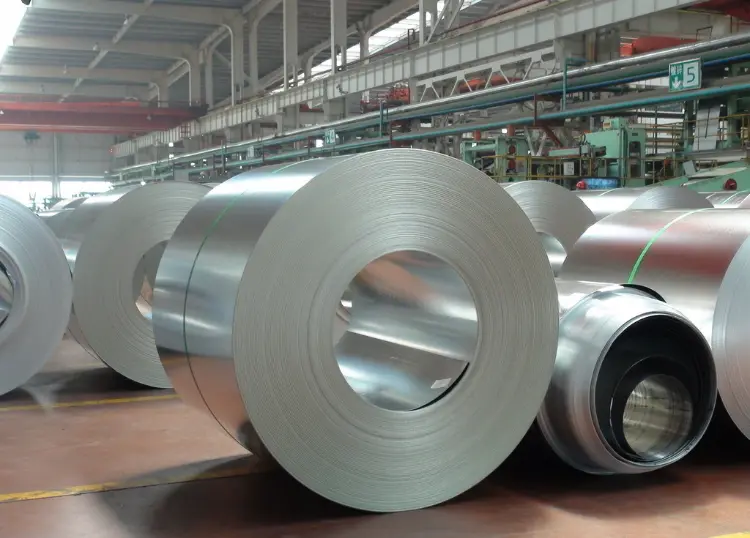
LR EH40 High-Strength Shipbuilding Steel Coil
LR EH40 High-Strength Shipbuilding Steel Coil - Certified by Lloyd's Register for Arctic Marine Applications
LR EH40 is a normalized/thermomechanical rolled shipbuilding steel with minimum yield strength of 390 MPa, excellent toughness at -40°C, and superior weldability. Meets Lloyd's Register rules for hull structures and offshore platforms.
Normalizing, thermomechanical rolling (TMCP), welding, cold forming, hot forming, cutting
- Phone : +8618037372205
- Email : [email protected]
- WhatsApp: Contact via Whtsapp
- WeChat: +8618037372205
LR EH40 High-Strength Shipbuilding Steel Coil Introduction
LR EH40 is a high-strength hull structural steel certified by Lloyd's Register, intended for shipbuilding and offshore engineering in low-temperature environments. It is supplied as coils, plates, or sections in normalized or thermomechanical rolled condition. The 'E' designation guarantees impact toughness at -40°C (minimum 41 J longitudinal).
Key features:
- High strength: Yield strength ≥390 MPa (thickness ≤50 mm), tensile strength 510–650 MPa.
- Excellent low-temperature toughness: Charpy V-notch energy ≥41 J at -40°C, suitable for Arctic service.
- Good weldability: Low carbon equivalent (Ceq ≤0.40–0.42%) and controlled microalloying reduce cold cracking risk.
- Tight quality control: Fully compliant with LR Rules for Materials, ensuring reliable performance in critical marine structures.
LR EH40 steel is widely used in hull plates, decks, bulkheads, stiffeners, and components of ice-class vessels, offshore platforms, and other heavy-duty marine structures.
LR EH40 High-Strength Shipbuilding Steel Coil Chemical Composition
Chemical requirements per LR Rules Chapter 3, Section 2. The composition is controlled to ensure strength, toughness, and weldability. Carbon equivalent (Ceq) calculated from formula: Ceq = C + Mn/6 + (Cr+Mo+V)/5 + (Ni+Cu)/15, typically ≤0.40% for thickness ≤50 mm, ≤0.42% for thickness >50–100 mm. Microalloying elements (Nb, V, Ti) may be added singly or in combination, with total Nb+V+Ti ≤0.12%. Aluminum is used for grain refinement and deoxidation (minimum acid-soluble Al 0.015%). Nitrogen is limited to prevent strain aging.
| Element | Specified Value (max unless range) | Remarks |
|---|---|---|
| C | 0.18 | Ladle analysis |
| Mn | 0.90 – 1.60 | Higher Mn for strength and toughness |
| Si | 0.10 – 0.50 | Deoxidizer; affects weldability |
| P | 0.025 | For low-temperature toughness |
| S | 0.025 | For ductility and weldability |
| Al (acid soluble) | ≥0.015 | Grain refinement |
| Nb | 0.02 – 0.05 | Microalloying (optional) |
| V | 0.05 – 0.10 | Microalloying (optional) |
| Ti | ≤0.02 | Microalloying (optional) |
| Cu | ≤0.35 | Residual; improved corrosion resistance |
| Cr | ≤0.20 | Residual; may increase hardenability |
| Ni | ≤0.40 | Residual; toughness enhancer |
| Mo | ≤0.08 | Residual; may improve high-temperature strength |
| N | ≤0.009 | Limited to avoid strain aging |
| Nb+V+Ti | ≤0.12 | Combined microalloying limit |
LR EH40 High-Strength Shipbuilding Steel Coil Thermal and Electrical Physical Properties
Physical properties are typical for carbon-manganese shipbuilding steel and are not part of the LR certification; they are provided for design calculations. Values are valid at room temperature unless otherwise noted. Density is used for weight estimation; elastic modulus and shear modulus for structural analysis; Poisson's ratio for stress analysis; thermal expansion for temperature-induced stress; thermal conductivity for heat transfer; specific heat for thermal mass; electrical resistivity for corrosion or electrical design.
| Property | Typical Value | Unit | Test Condition / Remarks |
|---|---|---|---|
| Density (ρ) | 7850 | kg/m³ | Room temperature |
| Elastic modulus (E) | 205 | GPa | Room temperature, tensile test |
| Shear modulus (G) | 80 | GPa | Calculated from E and ν |
| Poisson's ratio (ν) | 0.29 | — | Room temperature, elastic range |
| Thermal expansion coefficient (α) | 11.5 – 12.5 (20–100°C) | 10⁻⁶/K | Typical range for HSLA steel |
| Thermal conductivity (λ) | ~50 (at 20°C) | W/(m·K) | Decreasing with temperature |
| Specific heat capacity (c) | 460 – 480 | J/(kg·K) | Room temperature to 100°C |
| Electrical resistivity (ρ_e) | 0.15 – 0.25 | µΩ·m | At 20°C |
LR EH40 High-Strength Shipbuilding Steel Coil Mechanical Properties
Mechanical properties as per LR Rules for normalized or TMCP EH40 plates and coils. Testing is performed in the transverse direction for plates, longitudinal for sections. Impact tests use Charpy V-notch specimens at -40°C. For thickness >100 mm, properties may be agreed. Bending test: specimens bent over a former without cracking, with mandrel diameter depending on thickness.
- Yield strength (ReH) decreases with increasing thickness due to grain size and cooling rate effects.
- Tensile strength (Rm) range ensures high strength without brittle fracture risk.
- Elongation (A%) indicates good ductility, essential for forming and structural integrity.
- Impact energy (KV) guarantees resistance to brittle fracture in service at low temperatures.
| Property | Required Value | Unit | Test Conditions / Remarks |
|---|---|---|---|
| Yield strength (ReH) – thickness ≤50 mm | ≥390 | MPa | Transverse (plate), 0.2% offset |
| Yield strength (ReH) – 50 mm < t ≤ 70 mm | ≥375 | MPa | Transverse (plate) |
| Yield strength (ReH) – 70 mm < t ≤ 100 mm | ≥355 | MPa | Transverse (plate) |
| Tensile strength (Rm) – all thicknesses | 510 – 650 | MPa | Transverse or longitudinal |
| Elongation (A) – t ≤50 mm | ≥20 | % | Gauge length 5.65√So |
| Elongation (A) – 50 mm < t ≤ 70 mm | ≥19 | % | Gauge length 5.65√So |
| Elongation (A) – 70 mm < t ≤ 100 mm | ≥19 | % | Gauge length 5.65√So |
| Charpy V-notch impact (KV) – longitudinal | ≥41 (average) | J | At -40°C; min. single 29 J |
| Charpy V-notch impact (KV) – transverse | ≥27 (average) | J | At -40°C; min. single 19 J |
| Bend test – thickness ≤25 mm | Crack-free | Mandrel dia. = 3 × thickness, 180° | |
| Bend test – thickness >25 mm | Crack-free | Mandrel dia. = 4 × thickness, 180° |
LR EH40 High-Strength Shipbuilding Steel Coil Fully Equivalent Material Standards and Substitute Grades
| Country/Region | Standard | Grade | Remarks |
|---|---|---|---|
| International | IACS UR W11 | EH40 | Common specification by International Association of Classification Societies |
| USA | ABS Rules | EH40 | American Bureau of Shipping |
| Norway/Germany | DNV GL Rules (now DNV) | E40 | Det Norske Veritas / Germanischer Lloyd |
| France | BV Rules | EH40 | Bureau Veritas |
| Italy | RINA Rules | E40 | Registro Italiano Navale |
| China | CCS Rules | E40 | China Classification Society |
| Korea | KR Rules | KE40 | Korean Register |
| Japan | NK Rules | KE40 | Nippon Kaiji Kyokai (ClassNK) |
| India | IRS Rules | E40 | Indian Register of Shipping |
| Russia | RMRS Rules | E40 | Russian Maritime Register of Shipping |
LR EH40 High-Strength Shipbuilding Steel Coil Application Introduction
LR EH40 steel coil is primarily used in the construction of large ships and offshore structures where high strength and low-temperature toughness are critical. It is suitable for Arctic and ice-class vessels, as well as for critical structural components in marine environments.
Processing capabilities: The steel can be cut, formed, welded, and machined using conventional methods. Preheating may be required for thick sections to prevent cold cracking. Post-weld heat treatment is generally not necessary but can be applied for stress relief.
Corrosion protection: Like all carbon steels, EH40 requires coating or cathodic protection in seawater. The material is often supplied with a shop primer to prevent atmospheric corrosion during fabrication.
Product Applications: Hull plates and stiffeners, Decks and bulkheads, Ice belts and stringers, Jacket legs, piles, and braces for offshore platforms, Transition pieces for wind turbines, Ship superstructures and deckhouses
Processed into products: Longitudinal and transverse frames, Keels and bottom plating, Hatch coamings and girders, Rudder horns and stern frames, Mooring equipment foundations, Crane pedestals on offshore platforms
Application industries: Shipbuilding (merchant, naval, ice-class), Offshore oil & gas (fixed platforms, FPSOs), Renewable energy (offshore wind turbine foundations, substructures), Bridge and infrastructure (marine environment), Heavy machinery and port equipment
LR EH40 High-Strength Shipbuilding Steel Coil Similar / Related Substitute Materials
| Country/Region | Standard | Grade | Remarks |
|---|---|---|---|
| International | LR Rules | EH36 | Lower yield strength (≥355 MPa) but similar toughness; may be substituted in less demanding applications |
| International | LR Rules | FH40 | Higher toughness at -60°C; used for extreme Arctic conditions |
| International | LR Rules | DH40 | Toughness at -20°C; suitable for warmer environments than EH40 |
| EU | EN 10025-6 | S420ML/MC | Thermomechanical rolled steel with similar strength but not specifically for ship classification |
| USA | ASTM A131 / ABS | EH36 | Comparable shipbuilding grade but lower yield strength |
| International | API 5L | X65 | Pipeline grade with similar strength but different chemistry and toughness requirements |
Notes:
Additional information: LR EH40 coils may be produced with improved atmospheric corrosion resistance (e.g., by adding Cu) by agreement. Ultrasonic testing to any classification society standard can be performed upon request. The material should be stored in a dry environment to prevent rusting. Welding consumables should match the toughness level; typically low-hydrogen electrodes or wire are used. For critical applications, CTOD testing may be required to ensure crack-tip opening displacement toughness. The steel is normally produced by the basic oxygen process or electric arc furnace and is fully killed.
- Share



