
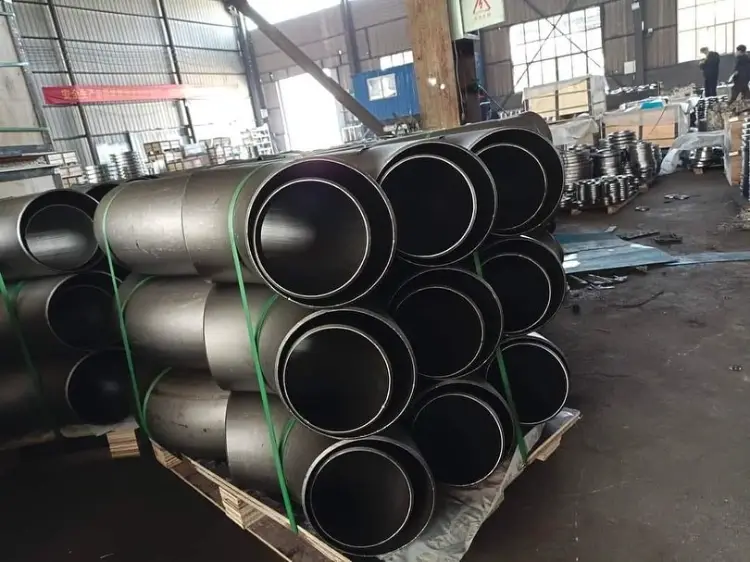
ASME SA312 TP317 Stainless Steel Pipe
ASME SA312 TP317 Stainless Steel Pipe: Properties, Chemistry & Equivalents
Complete material data for ASME SA312 TP317 pipe: chemical composition, mechanical and physical properties, international equivalents, similar grades, and application guidance.
Hot rolling, cold drawing, bending, flanging, welding, machining (typical for austenitic steels)
- Phone : +8618037372205
- Email : [email protected]
- WhatsApp: Contact via Whtsapp
- WeChat: +8618037372205
ASME SA312 TP317 Stainless Steel Pipe Introduction
ASME SA312 TP317 is an austenitic stainless steel pipe specified for seamless and welded construction, designated as UNS S31700. It features a higher molybdenum content (3.0–4.0%) compared to standard 316 steels, providing superior pitting and crevice corrosion resistance in chloride-containing environments. The balanced chromium (18–20%) and nickel (11–15%) composition ensures excellent general corrosion resistance and good mechanical strength at elevated temperatures. Key characteristics:
- Excellent resistance to a wide range of chemical media, including sulfuric acid compounds, acidic chloride solutions, and organic acids.
- Higher creep strength than 316/316L, suitable for service up to approximately 800°F (425°C).
- Readily weldable by common fusion and resistance methods, without post-weld annealing for thin sections (though solution annealing is recommended for best corrosion resistance).
- Good formability and machinability typical of austenitic stainless steels.
Typically supplied in the solution-annealed condition, TP317 pipe is widely used in chemical processing, oil refining, pulp and paper, textile equipment, and flue gas desulfurization systems where reliability under aggressive corrosion is required.
ASME SA312 TP317 Stainless Steel Pipe Chemical Composition
Chemical requirements for TP317 stainless steel pipe as mandated by ASME SA312/SA312M. All values are in weight percent. The elements listed are those specified; iron constitutes the balance.
| Chemical Element | Standard Value (%) | Notes |
|---|---|---|
| Carbon (C) | ≤ 0.08 | |
| Manganese (Mn) | ≤ 2.00 | |
| Phosphorus (P) | ≤ 0.045 | |
| Sulfur (S) | ≤ 0.030 | |
| Silicon (Si) | ≤ 1.00 | |
| Chromium (Cr) | 18.0 – 20.0 | |
| Nickel (Ni) | 11.0 – 15.0 | |
| Molybdenum (Mo) | 3.0 – 4.0 | |
| Iron (Fe) | Balance | Remainder |
ASME SA312 TP317 Stainless Steel Pipe Physical Properties
Typical physical properties of TP317 stainless steel in the annealed condition. These values are not specification requirements but represent accepted data for engineering calculations. Data compiled from recognized sources for UNS S31700.
| Property | Typical Value | Unit | Test Condition / Temperature |
|---|---|---|---|
| Density (ρ) | 7,980 | kg/m³ | Room temperature |
| Elastic Modulus (E) | 193 | GPa | Room temperature |
| Shear Modulus (G) | 77 | GPa | Room temperature |
| Poisson's Ratio (ν) | 0.28 | — | Room temperature |
| Thermal Expansion Coefficient (α) | 16.5 | ×10⁻⁶/K | 20–100 °C |
| Thermal Expansion Coefficient (α) | 18.0 | ×10⁻⁶/K | 20–500 °C |
| Thermal Expansion Coefficient (α) | 20.2 | ×10⁻⁶/K | 20–1000 °C |
| Thermal Conductivity (λ) | 14.6 | W/m·K | at 100 °C |
| Thermal Conductivity (λ) | 21.4 | W/m·K | at 500 °C |
| Specific Heat Capacity | 500 | J/kg·K | 0–100 °C |
| Electrical Resistivity (ρ_e) | 0.79 | μΩ·m | at 20 °C |
ASME SA312 TP317 Stainless Steel Pipe Mechanical Properties
Minimum tensile properties for TP317 pipe in the solution-annealed condition, tested at room temperature. These values represent mandatory requirements for acceptance. The standard does not specify impact toughness or bending requirements for this grade.
| Property | Minimum Required Value | Unit | Test Condition |
|---|---|---|---|
| Yield Strength (0.2% offset) | 205 | MPa | Room temperature |
| Tensile Strength | 515 | MPa | Room temperature |
| Elongation in 50 mm (2 in.) | 35 | % | Longitudinal strip or full-section specimen |
ASME SA312 TP317 Stainless Steel Pipe Completely Equivalent Material Standards & Alternative Grade Designations
| Country/Region | Standard | Grade | Remarks |
|---|---|---|---|
| USA | ASME SA312 / ASTM A312 | TP317 (UNS S31700) | Original specification for seamless and welded pipe |
| China | GB/T 14976 | 06Cr19Ni13Mo3 (also designated S31700) | Equivalent seamless stainless steel pipe for fluid transport |
| Japan | JIS G3459 | SUS 317 TP | Piping grade identical to TP317 |
ASME SA312 TP317 Stainless Steel Pipe Application Introduction
TP317 pipe is selected for services where superior corrosion resistance is required, especially in acidic, chloride, and sulfur-containing environments. Its combination of high molybdenum and chromium provides robust defense against pitting and crevice attack. Typical industries and applications include:
Product Applications: Process piping, Heat exchanger tubes, Condenser tubes, Evaporator tubes, FGD absorber inlet/outlet piping, Chemical injection lines, Boiler tubes (where corrosion is critical)
Processed into products: Reactor vessel linings and internal piping, Storage tanks for corrosive acids, Distillation column trays and piping, Pump and valve bodies, Flanges and fittings, Spray nozzles for scrubbers, Sea water handling components
Application industries: Chemical Processing, Petrochemical Refining, Pulp & Paper, Pharmaceutical Manufacturing, Food & Beverage, Flue Gas Desulfurization (FGD), Textile Dyeing, Pollution Control
ASME SA312 TP317 Stainless Steel Pipe Similar or Nearby Alternative Materials
| Country/Region | Standard | Grade | Remarks |
|---|---|---|---|
| USA | ASME SA312 | TP317L (S31703) | Low carbon variant (C ≤ 0.03), better welding corrosion resistance; mechanical properties slightly lower |
| USA | ASME SA312 | TP316 (S31600) | Mo 2–3%, lower pitting resistance; suitable for less aggressive media |
| USA | ASME SA312 | TP316L (S31603) | Low carbon 316, widely used but inferior to 317 in high‑chloride environments |
| USA | ASME SA312 | TP317LN (S31753) | Nitrogen‑strengthened 317, higher yield strength and similar corrosion resistance |
Notes:
TP317, like all austenitic stainless steels, is non-magnetic in the annealed condition but may become slightly magnetic after cold working. It provides excellent toughness at cryogenic temperatures and can be used down to -196°C. When welding, use matching filler metal ER317 or E317-XX electrodes. Post-weld solution annealing is recommended to restore maximum corrosion resistance, especially for heavy sections. No impact test requirements are specified in the base pipe standard. For high-pressure applications or specific temperature ranges, consult the relevant ASME B31.3 or B31.1 codes for allowable stresses.
- Share



