
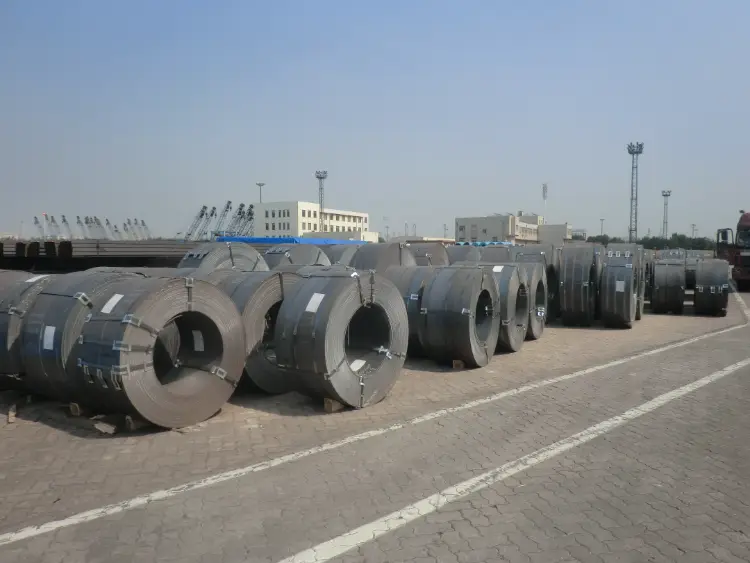
LR DH55 Shipbuilding Steel Coil
LR DH55 Shipbuilding Steel Coil: Superior Strength for Arctic-Ready Hull Structures
Comprehensive technical data on LR DH55 shipbuilding steel coil certified by Lloyd's Register, featuring minimum yield strength 550 MPa and guaranteed toughness at -20°C, ideal for Arctic and heavy-duty marine structures.
Cutting (plasma, laser, shear), cold forming (bending, pressing), welding (SMAW, SAW, GMAW under controlled procedures), machining (drilling, milling)
- Phone : +8618037372205
- Email : [email protected]
- WhatsApp: Contact via Whtsapp
- WeChat: +8618037372205
LR DH55 Shipbuilding Steel Coil Introduction
LR DH55 is a high-strength, low-temperature toughness hull structural steel grade certified by Lloyd's Register (LR) under the Rules for the Manufacture, Testing and Certification of Materials. It belongs to the H55 strength level (yield strength ≥ 550 MPa) and D quality grade (impact test at -20°C). This thermomechanically rolled steel offers an excellent combination of strength, weldability, and notch toughness, making it suitable for critical ship components operating in cold waters. The chemical composition is fine‑tuned with grain-refining elements (Al, Nb, V, Ti) while maintaining low carbon equivalent to ensure good weldability. Typical applications include decks, bottom shells, transverse bulkheads, and high‑stress structural members of large vessels, offshore platforms, and ice‑class ships.
LR DH55 Shipbuilding Steel Coil Chemical Composition
The following values are based on the LR Rules. A fully killed fine-grained practice is mandatory. Ceq = C + Mn/6 + (Cr+Mo+V)/5 + (Ni+Cu)/15 is typically limited to ≤ 0.45% to ensure weldability. If necessary, the manufacturer may use any combination of Nb, V, Ti, and Al to achieve the required grain refinement.
| Element | Required Value (max or range) | Remarks |
|---|---|---|
| Carbon (C) | ≤ 0.18 | Ladle analysis; lower values improve weldability |
| Silicon (Si) | ≤ 0.50 | Deoxidizer |
| Manganese (Mn) | 0.90 – 1.60 | Contributes to strength and toughness |
| Phosphorus (P) | ≤ 0.025 | Strict control for cold cracking resistance |
| Sulfur (S) | ≤ 0.025 | For inclusion shape control |
| Aluminium (Altotal) | ≥ 0.020 | Minimum for grain refinement; alternatively with other micro-alloying elements |
| Niobium (Nb) | 0.02 – 0.05 | Optional grain refiner, may be used alone or in combination |
| Vanadium (V) | 0.05 – 0.10 | Optional precipitation strengthener |
| Titanium (Ti) | ≤ 0.02 | Optional grain refiner; also forms carbosulfides |
| Copper (Cu) | ≤ 0.35 | Residual element; can improve atmospheric corrosion resistance |
| Chromium (Cr) | ≤ 0.20 | Residual; contributes to hardenability |
| Nickel (Ni) | ≤ 0.40 | Residual; beneficial for low-temperature toughness |
| Molybdenum (Mo) | ≤ 0.08 | Residual; increases hardenability |
| Nitrogen (N) | ≤ 0.009 | Controlled to avoid strain aging and ensure AlN precipitation |
LR DH55 Shipbuilding Steel Coil Physical and Electrical Properties
These values are not specified in the LR Rules but represent typical data for as‑rolled high‑strength low‑alloy steels of similar composition and strength level. They may be used for design calculations under ambient temperature conditions.
| Property | Typical Value | Unit | Condition / Remarks |
|---|---|---|---|
| Density (ρ) | 7.85 × 10³ | kg/m³ | Room temperature |
| Elastic modulus (E) | 210 | GPa | 20°C, tensile loading |
| Shear modulus (G) | 81 | GPa | 20°C, derived from E and ν |
| Poisson's ratio (ν) | 0.30 | — | 20°C, within elastic range |
| Coefficient of thermal expansion (α) | 12 × 10⁻⁶ | K⁻¹ | 20 – 100°C; approx. 13 × 10⁻⁶ at 100 – 200°C |
| Thermal conductivity (λ) | 48 – 52 | W/(m·K) | 20°C; decreases with temperature |
| Specific heat capacity (cₚ) | 450 – 480 | J/(kg·K) | 20 – 100°C |
| Electrical resistivity (ρₑ) | 0.15 – 0.25 | Ω·mm²/m | 20°C; typical for micro-alloyed steel (0.15 – 0.25 × 10⁻⁶ Ω·m) |
LR DH55 Shipbuilding Steel Coil Mechanical Properties
Values are specified in the LR Rules for thermomechanically rolled condition, transverse test pieces. Requirements may vary slightly with thickness; the most common ranges for ship structural applications are listed.
| Property | Required Value | Unit | Condition / Remarks |
|---|---|---|---|
| Yield strength (ReH) | ≥ 550 | MPa | Thickness ≤ 50 mm, transverse; for thickness >50 mm consult LR Rules |
| Tensile strength (Rm) | 670 – 830 | MPa | Thickness ≤ 50 mm; typical range applies for all shipbuilding grades of this strength level |
| Elongation after fracture (A5) | ≥ 16 | % | Gauge length 5.65√So; thickness ≤ 50 mm, transverse |
| Bend test (180° bend angle) | No cracks or defects | — | Bend diameter = 3a (a = specimen thickness, ≤ 20 mm); 4a for 20 < a ≤ 50 mm |
| Impact energy (KV2) at -20°C, longitudinal | ≥ 47 (average) / ≥ 33 (single) | J | Charpy V‑notch, 10×10 mm² specimen; for subsize specimens values are proportional |
| Impact energy (KV2) at -20°C, transverse | ≥ 31 (average) / ≥ 22 (single) | J | When specified in contract, otherwise longitudinal applies |
LR DH55 Shipbuilding Steel Coil Totally Equivalent Material Standards and Substitute Grades
| Country / Society | Standard | Grade | Remarks |
|---|---|---|---|
| American Bureau of Shipping | ABS Rules Part 2, Chapter 1 | DH55 | Identical mechanical and toughness requirements |
| DNV (Norway/Germany) | DNV GL Rules Pt.2 Ch.2 | DH55 | Formerly DNV DH550; full LR cross-recognition |
| Bureau Veritas | BV Rules NR216 | DH55 | Equivalent through IACS unified requirements |
| Korean Register | KR Rules Pt.2 Ch.1 | DH55 | Full equivalence; same chemical and mechanical criteria |
| Nippon Kaiji Kyokai (ClassNK) | NK Rules Part K | DH55 | Identified as NK DH55; identical to IACS UR W11 |
| Russian Maritime Register | RS Rules Part XIII | DH55 | Equivalent H55 strength level with D quality (-20°C) |
| China Classification Society | CCS Rules Part 1 | DH55 | CCS DH55; identical requirements |
| Registro Italiano Navale | RINA Rules Pt.B, Ch.2 | DH55 | Same property requirements as LR |
| China (GB) | GB/T 712‑2011 | DH550 | High-strength hull structural steel; yield ≥ 550 MPa, impact at -20°C, recognized by CCS |
LR DH55 Shipbuilding Steel Coil Application Introduction
LR DH55 is specifically developed for highly stressed hull members in modern shipbuilding, especially in the Arctic and harsh operating environments. Its combination of 550 MPa minimum yield strength and grade‑D low‑temperature toughness (‑20°C impact test) allows for lighter, yet safer designs. Key benefits:
- Excellent weldability with preheat only for very thick sections
- Grain refinement ensures uniform properties across the coil
- TMCP delivery condition minimizes residual stresses
- Certified by LR surveyor, ensuring traceability and full compliance with classification society rules
Product Applications: Container ships – deck plating and structural frames, Bulk carriers – bottom shell and bilge strake, Tankers (oil/chemical) – strength deck and longitudinal bulkheads, Ice‑class vessels (Ice‑breaker, cargo) – ice belt and impact zones, Offshore platforms – columns, bracings, and deck boxes, Jack‑up rig legs – high‑strength chords and rack plates
Processed into products: Longitudinal stiffeners and girders, Transverse web frames and floor plates, Bulkhead panels and corner brackets, Bilge keels and rubbing strips, Side shell and bottom shell panels, Deck house structural members, Anchor chain stopper supports and hawse pipe insert plates, Crane pedestal reinforcing seats
Application industries: Marine & shipbuilding (commercial vessels, navy auxiliaries), Offshore oil & gas (jack-up rigs, floating production units, modules), Renewable energy (offshore wind turbine foundations, transition pieces), Heavy engineering (port cranes, large‑scale steel structures in cold climates), Arctic research & logistics (ice‑strengthened hulls, polar supply ships)
LR DH55 Shipbuilding Steel Coil Closely Related Substitute Materials
| Country / Region | Standard | Grade | Remarks |
|---|---|---|---|
| International | IACS UR W11 | FH55 | Higher toughness: EH55/FH55 with -40°C or -60°C impact test; otherwise identical chemical and tensile properties |
| European | EN 10025‑4 | S550Q, S550QL | Low-alloy quenched & tempered structural steel; not certificated for marine use but similar tensile properties. Requires shipyard approval |
| China | GB/T 1591‑2018 | Q550D | High-strength structural steel with impact at -20°C; not marine-graded but may be considered for non-class components with additional testing |
| USA | ASTM A131/A131M | FH55 | Higher toughness variant (-40°C) under minor modifications; LR may accept with documentation |
| Japan | JIS G 3128 | SHY685 (modified) | High yield strength plate; quenched and tempered, not a direct substitute but used in some marine structures after additional approval |
Notes:
- All LR DH55 steel coils must be produced by a manufacturer approved by Lloyd's Register and delivered with a separate LR inspection certificate.
- The material shall be free from surface imperfections, laminations, and internal defects verified by ultrasonic testing if required by the order.
- Welding consumables and procedures must also be approved by LR to ensure compatibility with the chemical composition and mechanical properties.
- Storage and handling: coils should be kept dry and flat to avoid hydrogen induced stress corrosion cracking, especially when stored outdoors before fabrication.
- Share



