
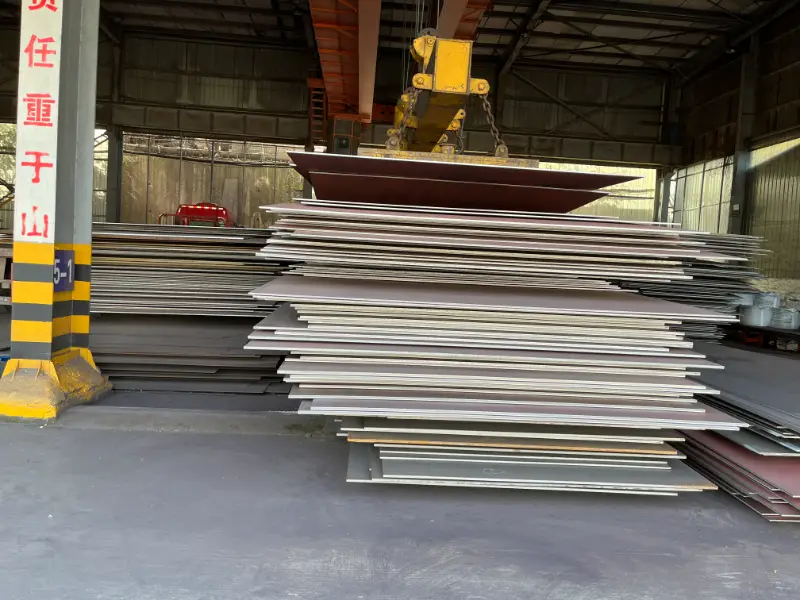
JIS G4305 SUS430 Ferritic Stainless Steel
JIS G4305 SUS430 Ferritic Stainless Steel for Pipes and Sheets
Comprehensive data sheet for SUS430 stainless steel according to JIS G4305, covering chemical composition, mechanical and physical properties, international equivalents, and application guidance for pipes and flat products.
Cold rolling, bending, deep drawing, welding (with appropriate filler), blanking, forming
- Phone : +8618037372205
- Email : [email protected]
- WhatsApp: Contact via Whtsapp
- WeChat: +8618037372205
JIS G4305 SUS430 Ferritic Stainless Steel Introduction
SUS430, specified in JIS G4305 (Cold-rolled stainless steel sheet, plate and strip), is a widely used ferritic chromium stainless steel containing 16–18% Cr. It offers good corrosion resistance in mildly corrosive environments, excellent formability, and a bright surface finish. The alloy is magnetic in all conditions and cannot be hardened by heat treatment. It is typically supplied in the annealed condition, providing a balance of strength and ductility. When referenced for stainless steel pipes, the base material chemistry and mechanical properties often follow JIS G4305, but pipe dimensions and tolerances are usually governed by separate standards such as JIS G3459. SUS430 is cost-effective compared to austenitic grades and is suitable for indoor and mildly outdoor applications where high corrosion resistance is not the primary requirement. Key features include:
- Good resistance to atmospheric corrosion, water, and many chemicals
- Excellent deep drawability and formability
- Non-hardenable by heat treatment; annealing relieves cold work stresses
- Magnetic, suitable for induction cooking appliances and electromagnetic applications
JIS G4305 SUS430 Ferritic Stainless Steel Chemical Composition
The composition of SUS430 is defined in JIS G4305. It is a plain chromium steel with controlled carbon to maintain ferritic structure. Nickel is not intentionally added but may appear as a residual. The alloy contains no molybdenum or other deliberate alloying additions. Typical values are listed for guidance only; the standard specifies maximum or range limits.
| Element | Specified Value (wt%) | Remarks |
|---|---|---|
| Carbon (C) | ≤0.12 | Max limit |
| Silicon (Si) | ≤0.75 | Max limit |
| Manganese (Mn) | ≤1.00 | Max limit |
| Phosphorus (P) | ≤0.040 | Max limit |
| Sulfur (S) | ≤0.030 | Max limit |
| Chromium (Cr) | 16.00–18.00 | Range |
| Nickel (Ni) | ≤0.60 | Residual, not specified in standard; typical max |
| Iron (Fe) | Balance | Remainder |
JIS G4305 SUS430 Ferritic Stainless Steel Thermal and Electrical Physical Properties
Physical properties are typical values at room temperature or as indicated. These are not part of JIS G4305 but represent commonly accepted reference data for SUS430 (1.4016). Thermal conductivity and thermal expansion are important for applications involving temperature changes. The alloy is ferromagnetic at all temperatures below the Curie point (approx. 600°C).
| Property | Typical Value | Unit | Test Condition / Remarks |
|---|---|---|---|
| Density (ρ) | 7.70 | g/cm³ | At 20°C |
| Elastic Modulus (E) | 200 | GPa | At 20°C |
| Shear Modulus (G) | 80 | GPa | Calculated from E and ν |
| Poisson's Ratio (ν) | 0.27 | - | At 20°C, typical |
| Thermal Expansion Coefficient (α) | 10.4 | 10⁻⁶/K | 0–100°C |
| Thermal Expansion Coefficient (α) | 11.3 | 10⁻⁶/K | 0–500°C |
| Thermal Conductivity (λ) | 26 | W/(m·K) | At 100°C |
| Thermal Conductivity (λ) | 26 | W/(m·K) | At 500°C (approximately) |
| Specific Heat Capacity (cp) | 460 | J/(kg·K) | At 20°C |
| Electrical Resistivity (ρe) | 0.60 | μΩ·m | At 20°C |
JIS G4305 SUS430 Ferritic Stainless Steel Mechanical Properties
Mechanical properties are based on annealed condition according to JIS G4305 for cold-rolled sheet/strip. For pipes manufactured from SUS430, these values are often adopted by agreement. Actual properties depend on thickness and finishing. Elongation requirements vary with thickness: ≥20% for 0.3–0.5 mm and ≥22% for ≥0.5 mm. Hardness values are typical for annealed material. Impact testing is not normally required for ferritic stainless steels in this standard; data available upon special request.
| Property | Specified Value | Unit | Test Condition |
|---|---|---|---|
| Tensile Strength (Rm) | ≥420 | MPa | Room temperature, annealed |
| Yield Strength (ReH, 0.2% offset) | ≥205 | MPa | Room temperature, annealed |
| Elongation (A) | ≥22 | % | Gauge length 50 mm, thickness ≥0.5 mm |
| Elongation (A) | ≥20 | % | Gauge length 50 mm, thickness 0.3–0.5 mm |
| Hardness | ≤183 | HBW | Annealed |
| Hardness | ≤88 | HRB | Annealed, typical conversion |
| Hardness | ≤200 | HV | Annealed |
| Bend Test | No cracks, 180° | - | Bend diameter = thickness (1t), for thickness ≤8 mm |
JIS G4305 SUS430 Ferritic Stainless Steel Completely Equivalent Material Standards and Replaceable Grades
| Country/Region | Standard | Grade | Remarks |
|---|---|---|---|
| USA | ASTM A240/A240M | 430 (UNS S43000) | Chemical and mechanical requirements closely match SUS430 |
| EU | EN 10088-2 | 1.4016 (X6Cr17) | Equivalent ferritic stainless steel for flat products |
| China | GB/T 3280 | 10Cr17 (formerly 1Cr17) | Chinese equivalent, similar chemistry |
| International | ISO 15510 | X6Cr17 | Harmonized grade |
| South Korea | KS D 3698 | STS430 | Korean standard for cold-rolled stainless steel |
| Russia | GOST 5632 | 12Ch17 | Close equivalent, wider C and Si ranges may apply |
JIS G4305 SUS430 Ferritic Stainless Steel Application Introduction
SUS430 is ideal for applications requiring moderate corrosion resistance, good formability, and lower cost. It is commonly used in environments where appearance and durability are important but aggressive chemicals are not present. Typical sectors include household appliances, automotive trim, architectural interior panels, and kitchenware. Due to its magnetic nature, it is preferred for induction-compatible cookware. When fabricated into pipes, SUS430 is employed in exhaust systems, heat exchangers operating below 450°C, and structural tubing for indoor decorative uses. Post-forming, annealing may be required to restore ductility. The material is readily welded by common methods, though low heat input and filler metals (e.g., 308L, 430) should be used to avoid grain growth in the heat-affected zone.
Product Applications: Kitchen sinks and cookware, Washing machine drums and dishwasher liners, Automotive exhaust mufflers and tailpipes, Decorative panels, elevator interiors, handrails, Heat exchanger tubes (low temperature), Structural tubing for furniture and display racks
Processed into products: Deep-drawn sink bowls, Stamped brackets and clips, Welded exhaust pipe assemblies, Roll-formed trim mouldings, Drawn tubular parts for lighting fixtures, Bent exhaust headers
Application industries: Home Appliance Manufacturing, Automotive (exhaust systems, trims), Architecture and Interior Design, Food Processing and Catering Equipment, Consumer Electronics (housings, brackets), Industrial Pipe and Tube (non-pressure, decorative)
JIS G4305 SUS430 Ferritic Stainless Steel Recommended Similar or Substitute Materials
| Country/Region | Standard | Grade | Remarks |
|---|---|---|---|
| Japan | JIS G4305 | SUS430J1L | Lower carbon and added Nb for improved weldability; similar corrosion resistance |
| Japan | JIS G4305 | SUS430LX | Nb-stabilized, better intergranular corrosion resistance after welding |
| USA | ASTM A240 | 430Ti (S43036) | Titanium stabilized version, 1.4510 in EN; better weld joint performance |
| EU | EN 10088-2 | 1.4510 (X3CrTi17) | Stabilized ferritic grade, suitable for welded applications without post-weld annealing |
| Global | AISI | 439 (S43035) | Low carbon + Ti stabilized, higher corrosion resistance due to Cr and Ti, often used in exhausts |
| Global | AISI | 434 (S43400) | Contains 0.75–1.25% Mo for improved pitting resistance; slight upgrade from 430 |
Notes:
Note: The data provided for SUS430 is primarily based on JIS G4305 for cold-rolled flat products. For stainless steel pipes, the applicable standard may be JIS G3459 or other dedicated pipe specifications; however, the chemical composition and minimum mechanical properties are often aligned with JIS G4305 unless otherwise agreed. Always confirm the exact specification with the material supplier for the intended pipe form. Welding considerations: preheating to 150–200°C and post-weld annealing at 760–815°C followed by rapid cooling can restore ductility. Avoid prolonged heating in the 400–550°C range to prevent 475°C embrittlement. Magnetic property is stable up to the Curie point (~600°C).
- Share



