
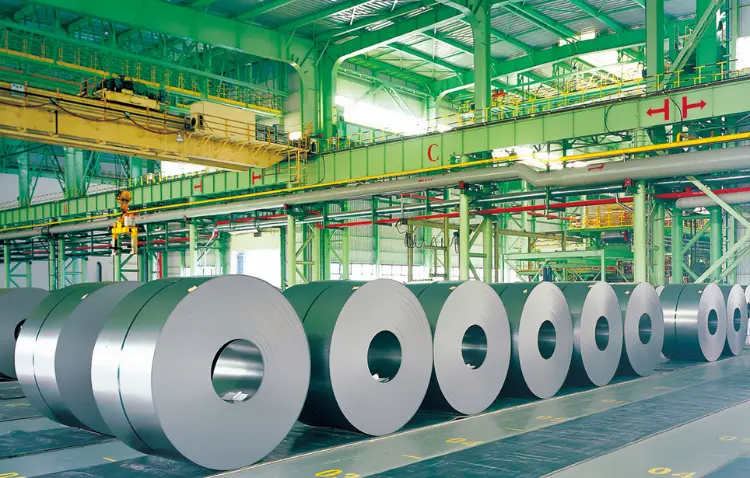
LR DH40 Shipbuilding Steel Coil
LR DH40 Shipbuilding Steel Coil: High-Strength Hull Structural Plate & Coil
Comprehensive data for LR DH40 shipbuilding steel coil: chemical composition, mechanical properties, physical performance, international equivalents, and application guide.
Hot rolling, normalizing (N), thermo-mechanical controlled processing (TMCP), or as-rolled (depending on thickness and class requirements)
- Phone : +8618037372205
- Email : [email protected]
- WhatsApp: Contact via Whtsapp
- WeChat: +8618037372205
LR DH40 Shipbuilding Steel Coil Introduction
LR DH40 is a high-strength shipbuilding structural steel grade certified by Lloyd's Register (LR), designed for critical hull and offshore structures. It belongs to the normalized or thermo-mechanically controlled rolled (TMCP) condition high-strength steel series, offering a minimum yield strength of 390 MPa for thicknesses up to 50 mm.
- Excellent low-temperature toughness with guaranteed Charpy V-notch impact energy of 27 J at -20 °C
- Good weldability due to controlled carbon equivalent (CE ≤ 0.40 typical)
- Superior resistance to brittle fracture and fatigue in marine environments
- Widely available in coil, plate, and sheet forms for efficient fabrication
The grade is equivalent to IACS UR W11 high-strength steels and recognized by all major classification societies.
LR DH40 Shipbuilding Steel Coil Chemical Composition
The chemical requirements are based on LR Rules and aligned with IACS UR W11. Microalloying elements such as Nb, V, Ti are added singly or in combination to achieve the required strength and toughness. Carbon equivalent (CE) is typically controlled to ≤0.40% for good weldability.
- CE = C + Mn/6 + (Cr+Mo+V)/5 + (Ni+Cu)/15
- If Al is used for grain refinement, total Al or acid-soluble Al content is verified.
| Chemical Element | Standard Value (wt%) | Remarks |
|---|---|---|
| Carbon, C | ≤0.18 | Ladle analysis |
| Manganese, Mn | 0.90 – 1.60 | |
| Silicon, Si | 0.10 – 0.50 | |
| Phosphorus, P | ≤0.035 | |
| Sulfur, S | ≤0.035 | |
| Aluminium, Al (total) | ≥0.020 | Alternatively acid-soluble Al ≥0.015 |
| Niobium, Nb | ≤0.05 | Can be used alone or with V/Ti |
| Vanadium, V | ≤0.10 | |
| Titanium, Ti | ≤0.02 | |
| Copper, Cu | ≤0.35 | |
| Chromium, Cr | ≤0.20 | |
| Nickel, Ni | ≤0.40 | |
| Molybdenum, Mo | ≤0.08 | |
| Nitrogen, N | ≤0.009 | For steels produced with nitrogen-binding elements |
| Carbon Equivalent, CE | ≤0.40 | Typical for thicknesses ≤50 mm; may be adjusted for thicker plates |
LR DH40 Shipbuilding Steel Coil Thermal and Electrical Physical Properties
The following physical properties are typical for LR DH40 carbon-manganese steel at room temperature, unless otherwise noted. These values are for reference in design and processing, and may vary slightly with actual composition and heat treatment.
- Density is close to that of pure iron with carbon and alloying effects.
- Thermal conductivity and expansion coefficients are similar to other structural steels in the 510–650 MPa tensile class.
| Property | Typical Value | Unit | Condition |
|---|---|---|---|
| Density (ρ) | 7.85 | g/cm³ | 20 °C |
| Elastic Modulus (E) | 205 | GPa | Room temperature |
| Shear Modulus (G) | 80 | GPa | Estimated from E and Poisson's ratio |
| Poisson's Ratio (ν) | 0.3 | - | Elastic range |
| Thermal Expansion Coefficient (α) | 11.5 × 10⁻⁶ | /K | 20 – 100 °C |
| Thermal Conductivity (λ) | ~50 | W/(m·K) | 20 °C |
| Specific Heat Capacity | ~460 | J/(kg·K) | 20 °C |
| Electrical Resistivity (ρe) | ~0.23 | µΩ·m | 20 °C |
LR DH40 Shipbuilding Steel Coil Mechanical Properties
Mechanical properties are determined on transverse test pieces unless otherwise agreed. Values depend on product thickness and delivery condition. Impact testing is performed at -20 °C for DH40 grade (Longitudinal: min 27 J, Transverse: min 20 J). Bend Test: mandrel diameter = 3t for thickness ≤25 mm, = 4t for thickness >25 mm; bending angle 180°.
- Yield strength decreases gradually for thicker sections as noted.
- Elongation is measured on gauge length 5.65√S₀ (proportional test piece).
| Property | Required Value | Unit | Test Condition / Thickness |
|---|---|---|---|
| Yield Strength (ReH) | ≥390 | MPa | Thickness ≤50 mm |
| Yield Strength (ReH) | ≥380 | MPa | Thickness >50 mm, ≤70 mm |
| Yield Strength (ReH) | ≥370 | MPa | Thickness >70 mm, ≤100 mm |
| Tensile Strength (Rm) | 510 – 650 | MPa | All thicknesses |
| Elongation (A) | ≥20 | % | Longitudinal, 5.65√S₀ gauge; transverse ≥19% |
| Bend Test (180°) | No cracks | - | Mandrel dia. = 3t for t ≤25 mm; = 4t for t >25 mm |
| Charpy Impact (KV2) | ≥27 (L) / ≥20 (T) | J | -20 °C, transverse test may be required |
LR DH40 Shipbuilding Steel Coil Completely Equivalent Material Standards & Replaceable Grades
| Country / Region | Standard / Classification Society | Grade | Remarks |
|---|---|---|---|
| International | Lloyd's Register (LR) | DH40 | Original grade; high strength ship steel |
| USA | American Bureau of Shipping (ABS) | DH40 | Identical in IACS UR W11 |
| France | Bureau Veritas (BV) | DH40 | Identical |
| China | China Classification Society (CCS) | DH40 | Identical |
| Norway/Germany | DNV GL (now DNV) | DH40 | Historically NV DH40 / GL DH40; now unified |
| South Korea | Korean Register (KR) | DH40 | Identical |
| Japan | Nippon Kaiji Kyokai (NK / ClassNK) | DH40 | Identical |
| Italy | Registro Italiano Navale (RINA) | DH40 | Identical |
| Russia | Russian Maritime Register of Shipping (RS) | DH40 | Identical |
LR DH40 Shipbuilding Steel Coil Application Introduction
LR DH40 steel coil is engineered for welded marine structures requiring high strength, good formability, and reliable low-temperature toughness. It is widely used in both commercial and naval shipbuilding.
- Typical processing includes plasma/laser cutting, cold forming, and submerged arc welding with appropriate consumables.
- Adequate preheating may be required for thicker sections to avoid hydrogen cracking.
- Can be coated with epoxy primers, anti-corrosion paints, or cathodic protection systems for long service life in sea water.
Product Applications: Container ships, bulk carriers, tankers, passenger vessels, Ice-strengthened hulls and icebreaker structures, Jack-up rig legs, semi-submersible platforms, FPSO modules, Offshore substructures, transition pieces, and monopiles, Ship cranes, hatch covers, deck machinery supports
Processed into products: Main hull plates, bottom shell, side shell, strength deck, Transverse and longitudinal bulkheads, frames, web frames, Stiffeners, brackets, rudder horns, stern frames, Weldments for foundation structures, pile guides, bracing nodes, Fabricated sections such as box girders and crane pedestals
Application industries: Shipbuilding and ship repair, Offshore oil & gas platforms, Renewable energy (offshore wind turbine foundations), Marine engineering and port machinery, Pressure vessel and boiler manufacturing (subject to approval)
LR DH40 Shipbuilding Steel Coil Similar / Comparable Substitute Materials
| Country / Region | Standard | Grade | Remarks |
|---|---|---|---|
| International | IACS UR W11 | DH36 | Lower yield strength (355 MPa min); similar toughness class – suitable if lower strength acceptable |
| International | IACS UR W11 | EH40 | Higher notch toughness requirement (impact at -40 °C); otherwise same strength |
| USA | ASTM A131 / A131M | DH40 | ASTM version with same strength and -20 °C impact; may differ slightly in chemical ranges |
| Europe | EN 10025-4 | S420ML/S420MLO | TMCP structural steel with min 420 MPa yield; needs verification for marine classification |
| Offshore | API Spec 2H | Grade 50 | Offshore structural steel plate, similar strength range, but certification and testing differ |
| International | IACS UR W11 | FH40 | Extra high toughness class (impact at -60 °C); for arctic applications |
Notes:
LR DH40 must be produced by an approved manufacturer and tested in the presence of a Lloyd's Register surveyor. Certificate of conformity (3.2 certificate per EN 10204) is normally required. Weldability: Carbon equivalent ≤0.40% ensures good shop-weldability. Thickness limitations: The coil form is usually available up to 12–25 mm thickness, while plates cover up to 100 mm. For thicker plates, vacuum degassing and additional through-thickness properties (Z-grade) may be specified. Corrosion protection: In seawater immersion, complementary cathodic protection or coating systems are recommended.
- Share



