
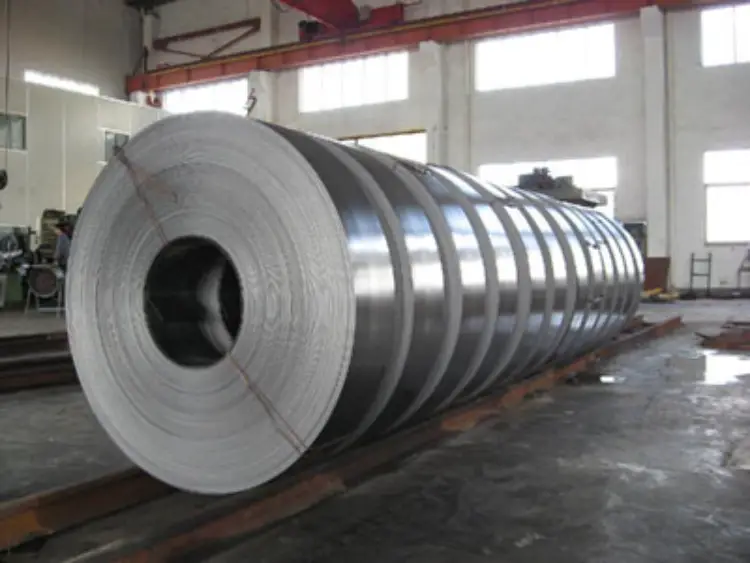
LR DH32 Shipbuilding Steel Coil
LR DH32 Shipbuilding Steel Coil: High-Strength Hull Structural Steel for Marine Applications
Detailed technical data for LR DH32 shipbuilding steel coil: chemical composition, mechanical properties, thermal and electrical properties, equivalent grades, and application guidelines, based on Lloyd's Register rules.
Hot rolling, controlled rolling (CR), thermo-mechanical controlled processing (TMCP), normalizing (N), welding, forming, machining
- Phone : +8618037372205
- Email : [email protected]
- WhatsApp: Contact via Whtsapp
- WeChat: +8618037372205
LR DH32 Shipbuilding Steel Coil Introduction
LR DH32 is a high-strength hull structural steel grade certified by Lloyd's Register, belonging to the DH32 series (D indicates impact test at -20°C). It is widely used in shipbuilding for hull plates, stiffeners, and structural members. With a minimum yield strength of 315 MPa and a tensile strength range of 440–590 MPa, it offers an excellent strength-to-weight ratio and good weldability. The steel is typically supplied in normalized (N) or thermo-mechanically controlled processed (TMCP) condition, ensuring fine grain size and uniform mechanical properties. Its specified low-temperature impact toughness ensures reliable performance in cold marine environments. Manufacturing follows IACS UR W11 requirements, with controlled chemical composition (C, Mn, Si, P, S, Al, Nb, V, Ti) to achieve the desired properties and weldability. Key features:
- Certified by Lloyd's Register for marine service
- Minimum yield strength 315 MPa
- Impact test temperature -20°C (DH grade)
- Available as coil, plate, or strip
- Suitable for welded structures
LR DH32 Shipbuilding Steel Coil Chemical Composition Requirements
The chemical composition of LR DH32 steel is defined in accordance with IACS UR W11 and Lloyd's Register rules. Controlled alloying elements such as niobium, vanadium, and titanium may be added to refine grain size and improve strength. Residual elements like copper, chromium, nickel, and molybdenum are limited to ensure weldability. The total content of grain refining elements (Nb+V+Ti) shall not exceed 0.12% when intentionally added. Nitrogen content is controlled depending on the use of grain refining additions.
| Chemical Element | Standard Value (%) | Remarks |
|---|---|---|
| Carbon (C) | max 0.18 | Crucial for weldability; low carbon level reduces hardening tendency |
| Manganese (Mn) | 0.90 - 1.60 | Contributes to strength and toughness; upper limit ensures weldability |
| Silicon (Si) | max 0.50 | Deoxidizer; higher levels may impair weldability |
| Phosphorus (P) | max 0.035 | Undesirable impurity; affects toughness and cold formability |
| Sulfur (S) | max 0.035 | Undesirable impurity; can cause hot cracking |
| Aluminum (Al) (soluble) | min 0.015 | Used for grain refinement and deoxidation; ensures fine-grain structure |
| Niobium (Nb) (optional) | max 0.05 | Grain refiner; increases strength via precipitation hardening |
| Vanadium (V) (optional) | max 0.10 | Grain refiner and precipitation strengthener |
| Titanium (Ti) (optional) | max 0.02 | Grain refiner; forms stable nitrides and carbides |
| Copper (Cu) (residual) | max 0.35 | Residual element; controlled to avoid hot shortness |
| Chromium (Cr) (residual) | max 0.20 | Residual element; influences hardenability |
| Nickel (Ni) (residual) | max 0.40 | Residual element; improves toughness but excessive amounts may increase cost |
| Molybdenum (Mo) (residual) | max 0.08 | Residual element; contributes to high-temperature strength |
| Nitrogen (N) | max 0.009 (if no Nb/V/Ti); max 0.012 (if grain refined) | Controlled to avoid strain aging; bound by Al, Nb, V, or Ti |
| Sum Nb+V+Ti | max 0.12 (when intentionally added) | Total grain refining element limit per IACS UR W11 |
LR DH32 Shipbuilding Steel Coil Thermal and Electrical Physical Properties
The physical properties of LR DH32 steel are similar to those of typical low-carbon structural steels. These values are not mandatory specification requirements but are provided as typical data from material property databases for design and engineering reference. Properties may vary slightly depending on exact composition and heat treatment condition. Density is about 7.85 g/cm³; elastic modulus ranges from 190 to 210 GPa; thermal expansion coefficient near 11.7×10⁻⁶/K for ambient to 100°C; thermal conductivity approx. 50 W/(m·K); electrical resistivity about 0.23 µΩ·m at room temperature.
| Performance Item | Typical Value | Unit | Test Condition |
|---|---|---|---|
| Density (ρ) | 7.85 | g/cm³ | At 20°C |
| Elastic Modulus (E) | 205 | GPa | Room temperature, tension |
| Shear Modulus (G) | 80 | GPa | Calculated from E and ν |
| Poisson's Ratio (ν) | 0.3 | — | Elastic region |
| Thermal Expansion Coefficient (α) | 11.7 | 10⁻⁶/K | Temperature range 20–100°C |
| Thermal Expansion Coefficient (α) | 12.5 | 10⁻⁶/K | Temperature range 20–200°C |
| Thermal Conductivity (λ) | 50 | W/(m·K) | At 20°C |
| Specific Heat Capacity (c) | 460 | J/(kg·K) | At 20°C |
| Electrical Resistivity (ρ_e) | 0.23 | µΩ·m | At 20°C |
LR DH32 Shipbuilding Steel Coil Mechanical Properties
Mechanical properties of LR DH32 steel plate/coil are specified in Lloyd's Register rules and IACS UR W11. These values apply to material in normalized or TMCP condition. The minimum yield strength is 315 MPa for thicknesses up to 100 mm. Impact tests are performed on Charpy V-notch specimens at -20°C (D-grade designation) and must meet minimum average absorbed energy values that vary with product thickness. Elongation requirements also depend on thickness. Bending tests are conducted to verify ductility and freedom from cracking. All tests are performed in accordance with LR test procedures.
| Performance Item | Specification Requirement | Unit | Test Condition |
|---|---|---|---|
| Yield Strength (ReH) | min 315 | MPa | Thickness ≤ 100 mm; transverse direction |
| Tensile Strength (Rm) | 440 – 590 | MPa | Thickness ≤ 100 mm; transverse direction |
| Elongation (A) | min 22 | % | Thickness ≤ 50 mm; gauge length 5.65√S₀ or 50 mm |
| Elongation (A) | min 21 | % | Thickness > 50 – 70 mm |
| Elongation (A) | min 20 | % | Thickness > 70 – 100 mm |
| Impact Energy (KV) (Charpy V-notch) | min 34 | J | Thickness ≤ 50 mm; test temperature -20°C; longitudinal direction, average of 3 specimens |
| Impact Energy (KV) (Charpy V-notch) | min 41 | J | Thickness > 50 – 70 mm; test temperature -20°C; longitudinal direction, average of 3 specimens |
| Impact Energy (KV) (Charpy V-notch) | min 50 | J | Thickness > 70 – 100 mm; test temperature -20°C; longitudinal direction, average of 3 specimens |
| Bend Test (180°) | No cracks; mandrel diameter = 3t | — | Thickness ≤ 25 mm; bend test in accordance with LR requirements |
| Bend Test (180°) | No cracks; mandrel diameter = 4t | — | Thickness > 25 mm |
LR DH32 Shipbuilding Steel Coil Equivalent Material Standards and Alternative Grades
| Country/Region | Standard | Grade | Remarks |
|---|---|---|---|
| International (IACS) | IACS UR W11 | DH32 | Unified Requirement for normal and higher strength hull structural steels; identical chemistry and mechanical requirements |
| United Kingdom | Lloyd's Register (LR) | DH32 | Original LR grade |
| USA | American Bureau of Shipping (ABS) | DH32 | Identical grade under ABS Rules |
| Norway | Det Norske Veritas (DNV) | NV D32 | Equivalent to DH32 under DNV Rules; same properties |
| France | Bureau Veritas (BV) | DH32 | Identical grade under BV Rules |
| China | China Classification Society (CCS) | DH32 | Equivalent grade per CCS Rules; also matches GB/T 712 DH32 |
| Japan | Nippon Kaiji Kyokai (ClassNK) | DH32 | Identical grade under ClassNK Rules |
| Italy | RINA | DH32 | Identical grade under RINA Rules |
| South Korea | Korean Register (KR) | DH32 | Identical grade under KR Rules |
| Germany | Germanischer Lloyd (GL) (now DNV GL) | DH32 | Historically identical; now integrated under DNV |
LR DH32 Shipbuilding Steel Coil Application Introduction
LR DH32 steel is primarily intended for the construction of ship hulls and offshore structures, where high strength, weldability, and low-temperature toughness are essential. It is used in a wide range of structural components that require reliable performance under static and dynamic loading in marine environments. Typical applications include:
- Ship hull plates (bottom, side, deck)
- Longitudinal and transverse stiffeners
- Frames, bulkheads, and girder webs
- Offshore platform decks and module structures
- Structural parts of marine equipment
The material is delivered in flat product form (coils/plates) and can be further processed by cutting, welding, forming, and machining to produce finished components. All fabrication should follow approved welding procedures and classification society requirements to maintain mechanical properties and corrosion resistance.
Product Applications: Ship hulls (tankers, bulk carriers, container ships, passenger vessels), Decks and superstructures, Bulkheads and deep frames, Side shells and bottom plates, Stiffeners and longs, Offshore jacket structures and decks, Caissons and flare booms
Processed into products: Cut-to-size hull plates, Welded T-beams and L-sections, Gusset plates and brackets, Face plates for built-up sections, Stool plates, Anchor and chain locker stiffeners, Bulkhead stiffeners and corrugated panel parts, Flange plates for web frames
Application industries: Shipbuilding, Offshore oil & gas engineering, Marine equipment manufacturing, Bridge construction (when approved), Structural engineering (heavy fabrication)
LR DH32 Shipbuilding Steel Coil Similar/Alternative Steels for Non-marine Use
| Country/Region | Standard | Grade | Remarks |
|---|---|---|---|
| Europe | EN 10025-2 | S355J2 | Structural steel with minimum 355 MPa yield and -20°C impact test; similar strength but not specifically certified for marine service |
| USA | ASTM A572/A572M | Grade 50 (Type 1) | High-strength low-alloy structural steel, min yield 345 MPa (50 ksi); comparable strength but lacks marine classification |
| Japan | JIS G3106 | SM490YA | Welded structural steel, min yield 365 MPa, good weldability; requires additional qualification for shipbuilding |
| China | GB/T 1591 | Q355D | Low-alloy high-strength structural steel, min yield 355 MPa, -20°C impact; can be used in general structures but not in classed vessels without certification |
Notes:
Additional considerations:
- For thicknesses over 100 mm, mechanical properties are subject to special agreement and may be reduced; refer to LR rules.
- Carbon equivalent (CEV) is normally controlled to ≤ 0.38% (typically) to ensure adequate weldability. CEV = C + Mn/6 + (Cr+Mo+V)/5 + (Ni+Cu)/15.
- Improved through-thickness properties (Z-grade) can be specified as DH32-Z25 or DH32-Z35 according to IACS UR W21 to resist lamellar tearing.
- Preheating may be required for welding thick sections, particularly at low ambient temperatures; follow LR Welding Rules.
- The steel can be supplied with certificates for all major classification societies upon request.
- Share



