
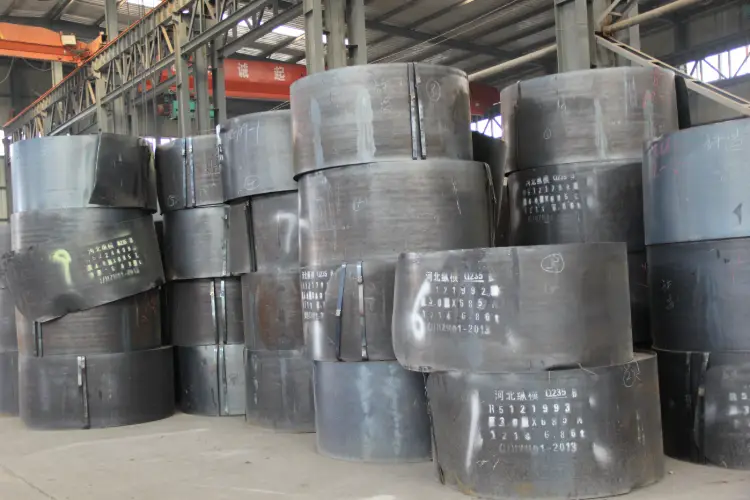
LR AH32 Shipbuilding Steel Coil
LR AH32 Shipbuilding Steel Coil: Properties, Equivalents & Applications
Comprehensive technical data for LR AH32 high-strength shipbuilding steel coil: chemical composition, mechanical & physical properties, international equivalents, and typical applications.
Flame cutting, plasma cutting, welding (all common methods), cold forming, hot forming, machining, bending, rolling
- Phone : +8618037372205
- Email : [email protected]
- WhatsApp: Contact via Whtsapp
- WeChat: +8618037372205
LR AH32 Shipbuilding Steel Coil Introduction
LR AH32 is a high-strength structural steel grade certified by Lloyd's Register (LR) for use in shipbuilding and marine construction. It is designed to provide a minimum yield strength of 315 MPa and excellent low-temperature toughness at 0°C. The steel is produced in accordance with the Lloyd's Register Rules for the Manufacture, Testing and Certification of Materials, which align with the International Association of Classification Societies (IACS) Unified Requirement W11.
Key features include good weldability, uniform mechanical properties, and resistance to brittle fracture. The chemical composition is carefully controlled with additions of microalloying elements such as niobium, vanadium, or titanium to refine the grain structure. LR AH32 steel is commonly supplied in the form of hot-rolled coils and plates in various thicknesses and is suitable for constructing ship hulls, decks, bulkheads, and structural components in marine environments. Its balanced properties make it a reliable choice for ocean-going vessels and offshore platforms, where safety and durability are paramount.
LR AH32 Shipbuilding Steel Coil Chemical Composition
The chemical composition of LR AH32 steel is governed by IACS UR W11 and the specific requirements of Lloyd's Register. The values below represent the typical ladle analysis limits. Microalloying elements (Nb, V, Ti) are used singly or in combination to achieve fine grain structure and the required strength. Residual elements are kept low to maintain weldability and toughness.
| Element | Standard Value (wt.%) | Remarks |
|---|---|---|
| Carbon (C) | ≤0.18 | Ladle analysis |
| Manganese (Mn) | 0.90 - 1.60 | Depending on thickness |
| Silicon (Si) | 0.10 - 0.50 | Typically ≤0.50 |
| Phosphorus (P) | ≤0.035 | Maximum |
| Sulfur (S) | ≤0.035 | Maximum |
| Aluminum (acid-soluble) (Als) | ≥0.015 | Minimum, grain refining |
| Niobium (Nb) | 0.02 - 0.05 | Optional, microalloy |
| Vanadium (V) | 0.05 - 0.10 | Optional, microalloy |
| Titanium (Ti) | ≤0.02 | Optional, microalloy |
| Copper (Cu) | ≤0.35 | Residual element |
| Chromium (Cr) | ≤0.20 | Residual element |
| Nickel (Ni) | ≤0.40 | Residual element |
| Molybdenum (Mo) | ≤0.08 | Residual element |
LR AH32 Shipbuilding Steel Coil Thermal and Electrical Physical Properties
The following physical properties are typical for LR AH32 at room temperature unless otherwise noted. These values are provided for design and process engineering purposes and may vary slightly with composition and heat treatment condition.
| Property | Typical Value | Unit | Condition / Temperature |
|---|---|---|---|
| Density (ρ) | 7850 | kg/m³ | 20°C |
| Modulus of elasticity (E) | 205 | GPa | Room temperature |
| Shear modulus (G) | ~79.3 | GPa | Room temperature (calculated) |
| Poisson's ratio (ν) | 0.30 | - | Room temperature |
| Coefficient of thermal expansion (α) | 12.0 | 10-6/K | 20 - 100°C |
| Coefficient of thermal expansion (α) | 12.9 | 10-6/K | 20 - 200°C |
| Coefficient of thermal expansion (α) | 13.7 | 10-6/K | 20 - 300°C |
| Thermal conductivity (λ) | ~52 | W/(m·K) | 20°C |
| Thermal conductivity (λ) | ~48 | W/(m·K) | 100°C |
| Specific heat capacity (cp) | ~460 | J/(kg·K) | 20 - 100°C |
| Electrical resistivity (ρe) | ~0.15 | μΩ·m | 20°C |
LR AH32 Shipbuilding Steel Coil Mechanical Properties
Mechanical properties for LR AH32 are determined in accordance with LR Rules and IACS UR W11. Tensile and impact tests are performed on specimens oriented transversely to the rolling direction. Values are applicable for thicknesses up to 50 mm unless otherwise noted. Bend tests confirm formability and freedom from cracking.
| Property | Specified Value | Unit | Test Condition |
|---|---|---|---|
| Yield strength (ReH) | ≥315 | MPa | Thickness t ≤ 50 mm, transverse |
| Tensile strength (Rm) | 440 - 590 | MPa | Thickness t ≤ 50 mm, transverse |
| Elongation (A) | ≥22 | % | Gauge length Lo = 200 mm (or 5.65√So), t ≤ 50 mm |
| Charpy V-notch impact energy (KV2) | ≥34 | J | Longitudinal specimen, test temperature 0°C |
| Charpy V-notch impact energy (KV2) | ≥24 | J | Transverse specimen, test temperature 0°C |
| Bend test (180°) | No cracks | - | Mandrel diameter = 2t for t ≤ 25 mm; 3t for 25 < t ≤ 40 mm |
LR AH32 Shipbuilding Steel Coil Fully Equivalent Material Standards and Substitutable Grades
| Country / Region | Standard | Grade | Remarks |
|---|---|---|---|
| International | IACS UR W11 | AH32 | Common unified requirement for all IACS class societies |
| United Kingdom | LR Rules | LR AH32 | Lloyd's Register original grade |
| United States | ASTM A131/A131M | Grade AH32 | Recognized by ABS and other societies |
| United States | ABS Rules | ABS AH32 | American Bureau of Shipping equivalent |
| Norway / Germany | DNV Rules | DNV AH32 | DNV equivalent; also accepted by Germanischer Lloyd (now DNV GL) |
| France | BV Rules | BV AH32 | Bureau Veritas equivalent |
| China | GB 712 | AH32 | Chinese national standard for shipbuilding steel, equivalent to IACS |
| China | CCS Rules | CCS AH32 | China Classification Society equivalent |
| Japan | NK Rules | NK AH32 | Nippon Kaiji Kyokai equivalent |
| South Korea | KR Rules | KR AH32 | Korean Register equivalent |
| Italy | RINA Rules | RINA AH32 | Registro Italiano Navale equivalent |
LR AH32 Shipbuilding Steel Coil Application Introduction
LR AH32 steel is widely applied in the shipbuilding and offshore industries where high strength, good weldability, and reliable toughness at 0°C are mandatory. The material is available as coils and plates and can be readily formed, cut, and welded to build large assembled structures.
Product Applications: Hull plates (shell, bottom, side, weather deck), Strength deck plating, Bulkheads (transverse and longitudinal), Web frames and stiffeners, Girders (bottom, side, deck longitudinals), Floor plates and brackets, Hatch coamings and deck openings, Offshore platform primary and secondary structural members
Processed into products: Ship scantlings (plates and profiles constituting the hull structure), Stiffeners (flat bars, angles, bulb profiles, tees), Brackets and tripping brackets, Web and flange plates for built-up sections, Deck beams and carlings, Rudder horns and stern frame components, Mooring equipment foundations, Bilge keels and rubbing strakes, Offshore module skid beams and crane pedestal supports
Application industries: Shipbuilding (commercial, naval, and specialized vessels), Offshore Oil & Gas (topside modules, jackets, flare booms), Marine Engineering (floating docks, barges, pontoons), Port & Harbor Construction (dock gates, sea walls, caissons), Renewable Energy (offshore wind turbine substructures, transition pieces)
LR AH32 Shipbuilding Steel Coil Similar / Comparable Alternative Material Recommendations
| Country / Region | Standard | Grade | Remarks |
|---|---|---|---|
| Japan | JIS G 3106 | SM490A | Minimum yield strength 325 MPa; tensile 490-610 MPa; not class-specific but often used in marine structures; requires separate approval for ship class applications. |
| Japan | JIS G 3106 | SM490B | Similar to SM490A but with guaranteed impact toughness at 0°C; mechanical properties close to AH32. |
| Europe | EN 10025-4 | S355ML | Minimum yield strength 355 MPa at t≤40 mm; TMCP delivery; higher strength than AH32; can replace AH32 with thickness reduction when permitted. |
| United States | ASTM A572 | Grade 50 [345] | Yield strength 345 MPa; general structural steel; not class-approved; may be used for non-class marine or structural applications with engineering review. |
Notes:
Through-thickness (Z-direction) properties: When specified, LR AH32 can be produced with enhanced through-thickness ductility in accordance with LR rules (e.g., Z25, Z35) to resist lamellar tearing in welded joints. Impact testing temperature: The "A" in AH32 indicates impact testing at 0°C. For lower temperature requirements, grades DH32 (−20°C) and EH32 (−40°C) should be considered. Certification: All deliveries must be accompanied by a Lloyd's Register inspection certificate (3.1 or 3.2 type) confirming compliance with the specifications. Welding consumables: Matching or undermatching weld metals should be selected according to LR welding requirements; post-weld heat treatment is typically not required for thicknesses below 40 mm.
- Share



