
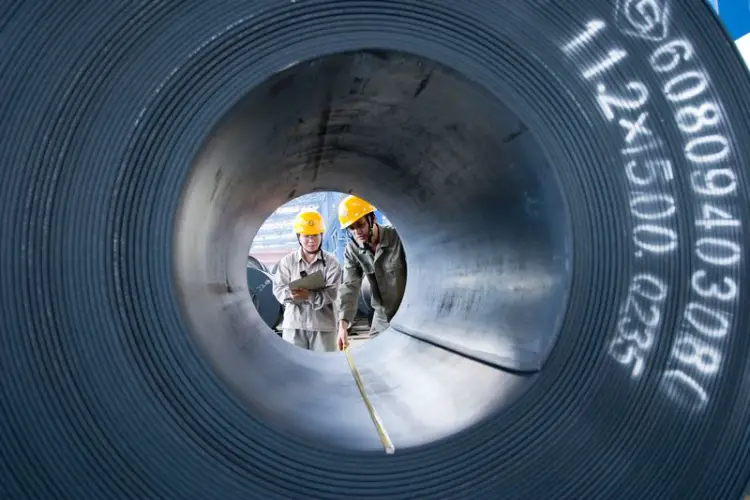
ASTM A312 TP317 Stainless Steel Pipe
ASTM A312 TP317 Stainless Steel Pipe: Full Data, Equivalents & Applications
Complete analysis of ASTM A312 TP317 stainless steel pipe including chemical composition, mechanical and physical properties, international equivalents, and industrial applications.
Hot rolling, cold drawing, welding, machining, solution annealing
- Phone : +8618037372205
- Email : [email protected]
- WhatsApp: Contact via Whtsapp
- WeChat: +8618037372205
ASTM A312 TP317 Stainless Steel Pipe Introduction
ASTM A312 TP317 is an austenitic stainless steel grade designed for seamless and welded pipes intended for high-temperature and general corrosive service. It belongs to the 317 family (UNS S31700), featuring a higher molybdenum content (3.0–4.0%) compared to 316, which significantly enhances resistance to pitting and crevice corrosion in chloride-containing environments. The alloy exhibits excellent resistance to sulfuric, phosphoric, and acetic acids, making it suitable for chemical processing equipment.
- Superior corrosion resistance, especially in acidic and halide media.
- Good high-temperature mechanical strength up to approximately 800°C (1472°F).
- Excellent weldability and formability in the annealed condition.
- Non-magnetic in the annealed state, slightly magnetic after cold working.
ASTM A312 TP317 Stainless Steel Pipe Chemical Composition per ASTM A312
The chemical requirements for TP317 are specified in ASTM A312. The alloy is a chromium-nickel-molybdenum austenitic stainless steel with restricted carbon for enhanced corrosion resistance. All values are in weight percent.
- Single values indicate maximum unless a range is given.
- The balance is iron (Fe).
| Element | Standard Value (wt%) | Remarks |
|---|---|---|
| Carbon (C) | ≤ 0.08 | |
| Manganese (Mn) | ≤ 2.00 | |
| Silicon (Si) | ≤ 1.00 | |
| Phosphorus (P) | ≤ 0.045 | |
| Sulfur (S) | ≤ 0.030 | |
| Chromium (Cr) | 18.0 – 20.0 | Key for corrosion resistance |
| Nickel (Ni) | 11.0 – 15.0 | Stabilizes austenite |
| Molybdenum (Mo) | 3.0 – 4.0 | Enhances pitting resistance |
ASTM A312 TP317 Stainless Steel Pipe Thermal and Electrical Physical Properties
Physical properties listed below are typical values for UNS S31700 in the annealed condition. These are not specification limits but serve as design references. Data collected from published technical datasheets.
- Properties may vary slightly with product form and exact heat treatment.
- Thermal expansion and conductivity are temperature-dependent.
| Property | Typical Value | Unit | Test Condition |
|---|---|---|---|
| Density (ρ) | 8.0 | g/cm³ | 20°C |
| Elastic Modulus (E) | 193 | GPa | 20°C |
| Shear Modulus (G) | 77 | GPa | 20°C |
| Poisson's Ratio (ν) | 0.27 – 0.30 | – | 20°C |
| Coefficient of Thermal Expansion (α) | 15.9 | µm/m·°C | 0 – 100°C |
| Coefficient of Thermal Expansion (α) | 16.2 | µm/m·°C | 0 – 315°C |
| Coefficient of Thermal Expansion (α) | 17.0 | µm/m·°C | 0 – 538°C |
| Thermal Conductivity (λ) | 14.6 | W/m·K | 20°C |
| Thermal Conductivity (λ) | 16.0 | W/m·K | 100°C |
| Thermal Conductivity (λ) | 20.9 | W/m·K | 500°C |
| Specific Heat Capacity | 500 | J/kg·K | 0 – 100°C |
| Electrical Resistivity (ρ_e) | 0.74 | µΩ·m | 20°C |
ASTM A312 TP317 Stainless Steel Pipe Mechanical Properties
The following mechanical properties are required for TP317 pipe in the solution-annealed condition as per ASTM A312. Testing is conducted at room temperature on longitudinal specimens. No impact or bending test is mandated by this standard.
- The yield strength is the 0.2% offset yield (ReH).
- Elongation is measured in a 2-inch (50 mm) gauge length.
| Property | Standard Requirement | Unit | Test Condition |
|---|---|---|---|
| Tensile Strength (Rm) | ≥ 515 (75 ksi) | MPa | Room temperature |
| Yield Strength (ReH) | ≥ 205 (30 ksi) | MPa | Room temperature |
| Elongation (A) | ≥ 35 | % | In 2 in. (50 mm) |
ASTM A312 TP317 Stainless Steel Pipe Complete Equivalent Material Standards and Substitute Grades
No worldwide standard carries a chemically identical grade to ASTM A312 TP317 across all national specifications. The table below lists the closest international designations by specification. Minor differences in molybdenum and nickel ranges exist; users must verify suitability for critical applications.
| Country/Region | Standard | Grade | Remarks |
|---|---|---|---|
| USA | ASTM A312/A312M | TP317 (UNS S31700) | Reference standard |
| Japan | JIS G3459 | SUS317TP | Closest equivalent; identical nominal composition |
| China | GB/T 14976, GB/T 12771 | 06Cr19Ni13Mo3 (S31708) | New Chinese designation; similar but Mo 3.0–3.5%, Ni 11.0–15.0% |
| Germany (EN) | EN 10088-2 / EN 10216-5 | 1.4449 (X5CrNiMo17-13-3) | Similar; Cr 16.5–18.5%, Ni 12.5–14.5%, Mo 2.5–3.5% – lower Mo |
| UK (obsolete) | BS 3605 / BS 3606 | 317S16 | Withdrawn; composition aligned with UNS S31700 |
| Russia | GOST 9941 | 08Х17Н15М3Т (08Kh17N15M3T) | Rough equivalent; Ti stabilized |
ASTM A312 TP317 Stainless Steel Pipe Application Introduction
ASTM A312 TP317 is predominantly used in industries requiring superior resistance to acidic and chloride pitting environments. Its high molybdenum content makes it the material of choice for handling sulfuric, phosphoric and acetic acids, as well as flue gases containing sulfur. It can be fabricated into a wide range of components through welding, bending, and machining.
Product Applications: Process piping and heat exchanger tubes, Condensers and evaporators in acid plants, Reaction vessels and storage tanks (clad or solid), Spray bars and absorption towers for FGD, Pulp digester and bleach plant piping, Sanitary tubing and fittings for food/pharma
Processed into products: Welded and seamless pipe spools, Tube sheets for shell-and-tube exchangers, Flanges, elbows, tees, reducers (A403 WP317), Valve bodies and pump casings, Instrument tubing and thermowells, Expansion joints and bellows
Application industries: Chemical and Petrochemical Processing, Pulp and Paper Production, Flue Gas Desulfurization (FGD) Systems, Marine and Offshore Engineering, Pharmaceutical and Food Processing, Textile and Dyeing Equipment, Nuclear and Power Generation (moderate temperatures)
ASTM A312 TP317 Stainless Steel Pipe Similar / Alternative Materials Recommendation
If TP317 is not available, a lower-carbon version (317L) or other grades with similar corrosion resistance can be considered. The selection depends on required weldability, strength, and corrosion service environment.
| Country/Region | Standard | Grade | Remarks |
|---|---|---|---|
| USA | ASTM A312 | TP317L (UNS S31703) | Low carbon version (<0.03% C); eliminates sensitization risk; mechanical properties similar, slightly lower strength. Preferred for welded structures. |
| USA | ASTM A312 | TP316 (UNS S31600) | Lower molybdenum (2.0–3.0%); reduced pitting resistance; less expensive; widely used in less aggressive environments. |
| USA | ASTM A312 | TP316L (UNS S31603) | Low carbon version of 316; good general corrosion resistance; not equivalent in chloride-acid service. |
| Germany (EN) | EN 10088-2 | 1.4438 (X2CrNiMo18-15-4) | Low-carbon austenitic grade with Mo 3.0–4.0%; equivalent to 317L; direct replacement for TP317 where welding is required. |
| Germany (EN) | EN 10088-2 | 1.4539 (X1NiCrMoCuN25-20-7) | Superaustenitic alloy; much higher corrosion resistance than 317; for severe acid/chloride services. |
Notes:
Additional requirements per ASTM A312:
- All pipe must pass hydrostatic or nondestructive electric test as per the standard.
- For welded pipe, the weld zone may require solution annealing or be delivered as-welded; supplementary requirements S1 through S9 apply.
- Cold working increases strength but may induce slight magnetism.
- Not recommended for continuous service above the scaling temperature (approx. 870°C in air).
- When full corrosion resistance is needed after welding, post-weld solution treatment is advised unless low carbon (317L) filler is used.
- Share



