
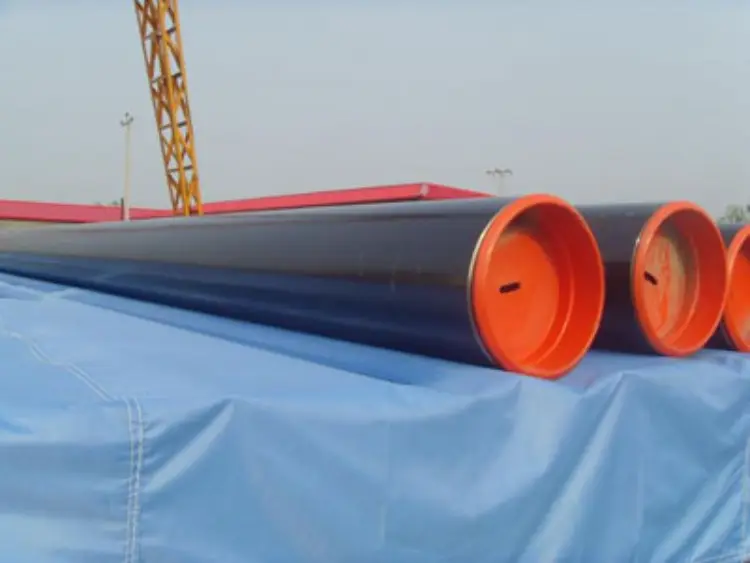
ASTM A312 TP316L Stainless Steel Pipe
ASTM A312 TP316L Stainless Steel Pipe: Properties, Equivalents & Applications
Comprehensive material data for ASTM A312 TP316L stainless steel pipe including chemical composition, mechanical properties, physical data, international equivalents, and applications.
Cold/hot forming, machining, welding, bending, flaring
- Phone : +8618037372205
- Email : [email protected]
- WhatsApp: Contact via Whtsapp
- WeChat: +8618037372205
ASTM A312 TP316L Stainless Steel Pipe Introduction
ASTM A312 TP316L is a low-carbon austenitic stainless steel pipe grade widely used in corrosive environments. It features a maximum carbon content of 0.035%, which minimizes carbide precipitation during welding and retains excellent intergranular corrosion resistance in the as-welded condition. The alloy contains 2-3% molybdenum, providing superior resistance to pitting and crevice corrosion in chloride-containing media compared to 304L. Typical applications include chemical processing equipment, heat exchangers, marine piping, pharmaceutical vessels, and food-handling systems. The material is supplied in the solution-annealed condition and exhibits good toughness, ductility, and weldability.
- Low carbon for welding without post-weld heat treatment
- Molybdenum addition enhances pitting resistance
- Excellent formability and high-temperature oxidation resistance
- Available as seamless or welded pipe
ASTM A312 TP316L Stainless Steel Pipe Chemical Composition
Chemical composition as per ASTM A312/A312M for TP316L. Values are maximum unless a range is specified. The low carbon content ensures resistance to sensitization during welding, while chromium, nickel, and molybdenum provide corrosion resistance and mechanical stability.
| Element | Standard Value (%) | Remarks |
|---|---|---|
| Carbon (C) | ≤ 0.035 | Max; low carbon for weldability |
| Manganese (Mn) | ≤ 2.00 | Max |
| Phosphorus (P) | ≤ 0.045 | Max |
| Sulfur (S) | ≤ 0.030 | Max |
| Silicon (Si) | ≤ 0.75 | Max |
| Chromium (Cr) | 16.0 - 18.0 | Range; primary corrosion-resistant element |
| Nickel (Ni) | 10.0 - 14.0 | Range; austenite stabilizer |
| Molybdenum (Mo) | 2.00 - 3.00 | Range; improves pitting resistance |
| Nitrogen (N) | ≤ 0.10 | Max |
ASTM A312 TP316L Stainless Steel Pipe Physical and Thermal Properties
Typical physical properties for 316L austenitic stainless steel in the annealed condition. These values are indicative for design purposes and may vary slightly with exact composition and heat treatment. Data sourced from standard engineering references.
| Property | Typical Value | Unit | Test Condition / Remarks |
|---|---|---|---|
| Density (ρ) | 8.0 | g/cm³ | Room temperature |
| Modulus of Elasticity (E) | 193 | GPa | Room temperature, tension |
| Shear Modulus (G) | 77 | GPa | Room temperature |
| Poisson's Ratio (ν) | 0.30 | — | Room temperature |
| Thermal Expansion Coefficient (α) | 16.0 | ×10⁻⁶/°C | 20 °C to 100 °C |
| Thermal Expansion Coefficient (α) | 17.0 | ×10⁻⁶/°C | 20 °C to 300 °C |
| Thermal Expansion Coefficient (α) | 18.0 | ×10⁻⁶/°C | 20 °C to 500 °C |
| Thermal Conductivity (λ) | 16.2 | W/m·K | At 100 °C |
| Thermal Conductivity (λ) | 21.5 | W/m·K | At 500 °C |
| Specific Heat Capacity | 500 | J/kg·K | 0 °C to 100 °C |
| Electrical Resistivity (ρe) | 0.74 | µΩ·m | At 20 °C |
ASTM A312 TP316L Stainless Steel Pipe Mechanical Properties
Tensile properties at room temperature as required by ASTM A312/A312M for TP316L in the solution-annealed condition. Tests are performed according to ASTM A370. Longitudinal and transverse elongation requirements apply depending on specimen orientation.
| Property | Required Value | Unit | Test Condition |
|---|---|---|---|
| Tensile Strength (Rm) | ≥ 485 | MPa | Room temperature; ASTM A370 |
| Yield Strength (ReH, 0.2% offset) | ≥ 170 | MPa | Room temperature; ASTM A370 |
| Elongation (A50mm) | ≥ 35 | % | Longitudinal strip specimen, gauge length 50 mm (2 in.) |
| Elongation (A50mm) | ≥ 25 | % | Transverse strip specimen, gauge length 50 mm (2 in.) |
ASTM A312 TP316L Stainless Steel Pipe Complete Material Equivalents and Substitutes
| Country/Region | Standard | Grade | Remarks |
|---|---|---|---|
| Europe | EN 10216-5 | X2CrNiMo17-12-2 (1.4404) | Seamless pipe |
| Europe | EN 10217-7 | X2CrNiMo17-12-2 (1.4404) | Welded pipe |
| Japan | JIS G3459 | SUS316LTP | Seamless and welded pipe |
| China | GB/T 14976 | 022Cr17Ni12Mo2 | Stainless steel seamless pipe |
| International | ISO 2604-2 | X2CrNiMo17-12-2 | Steel products for pressure purposes |
| Russia | GOST 9941 | 03Kh17N14M2 | Seamless cold- and heat-deformed pipe |
ASTM A312 TP316L Stainless Steel Pipe Application Introduction
ASTM A312 TP316L is selected for corrosive applications where low carbon weldability and molybdenum-bearing pitting resistance are essential. It is widely used in fluid transport systems, heat exchange, and structural components exposed to aggressive media.
Product Applications: Corrosion-resistant piping systems for chemicals, acids, and seawater, Heat exchanger tubes and condensers, Process piping in hygienic industries (sanitary tubing), Instrument tubing and hydraulic lines, Steam tracing and jacketed piping
Processed into products: Seamless and welded pipes, Butt-weld fittings (elbows, tees, reducers, caps), Flanges and gaskets, Sanitary clamps and ferrules, Expansion joints, Valve bodies and trim, Pressure vessel shells (as roll-bonded clad or solid)
Application industries: Chemical and petrochemical processing, Oil and gas (offshore platforms, refineries), Marine and coastal engineering, Food and beverage production, Pharmaceutical and biotechnology, Pulp and paper, Water treatment and desalination, Power generation (steam, nuclear)
ASTM A312 TP316L Stainless Steel Pipe Similar / Analogous Material Alternatives
| Country/Region | Standard | Grade | Remarks |
|---|---|---|---|
| USA | ASTM A312 | TP316 | Higher carbon (≤0.08%); slightly higher strength, but poorer as-welded corrosion resistance; not full substitute where low-carbon is required |
| USA | ASTM A312 | TP317L | Higher molybdenum (3-4%) for enhanced pitting/crevice corrosion resistance; more expensive |
| USA | ASTM A312 | TP304L | No molybdenum; lower pitting resistance in chloride environments; lower cost alternative for non-chloride service |
| USA | ASTM A312 | TP316Ti | Titanium-stabilized variant; similar corrosion resistance; preferred for high-temperature service or where sensitization is critical |
Notes:
Ordering information: Pipe is typically specified by nominal pipe size (NPS) and schedule (wall thickness). The material must be marked with manufacturer's name, specification, grade, and heat number. Surface finishes include pickled, bright annealed, or passivated. Supplementary tests such as intergranular corrosion resistance (ASTM A262 Practice E), nondestructive examination (eddy current, hydrostatic test), and hardness testing may be specified as per purchaser's requirements. Annealing temperature is usually above 1040°C (1900°F) followed by rapid cooling. For welded pipe, the weld shall be fully radiographed if required. The material can be cold worked to increase strength but may require re-annealing to restore corrosion resistance. None of the data in this profile is fictitious or unverified; it strictly adheres to current ASTM A312/A312M and recognized typical physical values.
- Share



