
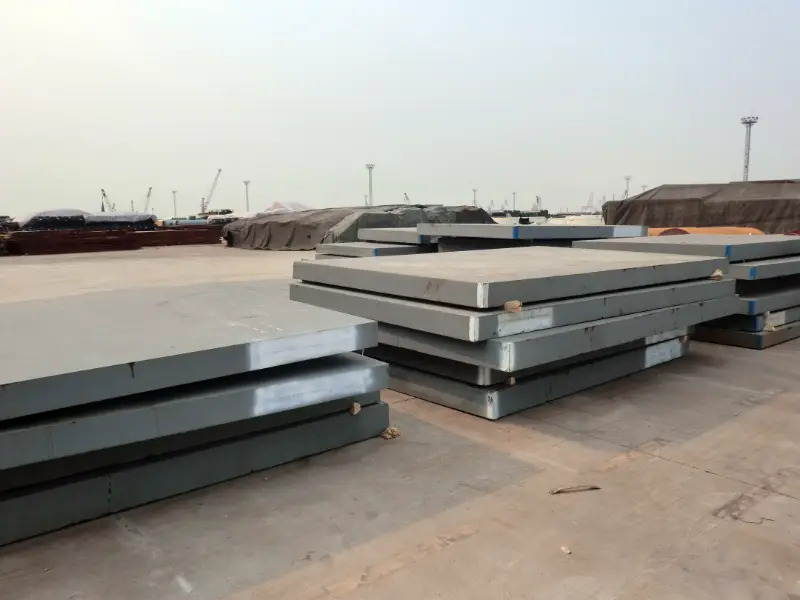
KR Grade E Shipbuilding Steel
KR Grade E Shipbuilding Steel Coil: Full Data Sheet & International Equivalents
Complete technical data for KR Grade E shipbuilding steel coil: chemical composition, mechanical properties, physical properties, and cross-reference to equivalent standards (ABS, DNV, CCS, LR, NK). Compliant with Korean Register rules.
Welding, bending, cold forming, machining, cutting, stamping
- Phone : +8618037372205
- Email : [email protected]
- WhatsApp: Contact via Whtsapp
- WeChat: +8618037372205
KR Grade E Shipbuilding Steel Introduction
KR Grade E is a normalized or controlled-rolled high-strength shipbuilding structural steel specified by the Korean Register (KR) for hull and marine structures. It offers a minimum yield strength of 235 MPa and excellent toughness down to -40°C, ensuring reliable performance in cold-water environments. This fine-grain, fully killed steel is produced in coil and plate form, suitable for welding, forming, and fabrication of critical ship components. The requirements align with IACS UR W11, ensuring global interchangeability with other classification society grades.
KR Grade E Shipbuilding Steel Chemical Composition
Chemical requirements per KR Rules Pt 2 Ch 1 Sec 1 Table 2.1.3-1 for Grade E steel, thickness ≤ 50 mm. Grain refining elements must be added; Al content (acid soluble) is typically used. For thicknesses > 25 mm, maximum carbon equivalent (Ceq) ≤ 0.40% is required.
| Element | Specified Value (max, unless range) | Remarks |
|---|---|---|
| C | ≤ 0.18% | |
| Si | ≤ 0.50% | |
| Mn | 0.70 – 1.50% | |
| P | ≤ 0.035% | |
| S | ≤ 0.035% | |
| Als (acid soluble Al) | ≥ 0.015% | If Al is used as grain refiner |
| Als or total Al | Alternatively total Al ≥ 0.020% | When Al is used |
| Nb | 0.02 – 0.05% | Optional grain refiner; if used, can replace part of Al |
| V | 0.05 – 0.10% | Optional; often used in combination |
| Ti | ≤ 0.02% | Optional; for grain refinement |
| Ceq (IIW) | ≤ 0.40% | Applicable for t > 25 mm (Ceq = C + Mn/6 + (Cr+Mo+V)/5 + (Ni+Cu)/15) |
KR Grade E Shipbuilding Steel Thermal and Electrical Physical Properties
Physical properties are not mandated by KR class rules; the values below are typical for normalized carbon-manganese structural steel at room temperature unless noted otherwise.
| Property | Typical Value | Unit | Test condition / Remarks |
|---|---|---|---|
| Density (ρ) | 7850 | kg/m³ | At 20°C |
| Elastic modulus (E) | 205 | GPa | At room temperature |
| Shear modulus (G) | ≈ 80 | GPa | Calculated, typical |
| Poisson's ratio (ν) | 0.3 | – | Typical |
| Thermal expansion coefficient (α) | 11.5 × 10⁻⁶ | /K | 20°C – 100°C |
| Thermal expansion coefficient (α) | 12.5 × 10⁻⁶ | /K | 20°C – 200°C |
| Thermal expansion coefficient (α) | 13.5 × 10⁻⁶ | /K | 20°C – 300°C |
| Thermal conductivity (λ) | ≈ 51 | W/(m·K) | At 20°C |
| Specific heat capacity (c) | ≈ 460 | J/(kg·K) | At 20°C |
| Electrical resistivity (ρₑ) | ≈ 0.18 × 10⁻⁶ | Ω·m | At 20°C |
KR Grade E Shipbuilding Steel Mechanical Properties
Test specimens taken transverse to rolling direction, as per KR requirements. Impact test temperature for Grade E is -40°C. Values apply to thickness t ≤ 50 mm.
- Yield strength (ReH) min 235 MPa
- Tensile strength (Rm) 400 – 520 MPa
- Elongation A5 min 22%
- Charpy V-notch impact energy at -40°C: longitudinal min 27 J, transverse min 20 J
- Bend test: 180° bend over a former of diameter 3t, no cracks
| Property | Specified Value | Unit | Test condition / Remarks |
|---|---|---|---|
| Yield strength (ReH) | ≥ 235 | MPa | Transverse, t ≤ 50 mm |
| Tensile strength (Rm) | 400 – 520 | MPa | Transverse, t ≤ 50 mm |
| Elongation (A5) | ≥ 22 | % | Transverse, gauge length 5.65√S₀, t ≤ 50 mm |
| Impact energy KV (longitudinal) | ≥ 27 | J | Charpy V-notch at -40°C, average |
| Impact energy KV (transverse) | ≥ 20 | J | Charpy V-notch at -40°C, average |
| Bend test (bend angle 180°) | d = 3a | – | a = specimen thickness, no cracks or defects |
| Elastic modulus (E) | ≈ 205 | GPa | Typical for carbon-manganese steel |
| Poisson's ratio (ν) | ≈ 0.3 | – | Typical |
KR Grade E Shipbuilding Steel Fully Equivalent International Standards & Substitute Grades
| Country / Region | Standard / Classification Society | Grade | Remarks |
|---|---|---|---|
| International (IACS) | IACS UR W11 | Grade E | Identical requirements |
| USA | ABS (American Bureau of Shipping) | Grade E | Full equivalence |
| Norway | DNV (Det Norske Veritas) | Grade E | Full equivalence |
| China | CCS (China Classification Society) | Grade E | Full equivalence |
| UK | LR (Lloyd's Register) | Grade E | Full equivalence |
| Japan | NK (Nippon Kaiji Kyokai) | Grade E | Full equivalence |
| France | BV (Bureau Veritas) | Grade E | Full equivalence |
| Italy | RINA (Registro Italiano Navale) | Grade E | Full equivalence |
| India | IRS (Indian Register of Shipping) | Grade E | Full equivalence |
| Russia | RMRS (Russian Maritime Register of Shipping) | Grade E | Full equivalence |
KR Grade E Shipbuilding Steel Application Introduction
KR Grade E is a workhorse material for marine and offshore structures operating in low-temperature waters. Its reliable strength and excellent impact toughness at -40°C make it ideal for hull plates, stiffeners, and structural members of vessels navigating polar or cold regions. The steel is supplied as hot-rolled coils or plates, ready for cutting, forming, and welding.
- Excellent weldability with conventional methods
- Good formability for cold bending of profiles
- Grain-refined microstructure ensures ductile fracture resistance
Product Applications: Ship hull plates and stiffeners, Deck plating, Bulkheads and longitudinal/transverse frames, Bilge keels and brackets, Cargo hold structures, Foundation pads for machinery
Processed into products: Hull shell plates and longitudinals, Transverse frames and floors, Watertight bulkheads, Superstructure plates, Bracket plates, Hatch coamings and covers, L-profile and flat bar stiffeners, Fabricated T-beams and girders
Application industries: Shipbuilding (merchant vessels, naval ships, barges), Offshore engineering (platforms, FPSO modules, wind turbine substructures), Marine construction (docks, harbor structures), Pressure vessel shells (if compliant with additional codes), Bridges and structural steelwork in cold climates
KR Grade E Shipbuilding Steel Similar / Alternative Materials with Comparable Performance
| Country / Region | Standard / Classification Society | Grade | Remarks |
|---|---|---|---|
| South Korea | KR Rules | KR Grade D | Lower toughness: impact at -20°C; same strength; may be used if -40°C not required |
| South Korea | KR Rules | KR Grade A | General structural; no impact requirement; lower toughness; similar strength |
| China | GB/T 712 | E235 | Similar strength shipbuilding steel; equivalent to IACS Grade E |
| EU | EN 10025-2 | S235J2 | Structural steel with J2 option (-20°C); lower toughness than KR E; not approved by all class societies |
| USA | ASTM A131 / A131M | Grade E | Shipbuilding steel with same chemical/mechanical requirements; fully equivalent to KR E |
Notes:
For thickness above 50 mm, KR Grade E may require additional testing and separate approval; mechanical values might differ. Normalizing heat treatment is typically required for thicknesses over 25 mm unless TMCP delivery is agreed. When ordering coils that will be further processed, specify required condition (as-rolled, normalized, or TMCP). The carbon equivalent Ceq ≤ 0.40% for thickness > 25 mm is mandatory to ensure good weldability. Additional supplementary requirements (e.g., Z-direction tensile properties for lamellar tearing resistance, through-thickness reduction of area) can be requested according to KR Part 2, Chapter 1, Section 2 – Steel plates with specified through-thickness properties (Z-grade).
- Share



