
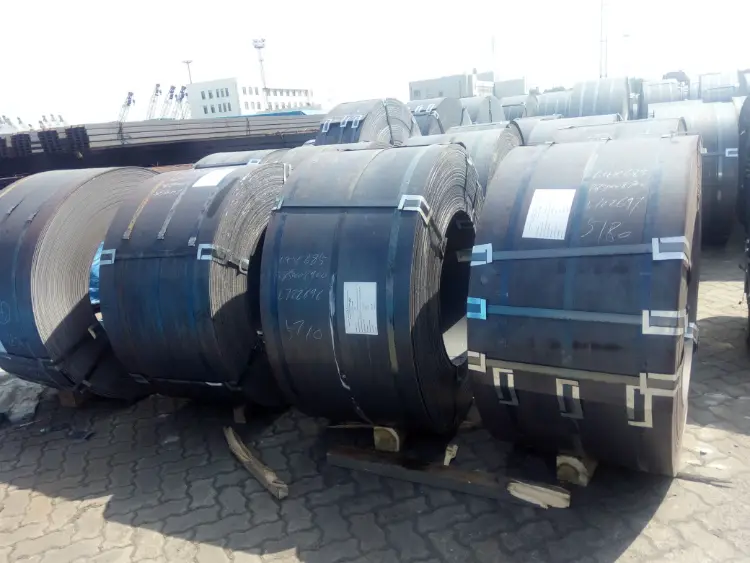
KR A32 Shipbuilding Steel Coil
KR A32 Shipbuilding Steel Coil - High Strength Hull Structural Steel with Excellent Toughness
Comprehensive technical data for KR A32 shipbuilding steel coil, including chemical composition, mechanical and physical properties, equivalent grades, and application guidelines for marine and offshore engineering.
Hot rolling, cold forming, welding, cutting, bending, edge preparation
- Phone : +8618037372205
- Email : [email protected]
- WhatsApp: Contact via Whtsapp
- WeChat: +8618037372205
KR A32 Shipbuilding Steel Coil Introduction
KR A32 is a high-strength hull structural steel coil certified by the Korean Register of Shipping (KR). It conforms to KR Rules for the Classification of Steel Ships and complies with IACS UR W11 requirements. With a minimum yield strength of 315 MPa, it offers good weldability, superior toughness, and excellent resistance to brittle fracture in marine environments. The steel is typically supplied in the normalized or thermo-mechanically rolled condition, ensuring uniform mechanical properties across a wide range of thicknesses. Its balanced chemical composition, including micro-alloying elements, provides enhanced strength without compromising ductility or crack arrest capability. A32 steel is widely used in the construction of ship hulls, decks, bulkheads, and offshore structures, where high strength and impact toughness at 0 °C are critical.
KR A32 Shipbuilding Steel Coil Chemical Composition
The chemical composition of KR A32 shipbuilding steel is carefully balanced to achieve high strength and good low-temperature toughness. Carbon content is limited to ensure weldability, while manganese and micro-alloying elements (Nb, V, Ti) provide grain refinement and precipitation strengthening. Phosphorus and sulfur are kept low to prevent brittleness and hot shortness. The carbon equivalent (CEV) must not exceed 0.38% to guarantee cold cracking resistance during welding.
| Element | Standard Value (wt.%) | Remarks |
|---|---|---|
| C | ≤ 0.18 | Heat analysis |
| Si | ≤ 0.50 | Killed steel |
| Mn | 0.90 – 1.60 | If Al is used for grain refinement |
| P | ≤ 0.035 | |
| S | ≤ 0.035 | |
| Als (Acid sol. Al) | ≥ 0.015 (if added) | For fine grain practice |
| Nb | 0.02 – 0.05 | Optional micro-alloy |
| V | 0.05 – 0.10 | Optional micro-alloy |
| Ti | 0.007 – 0.05 | Optional micro-alloy |
| Cu | ≤ 0.35 | May be present |
| Cr | ≤ 0.20 | |
| Ni | ≤ 0.40 | |
| Mo | ≤ 0.08 | |
| N | ≤ 0.012 | If not using Ti/Al |
| CEV (max) | ≤ 0.38 | CEV = C + Mn/6 + (Cr+Mo+V)/5 + (Ni+Cu)/15 |
KR A32 Shipbuilding Steel Coil Thermal and Electrical Physical Properties
The physical properties are representative for low‑carbon micro‑alloyed steel of the KR A32 type. Thermal expansion and conductivity influence heat treatment and welding procedures. The modulus of elasticity and Poisson's ratio are essential for structural deflection and stress analyses.
| Property | Typical Value | Unit | Test Condition |
|---|---|---|---|
| Density (ρ) | 7.85 | g/cm³ | At 20 °C |
| Modulus of Elasticity (E) | 210 | GPa | At room temperature |
| Shear Modulus (G) | ≈ 80.8 | GPa | At room temperature |
| Poisson's Ratio (ν) | 0.3 | - | Elastic range |
| Thermal Expansion Coefficient (α) | 12.0 | 10⁻⁶/K | 20 – 100 °C |
| Thermal Expansion Coefficient (α) | 13.5 | 10⁻⁶/K | 20 – 300 °C |
| Thermal Conductivity (λ) | ≈ 50 | W/(m·K) | At 20 °C |
| Specific Heat Capacity (c) | ≈ 480 | J/(kg·K) | At 20 °C |
| Electrical Resistivity (ρₑ) | ≈ 0.20 | 10⁻⁶ Ω·m | At 20 °C |
KR A32 Shipbuilding Steel Coil Mechanical Properties
The mechanical properties of KR A32 steel are evaluated through tensile and impact tests on specimens taken transverse to the rolling direction. Yield and tensile strengths depend on thickness; values below are for thicknesses ≤ 100 mm. Impact toughness is verified at 0 °C. Bend test guarantees formability without cracking. These values comply with IACS UR W11 and KR Rules.
| Property | Standard Requirement | Unit | Test Condition |
|---|---|---|---|
| Yield Strength (ReH) | ≥ 315 | MPa | Thickness ≤ 100 mm |
| Tensile Strength (Rm) | 440 – 570 | MPa | Thickness ≤ 100 mm |
| Elongation (A5) | ≥ 22 | % | Gauge length 5.65√So, transverse specimen |
| Elongation (A5) | ≥ 21 | % | Thickness > 40 mm, transverse |
| Impact Energy (KV, -20°C) | ≥ 27 (avg) / 20 (single) | J | Longitudinal, thickness ≤ 50 mm; not required for A32, typical value given for D32 equivalent |
| Impact Energy (KV, 0°C) | ≥ 34 (avg) / 24 (single) | J | Transverse, thickness ≤ 50 mm |
| Impact Energy (KV, 0°C) | ≥ 41 (avg) / 27 (single) | J | Longitudinal, thickness ≤ 50 mm |
| Bend Test | No cracks or fissures | Bend angle 180°, former dia. = 3 × thickness (t ≤ 25 mm) | |
| Bend Test | No cracks or fissures | Bend angle 180°, former dia. = 4 × thickness (t > 25 mm) |
KR A32 Shipbuilding Steel Coil Fully Equivalent Material Standards and Replaceable Grades
| Country / Region | Standard / Classification Society | Grade | Remarks |
|---|---|---|---|
| International | IACS UR W11 | AH32 | Identical mechanical and chemical requirements |
| USA | ABS (American Bureau of Shipping) | AH32 | Fully interchangeable |
| Norway / Germany | DNV (Det Norske Veritas) | AH32 | Grade designation NV A32 before DNV‑GL merger |
| UK | LR (Lloyd's Register) | AH32 | LR Grade AH32 |
| France | BV (Bureau Veritas) | AH32 | |
| China | CCS (China Classification Society) | A32 | Equivalent to CCS A32 |
| Japan | NK (Nippon Kaiji Kyokai) | AH32 | |
| Italy | RINA (Registro Italiano Navale) | AH32 | |
| Europe | EN 10225:2009 | S315G1+M / S315G1+N | S315G1 is the closest EN grade, M=TMCP, N=normalized |
KR A32 Shipbuilding Steel Coil Application Introduction
KR A32 shipbuilding steel coil is primarily used in marine and offshore environments where high strength and good low‑temperature toughness (0 °C impact) are mandatory. It is suitable for structural components that undergo cold forming, welding, and exposure to corrosive saltwater. The coil format allows efficient cutting and forming in shipyards with automated processing lines.
Product Applications: Ship hull plates and coils for forming longitudinal stiffeners and shell plating, Deck plates and double‑bottom structures, Bulkheads and watertight subdivision plates, Transverse frames, floors, and girders, Offshore module structural members (deck beams, columns, braces), Wind turbine monopile foundations and transition piece shells
Processed into products: Longitudinal stiffeners (flat bars, T‑bars, L‑profiles cut from coil), Corrugated bulkheads and corrugated web frames, Keelsons and stringer plates (when bent from coil), Deck beams and hatch coamings (requiring thickness up to 50 mm), Frames for bulbous bows and stern transoms, Offshore living quarter steel panels
Application industries: Commercial shipbuilding (container ships, bulk carriers, tankers, ferries), Naval and defense ship construction, Offshore oil and gas platforms (jack‑up rigs, fixed platforms, FPSO topsides), Renewable energy (offshore wind turbine foundations, transition pieces, substation structures), Harbor and coastal engineering (quay walls, lock gates, breakwaters), Heavy lifting and crane barges
KR A32 Shipbuilding Steel Coil Similar / Comparable Replacement Materials
| Country / Region | Standard / Classification Society | Grade | Remarks |
|---|---|---|---|
| International | IACS UR W11 | DH32 / EH32 | Higher toughness (lower test temperature), same strength level |
| International | IACS UR W11 | AH36 / DH36 | Higher yield strength (≥355 MPa), suitable for heavier loads |
| Europe | EN 10025‑6 | S355J2+N / S355K2+N | Structural steel with similar strength but not specifically for marine use; check toughness |
| China | GB 712‑2011 | A32 / D32 | Chinese national standard for shipbuilding steel, fully analogous to A32 but with domestic certification |
| Russia | GOST 5521‑93 | A32 | Russian equivalent for hull steel with same designation |
| USA | ASTM A131 / A131M | EH32 | EH32 is a notch‑tough grade (impact at -40°C); can replace A32 if better toughness needed |
Notes:
Delivery condition: Coils are typically supplied in the thermo-mechanically rolled (M / TMCP) or normalized (N) condition, with ultrasonic testing available on request. Weldability: Low carbon equivalent (CEV ≤0.38) ensures good cold cracking resistance; preheating is generally not required for thicknesses below 50 mm when using low‑hydrogen welding processes. Certification: Each coil accompanies a KR inspection certificate (3.1 type according to EN 10204) with mechanical tests and chemical analysis traceable to the cast. Surface quality: Free from detrimental surface defects; coils may be pickled and oiled or supplied with mill scale, as agreed. Customization: Edges can be slit, and coils can be cut to length for flat plates prior to delivery.
- Share



