
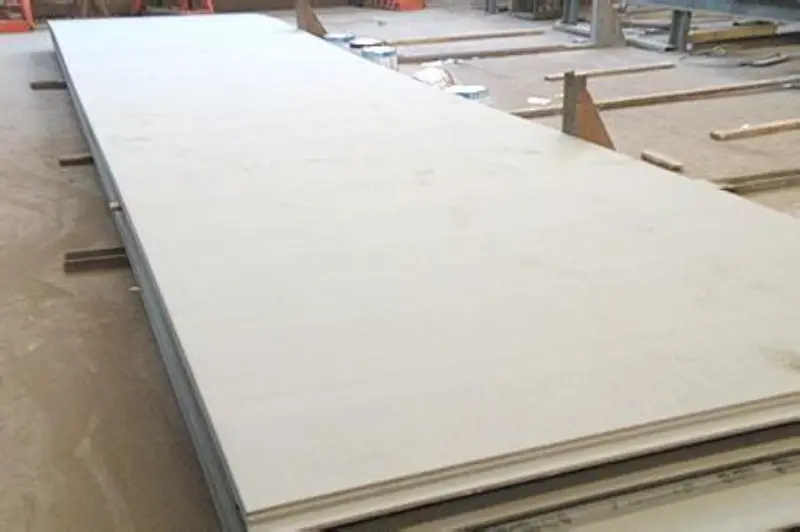
KR D32 Shipbuilding Steel Plate
KR D32 Shipbuilding Steel Coil – Grade Data Sheet, Chemical Composition & Mechanical Properties
Full technical data for KR D32 shipbuilding steel coil: chemical composition, mechanical and physical properties, equivalent grades by ABS, DNV, LR, CCS and other IACS members, plus application guides.
As-rolled, controlled-rolled, normalized, TMCP
- Phone : +8618037372205
- Email : [email protected]
- WhatsApp: Contact via Whtsapp
- WeChat: +8618037372205
KR D32 Shipbuilding Steel Plate Introduction
KR D32 is a high-strength hull structural steel certified by the Korean Register of Shipping (KR), intended for shipbuilding and offshore engineering. It complies with the IACS UR W11 unified requirements and offers a minimum yield strength of 315 MPa with guaranteed impact toughness at −20 °C. The steel is supplied in the as-rolled, controlled-rolled, normalized, or thermo-mechanically controlled processed (TMCP) condition. It features good weldability, excellent toughness, and reliable strength in the thickness range up to 100 mm.
- Yield strength ≥315 MPa for thicknesses ≤70 mm
- Impact energy ≥27 J at −20 °C (longitudinal)
- Good resistance to brittle fracture
- Widely used for hull plates, decks, and stiffeners
KR D32 Shipbuilding Steel Plate Chemical Composition
The chemical requirements for KR D32 conform to IACS UR W11 for high-strength hull structural steels. The steel is fully killed and fine-grained. Residual elements are strictly limited to ensure reliable weldability and toughness. Microalloying elements such as Al, Nb, V, Ti may be used singly or in combination.
| Element | Specified Value (max unless range given) | Remarks |
|---|---|---|
| Carbon (C) | ≤0.18 | ladle analysis |
| Manganese (Mn) | 0.90 - 1.60 | ladle analysis |
| Silicon (Si) | 0.10 - 0.50 | ladle analysis |
| Phosphorus (P) | ≤0.035 | |
| Sulfur (S) | ≤0.035 | |
| Chromium (Cr) | ≤0.20 | residual element |
| Nickel (Ni) | ≤0.40 | residual element |
| Copper (Cu) | ≤0.35 | residual element |
| Molybdenum (Mo) | ≤0.08 | residual element |
| Aluminum (Al total) | ≥0.015 | grain refinement |
| Niobium (Nb) | ≤0.05 (optional) | microalloy |
| Vanadium (V) | ≤0.10 (optional) | microalloy |
| Titanium (Ti) | ≤0.02 (optional) | microalloy |
| Nitrogen (N) | ≤0.012 | if Al killed |
KR D32 Shipbuilding Steel Plate Thermal & Electrical Physical Properties
The physical properties listed below are representative for carbon-manganese structural steels and do not constitute a mandatory part of the KR specification. They are provided as a guide for engineering calculations. Actual values may vary slightly with processing history.
| Property | Typical Value | Unit | Condition / Temperature |
|---|---|---|---|
| Density (ρ) | 7.85 | g/cm³ | at 20 °C |
| Modulus of elasticity (E) | 205 | GPa | at 20 °C |
| Shear modulus (G) | 80 | GPa | estimated |
| Poisson's ratio (ν) | 0.3 | – | typical |
| Thermal expansion coefficient (α) | 11.5 × 10⁻⁶ | K⁻¹ | 20 –100 °C |
| Thermal conductivity (λ) | 50 | W/(m·K) | at 20 °C |
| Specific heat capacity (cp) | 460 | J/(kg·K) | at 20 °C |
| Electrical resistivity (ρe) | 0.20 | μΩ·m | at 20 °C |
KR D32 Shipbuilding Steel Plate Mechanical Properties
The mechanical requirements are given according to KR Rules Pt.2 Ch.1 and IACS UR W11. Values are based on longitudinal test pieces taken from the plate/coil and vary with product thickness. Impact testing is performed at −20 °C with Charpy V‑notch specimens. Bending test uses a former diameter proportional to the specimen thickness.
| Property | Specified Requirement | Unit | Test Condition / Thickness |
|---|---|---|---|
| Yield strength (ReH), min | 315 | MPa | t ≤ 50 mm |
| Yield strength (ReH), min | 315 | MPa | 50 < t ≤ 70 mm |
| Yield strength (ReH), min | 295 | MPa | 70 < t ≤ 100 mm |
| Tensile strength (Rm) | 440 – 590 | MPa | t ≤ 100 mm |
| Elongation (A5), min | 22 | % | t ≤ 50 mm, gage length 200 mm or proportional |
| Elongation (A5), min | 22 | % | 50 < t ≤ 70 mm |
| Elongation (A5), min | 22 | % | 70 < t ≤ 100 mm |
| Bend test (180°) – bend former diameter | 3 × t | – | t ≤ 50 mm |
| Bend test (180°) – bend former diameter | 4 × t | – | 50 < t ≤ 100 mm |
| Impact energy (KV2, -20 °C), min | 27 | J | Longitudinal, t ≤ 50 mm |
| Impact energy (KV2, -20 °C), min | 27 | J | Longitudinal, 50 < t ≤ 70 mm |
| Impact energy (KV2, -20 °C), min | 27 | J | Longitudinal, 70 < t ≤ 100 mm |
KR D32 Shipbuilding Steel Plate Fully Equivalent Standards & Substitutable Grades
| Country / Region | Standard / Society | Grade | Remarks |
|---|---|---|---|
| South Korea | Korean Register (KR) | KR D32 | Identical to this specification |
| International | IACS UR W11 | D32 | Common IACS grade |
| China | China Classification Society (CCS) | CCS D32 | Equivalent per IACS |
| Norway / Germany | DNV | DNV D32 | DNV rules mirror IACS |
| USA | American Bureau of Shipping (ABS) | ABS D32 | Equivalent per IACS |
| France | Bureau Veritas (BV) | BV D32 | Equivalent per IACS |
| UK | Lloyd's Register (LR) | LR D32 | Equivalent per IACS |
| Japan | Nippon Kaiji Kyokai (ClassNK) | NK D32 | Equivalent per IACS |
| Italy | Registro Italiano Navale (RINA) | RINA D32 | Equivalent per IACS |
KR D32 Shipbuilding Steel Plate Application Introduction
KR D32 steel coil and plate are primarily used in the marine industry for critical structural members. Its excellent balance of strength and low‑temperature toughness makes it suitable for hulls, decks, and other components where notch toughness at −20 °C is required. The material is supplied in various dimensions and can be readily processed by welding, profiling, and bending.
Product Applications: Hull plates and shell plating, Deck plates and floors, Bulkheads and longitudinal frames, Stiffeners, stringers, and girders, Offshore platform substructures and topside modules
Processed into products: Ship hull plates (formed and welded), Deck stringer plates, Bilge keels, Hatch coamings, Brackets and stiffening profiles, Transition pieces in wind turbine foundations, Modular construction units for offshore installations
Application industries: Shipbuilding (commercial vessels, naval ships), Offshore oil & gas platforms, Renewable energy (offshore wind turbine foundations), Pressure vessels and storage tanks (where marine certification is required), Heavy structural engineering (bridge components with supplementary approval)
KR D32 Shipbuilding Steel Plate Similar / Comparable Material Recommendations
| Country / Region | Standard | Grade | Remarks |
|---|---|---|---|
| European Union | EN 10025-3 | S355N / S355NL | Minimum yield 355 MPa; toughness at -20 °C (NL). Not specifically for marine, but used in offshore structures. Slightly higher strength. |
| International (IACS) | IACS UR W11 | AH32 / DH32 / EH32 | Same yield class (315 MPa) with different impact test temperatures: 0 °C (A), -20 °C (D), -40 °C (E). D32 sits in the middle. |
| International | API 2H Grade 50 / 2W Grade 50 | 2H Gr.50 / 2W Gr.50 | Offshore structural steel plates, yield ≥345 MPa, often used for jacket legs and nodes. Can substitute for D32 in heavy structural applications. |
| Japan / Korea | JIS G 3106 | SM490A / SM490B | Weldable structural steels, yield ≥325 MPa (t≤50). Not marine-certified by default, but similar mechanical properties. |
Notes:
- Welding: KR D32 exhibits good weldability with conventional welding processes when using appropriate preheat and low-hydrogen consumables. Weld procedure qualification should follow KR or IACS guidelines.
- Heat treatment: Normalizing or stress-relieving may be applied. For TMCP grades, excessive reheating can reduce strength.
- Certification: All plates/coils are supplied with KR class certification (3.2 certificate) unless alternative society endorsement is agreed.
- Surface condition: Usually supplied in shot-blasted and shop-primed condition.
- Tolerances on thickness, width, and length comply with KR Rules or relevant EN 10029 / ASTM A6 upon agreement.
- Share



