
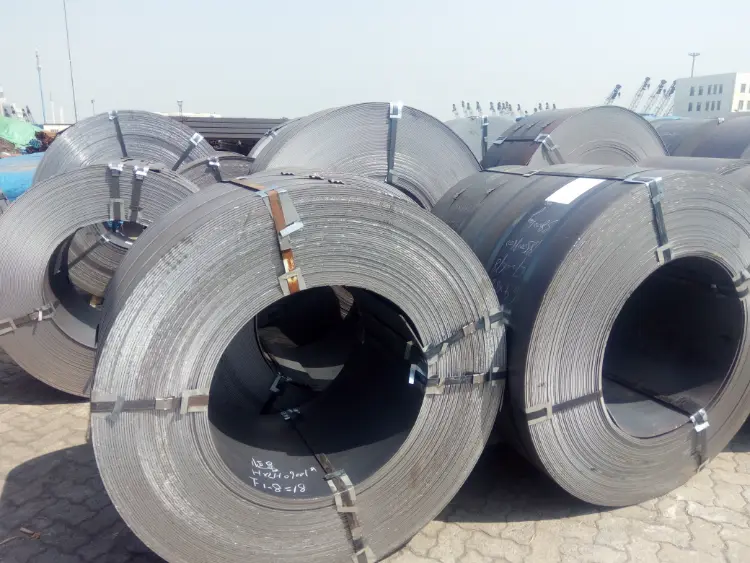
KR E32 Shipbuilding Steel Coil
KR E32 Shipbuilding Steel Coil: Properties, Equivalents & Applications
Detailed material data for KR E32 shipbuilding steel coil including chemical composition, mechanical properties, thermal & electrical physical properties, international equivalents, and application guide.
Hot rolling, Normalizing (N), Thermo-Mechanical Controlled Processing (TMCP), Quenching and Tempering (Q&T) optionally by agreement
- Phone : +8618037372205
- Email : [email protected]
- WhatsApp: Contact via Whtsapp
- WeChat: +8618037372205
KR E32 Shipbuilding Steel Coil Introduction
KR E32 shipbuilding steel coil is a high-strength hull structural steel specified by the Korean Register (KR) of Shipping. It belongs to the EH32 grade according to the International Association of Classification Societies (IACS) unified requirements, providing a minimum yield strength of 315 MPa and excellent notch toughness at temperatures down to -40 °C. This steel is produced as fully killed, fine-grain material, typically delivered in normalized (N) or thermo-mechanically controlled processed (TMCP) condition. It offers superior weldability, good formability, and high resistance to brittle fracture, making it ideal for critical ship hull components, offshore structures, and marine engineering applications that operate in cold environments.
Key features:
- High strength-to-weight ratio
- Excellent low-temperature impact toughness (KV2 ≥ 31 J at -40 °C)
- Good through-thickness properties
- Low carbon equivalent (CEV) to ensure weldability without extensive preheating
- Compliance with all major international classification societies
KR E32 Shipbuilding Steel Coil Chemical Composition
The chemical requirements are based on the KR Rules and IACS UR W11. The steel is fully killed and fine-grain treated with a minimum acid-soluble aluminum content. Additional microalloying elements such as niobium, vanadium, or titanium may be added for grain refinement and strengthening, and their amounts must be reported when present. Residual elements are controlled to ensure weldability and toughness.
Carbon equivalent (CEV) based on ladle analysis is typically ≤ 0.38 % to guarantee weldability without preheating for moderate thicknesses.
| Element | Standard Value (wt%) | Remarks |
|---|---|---|
| Carbon, C | ≤ 0.18 | For product analysis +0.02 tolerance |
| Silicon, Si | ≤ 0.50 | Deoxidation]] |
| Manganese, Mn | 0.90 - 1.60 | May be adjusted for thickness, product analysis ±0.10 |
| Phosphorus, P | ≤ 0.035 | Maximum |
| Sulfur, S | ≤ 0.035 | Maximum |
| Aluminum (acid-soluble), Als | ≥ 0.015 | Minimum requirement for fine-grain practice |
| Nickel, Ni | ≤ 0.40 | Residual element |
| Chromium, Cr | ≤ 0.20 | Residual element |
| Copper, Cu | ≤ 0.35 | Residual element |
| Molybdenum, Mo | ≤ 0.08 | Residual element |
| Niobium, Nb * | ≤ 0.05 | Optional; if added, must be reported |
| Vanadium, V * | ≤ 0.10 | Optional; if added, must be reported |
| Titanium, Ti * | ≤ 0.02 | Optional; if added, must be reported |
KR E32 Shipbuilding Steel Coil Thermal and Electrical Physical Properties
The following physical properties are typical for a normalized or TMCP carbon-manganese structural steel like KR E32/EH32. These values are provided for engineering calculations and design purposes; actual properties can vary slightly depending on exact composition and heat treatment.
Thermal expansion, conductivity, and specific heat values are given for common temperature ranges encountered in service.
| Property | Standard Requirement Value | Unit | Test Condition |
|---|---|---|---|
| Density (ρ) | 7850 | kg/m³ | At 20 °C |
| Elastic modulus (E) | 205 | GPa | At 20 °C |
| Shear modulus (G) | 80 | GPa | At 20 °C |
| Poisson's ratio (ν) | 0.3 | – | At 20 °C |
| Thermal expansion coefficient (α) | 12.0 | 10⁻⁶/K | Between 20 °C and 100 °C |
| Thermal expansion coefficient (α) | 12.5 | 10⁻⁶/K | Between 20 °C and 200 °C |
| Thermal expansion coefficient (α) | 13.0 | 10⁻⁶/K | Between 20 °C and 300 °C |
| Thermal conductivity (λ) | 51.9 | W/m·K | At 100 °C |
| Thermal conductivity (λ) | 48.5 | W/m·K | At 200 °C |
| Specific heat capacity (c) | 486 | J/kg·K | At 20 °C |
| Electrical resistivity (ρe) | 0.20 | μΩ·m | At 20 °C |
KR E32 Shipbuilding Steel Coil Mechanical Properties
The tensile and impact properties below are the mandatory minimum values according to KR and IACS UR W11 for flat products in the normalized or TMCP condition. Transverse tensile test specimens are normally used for thickness ≤ 40 mm; longitudinal samples may be agreed. Impact energy values are minimum average of three Charpy V-notch specimens; no single value shall be less than 70 % of the specified average.
Bend tests are performed on full-thickness specimens with no cracking regardless of orientation. These properties ensure the steel can withstand dynamic loading and low-temperature marine environments.
| Property | Standard Requirement Value | Unit | Test Condition |
|---|---|---|---|
| Yield Strength (ReH) | ≥ 315 | MPa | Thickness ≤ 100 mm |
| Yield Strength (ReH) | ≥ 295 | MPa | Thickness 100 < t ≤ 200 mm |
| Tensile Strength (Rm) | 440 - 590 | MPa | All thickness ranges (transverse or longitudinal) |
| Elongation (A5) | ≥ 22 | % | Thickness ≤ 40 mm, gauge length 5.65√So |
| Elongation (A5) | ≥ 21 | % | Thickness 40 < t ≤ 60 mm |
| Elongation (A5) | ≥ 20 | % | Thickness 60 < t ≤ 100 mm |
| Charpy V-notch impact energy (KV2), longitudinal | ≥ 31 (average) | J | At -40 °C |
| Charpy V-notch impact energy (KV2), transverse | ≥ 24 (average) | J | At -40 °C |
| Bend test, 180° (d = mandrel diameter, a = specimen thickness) | no cracks | – | d = 3a for t ≤ 25 mm |
| Bend test, 180° (d = mandrel diameter, a = specimen thickness) | no cracks | – | d = 4a for t > 25 mm |
KR E32 Shipbuilding Steel Coil Exact Equivalent Material Standards and Replaceable Grades
| Country / Region | Standard | Designation / Grade | Remarks |
|---|---|---|---|
| South Korea | KR Rules | E32 / EH32 | Original designation |
| International (IACS) | IACS UR W11 | EH32 | Unified requirement, identical chemistry and properties |
| USA | ABS Rules | EH32 | American Bureau of Shipping |
| UK | LR Rules | EH32 | Lloyd's Register |
| Norway / Germany | DNV Rules | EH32 | Det Norske Veritas |
| France | BV Rules | EH32 | Bureau Veritas |
| China | CCS Rules | EH32 | China Classification Society |
| Japan | NK Rules | EH32 | ClassNK (Nippon Kaiji Kyokai) |
| Italy | RINA Rules | EH32 | Registro Italiano Navale |
| Russia | RS Rules | EH32 | Russian Maritime Register of Shipping |
KR E32 Shipbuilding Steel Coil Application Introduction
KR E32 steel is specifically designed for critical structural components in shipbuilding and offshore engineering where high strength, excellent weldability, and reliable low-temperature toughness are required. Its fine-grain, fully killed nature ensures consistent mechanical properties across plate thicknesses. Available in coil form, it can be efficiently processed into plates, profiles, and fabricated structures using standard workshop practices. The material is especially suited for applications subjected to dynamic loads, fatigue, and arctic service temperatures.
Product Applications: Ship hull plates (side shell, bottom shell, deck), Longitudinal stiffeners and frames, Transverse bulkheads and web frames, Cargo tank structures for LNG/LPG carriers, Offshore platform decks, caissons, and jackets, Ice-strengthened vessel hulls (polar class), Ship rudder and stern frame components, Heavy-lift crane booms and offshore substructures
Processed into products: Hull plating (flat and curved panels formed from coil), Stiffeners (angle, tee, bulb profiles cut and welded from plate), Deck girders and hatch coamings, Watertight doors and manholes, Bracket plates and floor plates, Mooring bollards and fairleads, Helideck support structures, Transition pieces for offshore wind monopiles, Flanged pipe connections and pressure vessel shells
Application industries: Shipbuilding and ship repair, Offshore oil and gas (platforms, jack-up rigs, FPSOs), Marine engineering (port structures, breakwaters), Bridge construction (under certain class approval), Pressure vessel and storage tank manufacturing (cryogenic service), Wind turbine tower fabrication (offshore wind monopiles and transition pieces)
KR E32 Shipbuilding Steel Coil Similar / Closely Related Material Recommendations
| Country / Region | Standard | Designation / Grade | Remarks |
|---|---|---|---|
| International (IACS) | IACS UR W11 | AH32 | Same strength, impact test at 0 °C instead of -40 °C |
| International (IACS) | IACS UR W11 | DH32 | Same strength, impact test at -20 °C instead of -40 °C |
| Europe | EN 10025-3 | S355N / S355NL | 355 MPa yield, NL option -50 °C; fine grain structural steel, may be used in non-marine with additional verification |
| China | GB/T 1591 | Q345D | 345 MPa min. yield, impact -20 °C; not certified for shipbuilding but close in strength |
| USA | ASTM A709 | HPS 345W | Weathering steel grade, similar strength, impact temperature -20 °F (-29 °C), for bridges |
| International | API 2H / 2W | Grade 50 | Offshore structural steel, 345 MPa yield, toughness classes available |
Notes:
For optimum weldability, the carbon equivalent (CEV) is typically controlled below 0.38 % using the formula CEV = C + Mn/6 + (Cr+Mo+V)/5 + (Ni+Cu)/15. Preheating is generally not required for moderate thicknesses (< 40 mm) when using low-hydrogen welding processes. Post-weld heat treatment (PWHT) is not mandatory for this grade in most shipbuilding applications, but stress relieving may be applied for thick, constrained joints. KR E32 can be hot-dip galvanized or painted with standard marine coating systems. Availability in coil form enables efficient laser cutting, plasma cutting, and cold forming into complex shapes.
Always consult the latest KR Rules or the specific classification society's requirements for current acceptance criteria, as minor revisions may occur.
- Share



