
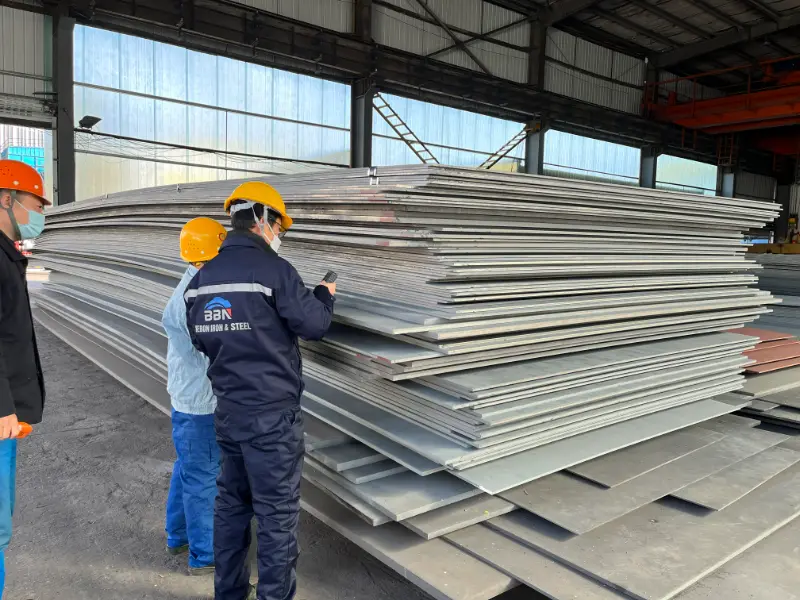
KR F32 Shipbuilding Steel
KR F32 Shipbuilding Steel Coil: High-Strength Marine Structural Material
Explore the detailed properties, chemical composition, and applications of KR F32 shipbuilding steel coil, a high-strength hull structural steel with excellent low-temperature toughness.
Hot rolling, cold rolling, normalizing, thermo-mechanical controlled processing (TMCP), quenching and tempering (optional), cutting, forming, welding, bending
- Phone : +8618037372205
- Email : [email protected]
- WhatsApp: Contact via Whtsapp
- WeChat: +8618037372205
KR F32 Shipbuilding Steel Introduction
KR F32 is a high-strength shipbuilding steel in coil form, classified under the Korean Register of Shipping (KR) rules for rolled steels used in hull structures. It corresponds to the FH32 grade as per IACS UR W11, with a specified minimum yield strength of 315 MPa and tensile strength between 440 and 590 MPa. The steel offers excellent weldability and notch toughness at temperatures down to -60 °C, making it ideal for critical structural components of ships, offshore platforms, and marine equipment. F32 is typically delivered in normalized or thermo-mechanical controlled processing (TMCP) condition, providing a fine-grained microstructure for superior strength and ductility.
KR F32 Shipbuilding Steel Chemical Composition
The following chemical composition limits are in accordance with KR Rules for grade F32 (FH32 equivalent). Values are for heat analysis. Additional elements may be present but shall comply with the standard. Nb, V, Ti, and Al may be added singly or in combination for grain refinement.
| Element | Standard Value (max, unless range given) | Remarks |
|---|---|---|
| Carbon (C) | ≤ 0.16 | Heat analysis |
| Silicon (Si) | ≤ 0.50 | Heat analysis |
| Manganese (Mn) | 0.90 - 1.60 | Heat analysis |
| Phosphorus (P) | ≤ 0.035 | Heat analysis |
| Sulfur (S) | ≤ 0.035 | Heat analysis |
| Chromium (Cr) | ≤ 0.20 | Optional; may be present as residual |
| Nickel (Ni) | ≤ 0.40 | Optional; may be present as residual |
| Copper (Cu) | ≤ 0.35 | Optional; may be present as residual |
| Molybdenum (Mo) | ≤ 0.08 | Optional; may be present as residual |
| Nitrogen (N) | ≤ 0.009 | For Al-treated steels |
| Aluminum (Al) | ≥ 0.015 (acid-soluble) | For grain refinement; total Al may be specified |
| Niobium (Nb) | 0.02 - 0.05 | Optional micro-alloying element |
| Vanadium (V) | 0.05 - 0.10 | Optional micro-alloying element |
| Titanium (Ti) | ≤ 0.02 | Optional grain refining element |
| Carbon Equivalent (CE) | ≤ 0.36 | CE = C + Mn/6 + (Cr+Mo+V)/5 + (Ni+Cu)/15 |
KR F32 Shipbuilding Steel Thermal and Electrical Physical Properties
Physical properties are typical for low-carbon structural steel and may vary slightly depending on exact composition and processing. These values are not specified by KR Rules but are useful for design calculations. Density, thermal expansion, and thermal conductivity are consistent with similar carbon-manganese steels.
| Property | Standard Requirement Value | Unit | Test Condition / Remarks |
|---|---|---|---|
| Density (ρ) | 7.85 | g/cm³ | At 20 °C, typical |
| Elastic Modulus (E) | 205 | GPa | At 20 °C, typical |
| Shear Modulus (G) | 80 | GPa | At 20 °C, typical |
| Poisson Ratio (ν) | 0.30 | — | At 20 °C, typical |
| Thermal Expansion Coefficient (α) | 11.7 × 10⁻⁶ | 1/K | 20 to 100 °C, average |
| Thermal Expansion Coefficient (α) | 12.5 × 10⁻⁶ | 1/K | 20 to 200 °C, average |
| Thermal Expansion Coefficient (α) | 13.7 × 10⁻⁶ | 1/K | 20 to 400 °C, average |
| Thermal Conductivity (λ) | 52 | W/(m·K) | At 20 °C |
| Thermal Conductivity (λ) | 49 | W/(m·K) | At 100 °C |
| Thermal Conductivity (λ) | 44 | W/(m·K) | At 300 °C |
| Specific Heat Capacity (cp) | 486 | J/(kg·K) | At 20 °C |
| Specific Heat Capacity (cp) | 515 | J/(kg·K) | At 100 °C |
| Specific Heat Capacity (cp) | 557 | J/(kg·K) | At 400 °C |
| Electrical Resistivity (ρe) | 0.16 | μΩ·m | At 20 °C, typical |
KR F32 Shipbuilding Steel Mechanical Properties
Mechanical properties for KR F32 steel coil must meet the minimum requirements when tested in the delivery condition (normalized or TMCP). The values are for thickness ranges up to 100 mm as typical; consult KR Rules for exact thickness-dependent limits. Charpy V-notch impact test is performed at -60 °C with a minimum average energy of 27 J.
| Property | Standard Requirement Value | Unit | Test Condition / Remarks |
|---|---|---|---|
| Yield Strength (ReH) | ≥ 315 | MPa | Transverse, for t ≤ 100 mm |
| Yield Strength (ReH) | ≥ 315 | MPa | Longitudinal, for t ≤ 100 mm |
| Tensile Strength (Rm) | 440 - 590 | MPa | Transverse, for t ≤ 100 mm |
| Tensile Strength (Rm) | 440 - 590 | MPa | Longitudinal, for t ≤ 100 mm |
| Elongation (A5) | ≥ 22 | % | Transverse, gauge length 5.65√So; t ≤ 40 mm |
| Elongation (A5) | ≥ 21 | % | Transverse, gauge length 5.65√So; 40 < t ≤ 63 mm |
| Elongation (A5) | ≥ 20 | % | Transverse, gauge length 5.65√So; 63 < t ≤ 100 mm |
| Charpy V-Notch Impact Energy (KV) | ≥ 27 (avg.) / ≥ 20 (single) | J | At -60 °C, longitudinal, for t ≤ 50 mm |
| Charpy V-Notch Impact Energy (KV) | ≥ 27 (avg.) / ≥ 20 (single) | J | At -60 °C, transverse, for t ≤ 50 mm |
| Bend Test (bend angle 180°) | d = 3a (t ≤ 25 mm), d = 4a (25 < t ≤ 50 mm) | — | Bend diameter d, specimen thickness a; no cracks or defects |
KR F32 Shipbuilding Steel Full Equivalent Material Standards and Substitutable Grades
| Country / Region | Standard / Rules | Grade | Remarks |
|---|---|---|---|
| International | IACS UR W11 | FH32 | Equivalent under unified requirements; identical requirements |
| USA | ABS Rules | FH32 | American Bureau of Shipping; equivalent to KR F32 |
| Norway / Germany | DNV Rules | FH32 | DNV classification; identical mechanical properties |
| United Kingdom | LR Rules | FH32 | Lloyd's Register; same strength and toughness level |
| France | BV Rules | FH32 | Bureau Veritas; equivalent ship steel grade |
| China | CCS Rules | FH32 | China Classification Society; directly comparable |
| Japan | NK Rules | FH32 | Nippon Kaiji Kyokai; identical specification |
| Italy | RINA Rules | FH32 | Registro Italiano Navale; interchangeable |
KR F32 Shipbuilding Steel Application Introduction
KR F32 steel coil is engineered for critical marine and offshore structures requiring high strength and excellent toughness at sub-zero temperatures. Its good weldability and formability allow fabrication into complex shapes. Typical applications include:
Product Applications: Hull plates and stiffeners, Decks and shell plating, Bulkheads and longitudinal frames, Tubular structural elements for jackets and topsides, Barge floors and side plates, Fuel and ballast tank bulkheads
Processed into products: Ship hull panels and sections, Stiffeners, stringers, and ribs, Flame-cut and welded brackets, Formed channel and angle profiles, Pipe piles and transition pieces for offshore structures, Watertight doors and hatch covers, Crane pedestals and foundation plates, Connector plates and gussets
Application industries: Shipbuilding (commercial and naval vessels), Offshore oil and gas platforms, Marine equipment manufacturing, Bridge and civil engineering (when marine environment demands corrosion/strength properties), Renewable energy (offshore wind turbine foundations)
KR F32 Shipbuilding Steel Similar Alternative Material Recommendations
| Country / Region | Standard / Rules | Grade | Remarks |
|---|---|---|---|
| South Korea | KR Rules | EH32 | Lower toughness; Charpy at -40 °C instead of -60 °C; similar strength |
| South Korea | KR Rules | DH32 | Charpy at -20 °C; suitable for less critical structural parts |
| South Korea | KR Rules | AH32 | Charpy at 0 °C; used in non-critical areas above waterline |
| International | IACS UR W11 | EH32 / DH32 / AH32 | Lower impact temperature variants for same yield/tensile strength |
| South Korea | KR Rules | FH36 | Higher yield strength (≥ 355 MPa) with similar -60 °C toughness; can be used if higher strength needed |
| South Korea | KR Rules | FH40 | Yield strength ≥ 390 MPa; for high-load structural members |
Notes:
Coil form availability: KR F32 is supplied as hot-rolled coil, which can be subsequently cut into sheets or plates. Surface condition shall be free from detrimental defects. Edge trimming and oiling are optional. Welding: The steel has low carbon equivalent for good weldability; preheat is generally not required for thicknesses below 50 mm. However, consumables matching the strength and toughness should be used. Corrosion protection: As an unalloyed structural steel, adequate coating or cathodic protection is required in seawater environment. Mill test certificates (MTC) to KR format are mandatory.
- Share



