
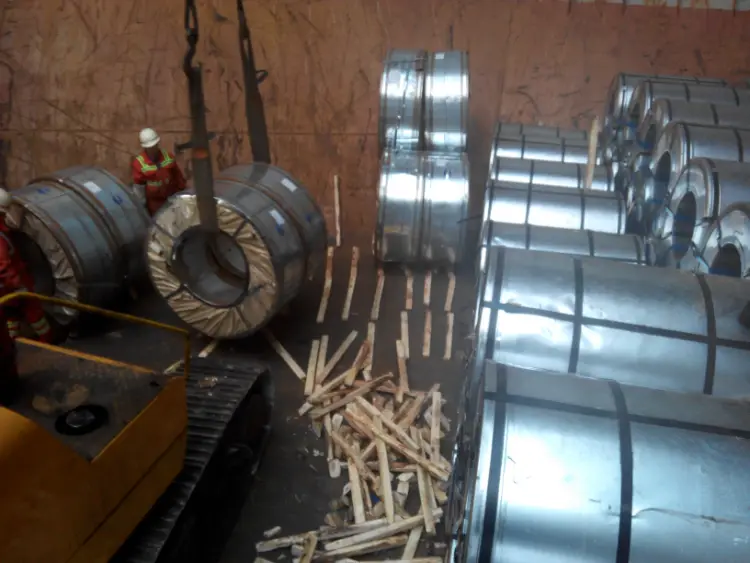
KR Grade D Shipbuilding Steel Coil
KR Grade D Shipbuilding Steel Coil: Data Sheet, Equivalents & Applications
Complete material data for KR Grade D shipbuilding steel coil including chemical composition, mechanical properties, thermal and electrical properties, international equivalents, and application guidance.
Hot rolling, normalizing, thermomechanical controlled processing (TMCP), flame cutting, welding, cold forming
- Phone : +8618037372205
- Email : [email protected]
- WhatsApp: Contact via Whtsapp
- WeChat: +8618037372205
KR Grade D Shipbuilding Steel Coil Introduction
KR Grade D shipbuilding steel coil is a normal strength hull structural steel certified by the Korean Register (KR). It is extensively used in the construction of ships, offshore platforms, and marine structures. This grade offers a minimum yield strength of 235 MPa, good weldability, and excellent toughness at low temperatures, especially in the as‑rolled, normalized, or TMCP condition. Controlled chemistry with low carbon and phosphorus/sulfur ensures superior formability and resistance to brittle fracture. The steel is typically supplied in coil, plate, or sheet form, and can be processed by cutting, welding, and forming operations. KR Grade D meets the IACS UR W11 unified requirements and is equivalent to other major classification society D grades, facilitating global procurement and fabrication.
KR Grade D Shipbuilding Steel Coil Chemical Composition
The chemical composition of KR Grade D steel is regulated to ensure good weldability, strength, and low‑temperature toughness. Key elements include carbon and manganese to provide strength, while phosphorus and sulfur are strictly controlled. Aluminum is added for grain refinement. Residual elements such as chromium, nickel, copper and molybdenum are limited to maintain anticipated properties.
- Mn lower limit depends on carbon content: ≥2.5×C, with a minimum of 0.60%.
- Acid‑soluble aluminum is optional but recommended for grain refinement.
| Chemical Element | Standard Value | Remarks |
|---|---|---|
| C | ≤0.21 % | – |
| Si | ≤0.50 % | – |
| Mn | ≥2.5×C (min 0.60 %) | 2.5×C, but not less than 0.60% |
| P | ≤0.035 % | – |
| S | ≤0.035 % | – |
| Al (acid soluble) | ≥0.015 % (if used) | For grain refinement |
| Cr | ≤0.20 % | Residual element |
| Ni | ≤0.40 % | Residual element |
| Cu | ≤0.35 % | Residual element |
| Mo | ≤0.08 % | Residual element |
| Cr+Ni+Cu+Mo | ≤0.70 % | Sum of residual elements |
KR Grade D Shipbuilding Steel Coil Thermal and Electrical Physical Properties
The following typical physical properties apply to normal strength carbon‑manganese steel similar to KR Grade D. They are provided as reference values for design calculations and may vary slightly depending on exact composition and temperature.
- Thermal expansion, thermal conductivity, and specific heat capacity are given for various temperature ranges.
- Electrical resistivity is measured at room temperature.
| Property | Standard Value | Unit | Test Condition |
|---|---|---|---|
| Density (ρ) | ~7.85 | g/cm³ | 20°C |
| Elastic Modulus (E) | ~210 | GPa | Room temperature |
| Shear Modulus (G) | ~80.8 | GPa | Room temperature |
| Poisson's Ratio (ν) | ~0.3 | – | Room temperature |
| Thermal Expansion (α) | 11.5 | 10⁻⁶/°C | 20 - 100°C |
| Thermal Expansion (α) | 12.2 | 10⁻⁶/°C | 20 - 200°C |
| Thermal Expansion (α) | 12.7 | 10⁻⁶/°C | 20 - 300°C |
| Thermal Expansion (α) | 13.2 | 10⁻⁶/°C | 20 - 400°C |
| Thermal Conductivity (λ) | ~52 | W/(m·K) | 20°C |
| Thermal Conductivity (λ) | ~51 | W/(m·K) | 100°C |
| Thermal Conductivity (λ) | ~49 | W/(m·K) | 200°C |
| Thermal Conductivity (λ) | ~46 | W/(m·K) | 300°C |
| Thermal Conductivity (λ) | ~42 | W/(m·K) | 400°C |
| Specific Heat Capacity (cp) | ~460 | J/(kg·K) | 20°C |
| Specific Heat Capacity (cp) | ~490 | J/(kg·K) | 100°C |
| Specific Heat Capacity (cp) | ~520 | J/(kg·K) | 200°C |
| Specific Heat Capacity (cp) | ~550 | J/(kg·K) | 300°C |
| Specific Heat Capacity (cp) | ~580 | J/(kg·K) | 400°C |
| Electrical Resistivity (ρe) | ~0.23 | Ω·mm²/m | 20°C |
KR Grade D Shipbuilding Steel Coil Mechanical Properties
Mechanical properties are specified in the KR Rules for hull structural steel. Values depend on plate thickness. The table lists the minimum requirements for yield strength, tensile strength, elongation, bend test parameters, and Charpy impact toughness.
- Elongation is measured on a gauge length L₀ = 5.65√S₀.
- Bend test is performed through 180° with the indicated bend diameter (a = plate thickness).
- Impact test specimens are 10×10 mm standard Charpy V‑notch; for thicknesses below 11 mm, subsize specimens and adjusted requirements apply.
| Property | Standard Value | Unit | Test Condition |
|---|---|---|---|
| Yield Strength (ReH) | ≥235 | MPa | Thickness ≤100 mm |
| Tensile Strength (Rm) | 400 - 520 | MPa | Thickness ≤100 mm |
| Elongation (A) | ≥22 | % | L₀=5.65√S₀, t ≤50 mm, longitudinal |
| Elongation (A) | ≥21 | % | L₀=5.65√S₀, 50 < t ≤70 mm, longitudinal |
| Elongation (A) | ≥20 | % | L₀=5.65√S₀, 70 < t ≤100 mm, longitudinal |
| Bend Test (Bend Diameter Ratio) | 3a (180°) | – | t ≤50 mm |
| Bend Test (Bend Diameter Ratio) | 4a (180°) | – | 50 < t ≤70 mm |
| Bend Test (Bend Diameter Ratio) | 5a (180°) | – | 70 < t ≤100 mm |
| Charpy V‑notch Impact (KV) | ≥27 | J | -20°C, longitudinal, 10×10 mm specimen |
KR Grade D Shipbuilding Steel Coil Completely Equivalent Material Standards and Replaceable Grade Recommendations
| Country/Region | Standard | Grade | Remarks |
|---|---|---|---|
| International | IACS UR W11 | Grade D | Unified requirement for ordinary strength hull structural steel |
| USA | ABS Rules | Grade D | Identical shipbuilding steel grade |
| Norway | DNV Rules | Grade D | Identical shipbuilding steel grade |
| France | BV Rules | Grade D | Identical shipbuilding steel grade |
| UK | LR Rules | Grade D | Identical shipbuilding steel grade |
| China | CCS Rules | Grade D | Identical shipbuilding steel grade |
| Japan | NK Rules | Grade D | Identical shipbuilding steel grade |
| Italy | RINA Rules | Grade D | Identical shipbuilding steel grade |
KR Grade D Shipbuilding Steel Coil Application Introduction
KR Grade D steel coil is ideally suited for ship hulls and marine structures where moderate strength and excellent notch toughness at low temperatures are required. Its good weldability allows efficient fabrication of large assemblies. Typical processing includes cutting, rolling, forming, and welding. This grade is often delivered with classification society certification, ensuring compliance with stringent safety codes. Designers and fabricators can utilize this steel for primary structural members in vessels and offshore units.
Product Applications: Hull Plates, Deck Plates, Bulkhead Panels, Ship Frames and Stiffeners, Offshore Platform Decks and Legs, Caissons
Processed into products: Shell Plating (bottom, side, and wind/water areas), Bottom and Side Shell Plates, Transverse and Longitudinal Bulkheads, Deck Stringer Plates and Deck Panels, Keel Plates and Frame Sections, Hull Structural Framing, Superstructure Components
Application industries: Shipbuilding and Repair, Offshore Oil & Gas, Marine and Harbor Engineering, Bridge Construction (with approval)
KR Grade D Shipbuilding Steel Coil Similar / Alternative Material Recommendations
| Country/Region | Standard | Grade | Remarks |
|---|---|---|---|
| China | GB/T 700 | Q235D | Similar yield strength (≥235 MPa) and -20°C impact toughness (≥27 J). Elongation may be lower for thick plates; not specifically certified for shipbuilding. |
| European Union | EN 10025-2 | S235J2 | Comparable strength and -20°C impact property. Guaranteed yield and elongation values differ for thicker sections; verify against marine classification rules. |
| Japan | JIS G3106 | SM400B | Similar tensile strength (400-510 MPa), but impact test performed at 0°C. Suitable only if -20°C toughness is not mandatory. |
Notes:
KR Grade D may require impact test at -20°C for material thickness ≥6 mm (according to KR Rules). Welding consumables should be selected to match the steel grade and service condition. Preheating is generally not required for typical thicknesses but may be applied in cold environments (below +5°C). For improved low‑temperature toughness, normalized or TMCP delivery condition is preferred. Actual property limits for specific thickness ranges shall be taken from the prevailing KR material certificate and Rules. Always refer to the latest KR Rules for the complete technical delivery conditions.
- Share



