
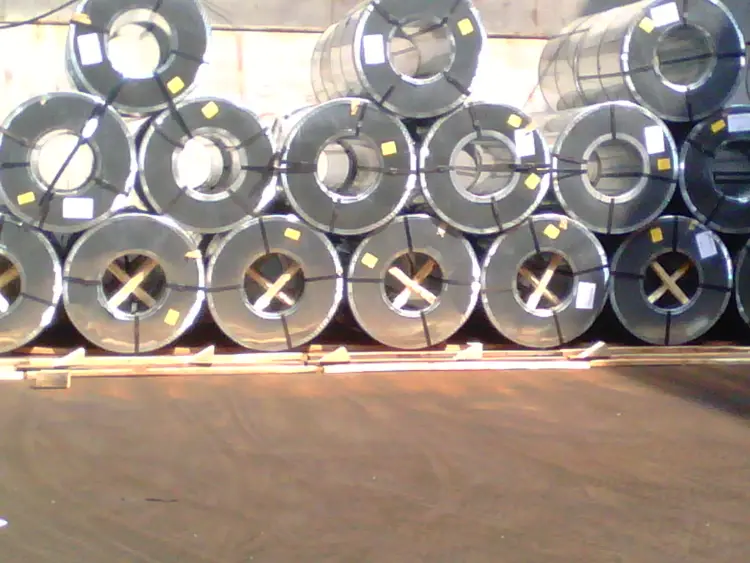
KR Grade A Shipbuilding Steel Coil
KR Grade A Shipbuilding Steel Coil: Properties, Equivalents & Marine Applications
Comprehensive data for KR Grade A shipbuilding steel coil: chemical composition, mechanical and thermal properties, international equivalents, similar materials, and application guidance for marine structures.
Welding, bending, cutting, forming, machining
- Phone : +8618037372205
- Email : [email protected]
- WhatsApp: Contact via Whtsapp
- WeChat: +8618037372205
KR Grade A Shipbuilding Steel Coil Introduction
KR Grade A is a normal-strength hull structural steel standardized by the Korean Register of Shipping (KR). It is primarily supplied as hot-rolled coils and plates and is widely used in shipbuilding for general structural components that do not require impact toughness guarantees.
- Yield strength ≥ 235 MPa, tensile strength 400–520 MPa
- Excellent weldability and formability
- Available in various thicknesses; as-rolled or normalized delivery
- Does not mandate Charpy impact testing in the base specification
KR Grade A Shipbuilding Steel Coil Chemical Composition
Chemical requirements for KR Grade A as per KR Rules. The composition is typical of common carbon-manganese structural steels. Deoxidation practice is usually rimmed, capped, or semi-killed (if agreed). Residual elements may be present but shall not exceed limits unless otherwise agreed.
- Ceiling for carbon ensures good weldability
- Manganese content is linked to carbon to maintain strength and toughness
| Element | Standard Value (max, unless range) | Remarks |
|---|---|---|
| Carbon (C) | ≤ 0.21% | Ladle analysis |
| Silicon (Si) | ≤ 0.50% | Killed steel may require Si ≥ 0.15% depending on deoxidation |
| Manganese (Mn) | ≥ 2.5 × C% | Commonly 0.80–1.60% in practice |
| Phosphorus (P) | ≤ 0.035% | 0.035% max for ladle analysis |
| Sulfur (S) | ≤ 0.035% | 0.035% max for ladle analysis |
| Aluminum (Al) | ≥ 0.015% (if required) | For fine grain practice; usually not mandated for Grade A |
| Residuals (Cr, Ni, Mo, Cu) | ≤ 0.30% each | Combined often limited to ensure weldability |
KR Grade A Shipbuilding Steel Coil Thermal & Electrical Physical Properties
The following physical properties are typical for carbon structural steel at room temperature and are provided as engineering guidelines. These values are not part of the mandatory KR specification but assist in design calculations.
- Data based on steel with ~0.2% C, density 7.85 g/cm³
- Thermal expansion and conductivity can vary slightly with temperature and exact composition
| Property | Typical Reference Value | Unit | Test Condition / Remarks |
|---|---|---|---|
| Density (ρ) | 7.85 | g/cm³ | At 20°C |
| Modulus of Elasticity (E) | 200 – 210 | GPa | Tension, room temperature |
| Shear Modulus (G) | 80 – 82 | GPa | Calculated from E and Poisson's ratio |
| Poisson's Ratio (ν) | 0.29 – 0.30 | – | Elastic range |
| Thermal Expansion Coefficient (α) | 11.5 – 12.5 × 10⁻⁶ | K⁻¹ | 20–100°C range |
| Thermal Conductivity (λ) | 50 – 55 | W/(m·K) | At 20°C |
| Specific Heat Capacity (cp) | 460 – 480 | J/(kg·K) | Room temperature |
| Electrical Resistivity (ρe) | 0.14 – 0.18 × 10⁻⁶ | Ω·m | At 20°C |
KR Grade A Shipbuilding Steel Coil Mechanical Properties
Tensile and bend properties as required by KR Rules for Grade A in delivery condition. Impact testing is not normally required for Grade A; if specified by the purchaser, test temperatures and minimum energy values must be agreed.
- Properties are valid for thicknesses commonly supplied in coil form (≤ 50 mm typical)
- Elongation measured on gauge length L0 = 5.65√S0 for plates ≥ 3 mm or using 200 mm gauge for thinner products
| Property | Standard Requirement (min / range) | Unit | Test Condition / Remarks |
|---|---|---|---|
| Yield Strength (ReH) | ≥ 235 | MPa | Thickness ≤ 100 mm; transverse test pieces |
| Tensile Strength (Rm) | 400 – 520 | MPa | All thicknesses |
| Elongation (A5.65) | ≥ 22 | % | Thickness ≤ 50 mm; L0 = 5.65√S0 |
| Elongation (A200) | ≥ 17 | % | For very thin products, gauge length 200 mm |
| Bend Test (180°) | No cracks | – | Bend diameter d = 2a for t ≤ 25 mm; d = 3a for 25 mm < t ≤ 50 mm |
| Impact Energy (KV) | Not required | J | Charpy V-notch test not mandatory for Grade A; if agreed, temperature and min values as per contract |
KR Grade A Shipbuilding Steel Coil Direct International Equivalent Grades
| Country / Region | Standard / Society | Grade / Designation | Remarks |
|---|---|---|---|
| South Korea | KR | Grade A | Original specification |
| USA | ABS | Grade A | American Bureau of Shipping – identical requirements |
| UK | LR | Grade A | Lloyd's Register |
| Norway / Germany | DNV | Grade A | DNV ordinary-strength hull structural steel |
| France | BV | Grade A | Bureau Veritas |
| China | CCS | Grade A | China Classification Society |
| Japan | NK (ClassNK) | KA | Nippon Kaiji Kyokai – Grade KA corresponds to KR A |
| Italy | RINA | Grade A | Registro Italiano Navale |
KR Grade A Shipbuilding Steel Coil Application Introduction
KR Grade A steel coil offers an economical choice for primary and secondary marine structures where ambient temperature toughness is sufficient. Its reliable mechanical properties and good fabrication behavior make it suitable for a wide range of components.
- Commonly used in inland and coastal vessels, as well as in less critical parts of ocean-going ships
- Can be processed into plates, rolled sections, and welded assemblies
Product Applications: Ship hull plates (side shells, bottom shells), Decks and deckhouses, Bulkheads and watertight divisions, Superstructure elements, Foundations for deck machinery, Longitudinal and transverse framing members
Processed into products: Non-critical hull shell plates (above the waterline or inside compartments), Stiffeners and brackets, Hatch coaming plates, Ventilation trunks and minor piping supports, Lighting mast bases and handrail stanchions, Tank boundary plates for non-cargo tanks (void spaces)
Application industries: Shipbuilding and ship repair, Offshore and marine engineering, Barge and pontoon construction, Floating structures (smaller docks, floating cranes), Harbor equipment
KR Grade A Shipbuilding Steel Coil Similar / Alternative Materials with Comparable Performance
| Country / Region | Standard / Specification | Grade | Remarks / Analysis |
|---|---|---|---|
| International | IACS UR W11 | Normal-strength ship steel A | Harmonized IACS requirement; equivalent to all society A grades |
| South Korea | KR | Grade B | Higher toughness (0°C impact), same strength; used when Charpy is needed |
| China | GB 712 | A | Chinese shipbuilding steel A – similar chemical and mechanical requirements |
| Japan | JIS G 3106 | SM400A | Welded structural steel; comparable strength (400–510 MPa TS) but without marine certification unless KV tested |
| Europe | EN 10025-2 | S235JR | Structural carbon steel; similar strength but not classified for shipbuilding; no Charpy guarantee at low temperature |
| USA | ASTM A36 | A36 | General structural steel with slightly higher yield (250 MPa); used in barge fabrication under additional approval |
Notes:
Special considerations for KR Grade A coil:
- When ordering coil, the purchaser should specify the desired edge condition (mill edge, trimmed edge) and surface quality
- For thicknesses exceeding 40 mm or for use in highly restrained joints, pre-heating and controlled interpass temperatures are recommended to avoid cold cracking
- Zinc coating or painting is typically applied after fabrication; surface preparation (shot blasting) is often carried out in shipyards
- KR Grade A can be substituted by higher-toughness grades (B, D, E) if design requirements change, without altering strength design
- Share



