
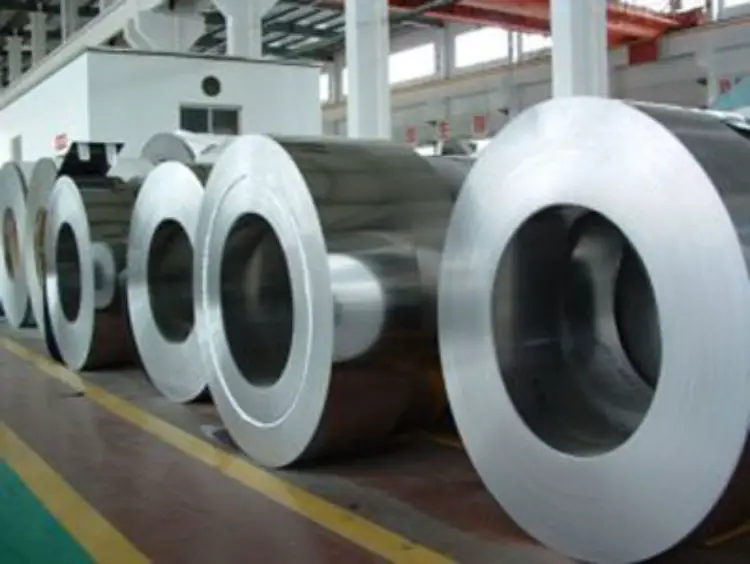
KR Grade B Shipbuilding Steel Coil
KR Grade B Shipbuilding Steel Coil - High Toughness Marine Structural Plate
KR Grade B is a hot-rolled shipbuilding steel coil certified by the Korean Register of Shipping. It offers a minimum yield strength of 235 MPa, excellent weldability, and reliable low-temperature toughness (0 °C impact test) for general hull structures.
Hot rolling, controlled rolling, normalising rolling; suitable for cutting, cold forming, welding, and machining
- Phone : +8618037372205
- Email : [email protected]
- WhatsApp: Contact via Whtsapp
- WeChat: +8618037372205
KR Grade B Shipbuilding Steel Coil Introduction
KR Grade B is a normal-strength hull structural steel grade conforming to the Rules of the Korean Register of Shipping (KR). It is produced as hot-rolled coils or plates and is primarily used in the construction of ships and marine structures. The steel is fully killed or semi-killed, ensuring fine grain structure and good notch toughness. Typical thicknesses range up to 50 mm. Compared with Grade A, Grade B provides enhanced impact toughness guaranteed at 0 °C, making it suitable for primary structural components operating in moderate climates. It features excellent weldability, formability, and ductility, matching the requirements of IACS UR W11 for equivalent grades across all major classification societies.
KR Grade B Shipbuilding Steel Coil Chemical Composition
The chemical composition complies with KR Rules and IACS UR W11 for Grade B shipbuilding steel. Elements are controlled to ensure weldability and toughness. Silicon and aluminium are used for deoxidation; manganese content is kept above a minimum to offset sulfur and improve strength.
| Element | Standard Value (max or min) | Remarks |
|---|---|---|
| C (Carbon) | ≤ 0.21 | If C ≤ 0.18 %, Mn may be reduced to min 0.60 % |
| Mn (Manganese) | ≥ 0.80 | Typically 0.80 – 1.10; for semi-killed steel min 0.80 %, for fully killed min 0.60 % |
| Si (Silicon) | ≤ 0.50 | Typical range 0.10 – 0.35 for killed steel |
| P (Phosphorus) | ≤ 0.035 | Lower P improves toughness |
| S (Sulfur) | ≤ 0.035 | Low sulfur for through-thickness ductility |
| Al (Aluminium, acid soluble) | ≥ 0.015 | When aluminium is used for grain refinement |
| Cu (Copper) | ≤ 0.35 | Residual element |
| Cr (Chromium) | ≤ 0.20 | Residual element |
| Ni (Nickel) | ≤ 0.40 | Residual element |
| Mo (Molybdenum) | ≤ 0.08 | Residual element |
| CEV (Carbon equivalent) | ≤ 0.38 | Typical (C + Mn/6 + (Cr+Mo+V)/5 + (Ni+Cu)/15) depending on thickness |
KR Grade B Shipbuilding Steel Coil Physical and Thermal Properties
Physical properties are representative for carbon-manganese structural steels and are not mandatory in the standard. They are useful for design calculations. Values are approximate for room temperature unless stated otherwise.
| Property | Typical Value | Unit | Condition / Temperature |
|---|---|---|---|
| Density (ρ) | 7.85 | g/cm³ | 20 °C |
| Modulus of Elasticity (E) | 210 | GPa | 20 °C |
| Shear Modulus (G) | 81 | GPa | 20 °C |
| Poisson's Ratio (ν) | 0.3 | – | 20 °C |
| Thermal Expansion Coefficient (α) | 11.5 | 10⁻⁶/K | 20–100 °C |
| Thermal Expansion Coefficient (α) | 12.5 | 10⁻⁶/K | 20–200 °C |
| Thermal Conductivity (λ) | 51.9 | W/(m·K) | 20 °C |
| Specific Heat Capacity (c) | 486 | J/(kg·K) | 20 °C |
| Electrical Resistivity (ρe) | 0.18 | μΩ·m | 20 °C |
KR Grade B Shipbuilding Steel Coil Mechanical Properties
Mechanical properties are tested on transverse specimens in the as-delivered condition. Yield strength, tensile strength, and elongation depend on product thickness. Charpy V-notch impact tests are performed at 0 °C with a minimum energy of 27 J (longitudinal). Bending tests require 180° bend over a former with diameter specified.
| Property | Required Value | Unit | Test Condition |
|---|---|---|---|
| Yield Strength (ReH) | ≥ 235 | MPa | Thickness ≤ 50 mm |
| Yield Strength (ReH) | ≥ 215 | MPa | Thickness > 50 ≤ 70 mm |
| Yield Strength (ReH) | ≥ 195 | MPa | Thickness > 70 ≤ 100 mm |
| Tensile Strength (Rm) | 400 – 520 | MPa | All thicknesses |
| Elongation (A) | ≥ 22 | % | Thickness ≤ 50 mm, gauge length 5.65√S0 |
| Elongation (A) | ≥ 21 | % | Thickness > 50 ≤ 70 mm |
| Elongation (A) | ≥ 20 | % | Thickness > 70 ≤ 100 mm |
| Bend Test (Bend Diameter) | Diameter = 3a (180°) | – | a = specimen thickness; no cracks |
| Charpy Impact (KV, long.) | ≥ 27 (average) | J | 0 °C, longitudinal specimen |
| Charpy Impact (KV, trans.) | ≥ 20 (average) | J | 0 °C, transverse specimen (if required) |
KR Grade B Shipbuilding Steel Coil Fully Equivalent Designations
| Country/Region | Standard / Classification Society | Grade | Remarks |
|---|---|---|---|
| International | IACS UR W11 | B | Unified requirement for normal-strength hull structural steel |
| USA / International | ABS (American Bureau of Shipping) | Grade B | Equivalent to KR Grade B |
| France / International | BV (Bureau Veritas) | Grade B | Equivalent |
| China / International | CCS (China Classification Society) | B | Equivalent |
| Norway / International | DNV (Det Norske Veritas, now DNV) | B (NV B) | Equivalent |
| UK / International | LR (Lloyd's Register) | Grade B | Equivalent |
| Japan / International | NK (Nippon Kaiji Kyokai / ClassNK) | Grade B | Equivalent |
| Italy / International | RINA (Registro Italiano Navale) | Grade B | Equivalent |
| Germany / International | GL (Germanischer Lloyd, merged into DNV) | B | Historical equivalent |
| USA | ASTM A131 / A131M | Grade B | Standard specification for structural steel for ships |
KR Grade B Shipbuilding Steel Coil Application Introduction
KR Grade B is intended for primary structural members of oceangoing, coastal, and inland vessels where good low-temperature toughness and weldability are required. It can withstand dynamic loads and is easily processed by cutting, forming, and welding. Weldability is excellent with all common processes, provided low-hydrogen procedures are followed. The product is mainly supplied as hot-rolled coil or plate to shipyards and fabricators.
Product Applications: Hull plating (bottom, side shell, main deck), Bulkheads and non-watertight partitions, Transverse and longitudinal stiffeners, Hatch coamings and minor deck structures, Superstructure components, Offshore platform decks and braces (non-critical low-temperature service)
Processed into products: Cut and shaped plates for hull blocks, Stiffeners, frames, and beams, Brackets and gussets, Ventilator trunks and small foundations, Welded pipe supports and outfitting items, Fabricated sections for hatch covers and masts
Application industries: Shipbuilding and offshore engineering, Marine equipment manufacturing, Barge and pontoon construction, Port and harbour infrastructure, Structural engineering requiring class-approved steel
KR Grade B Shipbuilding Steel Coil Similar / Substitute Materials
| Country/Region | Standard | Grade | Remarks |
|---|---|---|---|
| EU | EN 10025-2 | S235JR (1.0038) | Similar yield strength (235 MPa); impact at 20 °C rather than 0 °C; not class-certified |
| USA | ASTM A36 / A36M | A36 | Similar strength; not certified for marine use but widely used for structural applications |
| Japan | JIS G3101 | SS400 | Tensile strength comparable; no mandatory impact requirement; general structural steel |
| China | GB/T 700 | Q235B | Yield 235 MPa; impact at 20 °C; commonly used for civil structures |
| International | ISO 630-2 | S235B | Structural steel with comparable properties; not class-certified for shipbuilding |
Notes:
Certification: Material is supplied with KR inspection certificate (3.1 or 3.2 per EN 10204). Tolerances: Thickness, width, and flatness as per KR Rules or agreed standard. Weldability: Carbon equivalent typically ≤ 0.38; low-hydrogen welding consumables are recommended. Through-thickness properties: For critical applications, Z-quality (e.g., Z25, Z35) can be specified according to IACS UR W11. Surface condition: as-rolled, free from detrimental scale and defects. Ordering must include thickness, width, grade, and class notation (e.g., KR B).
- Share



