
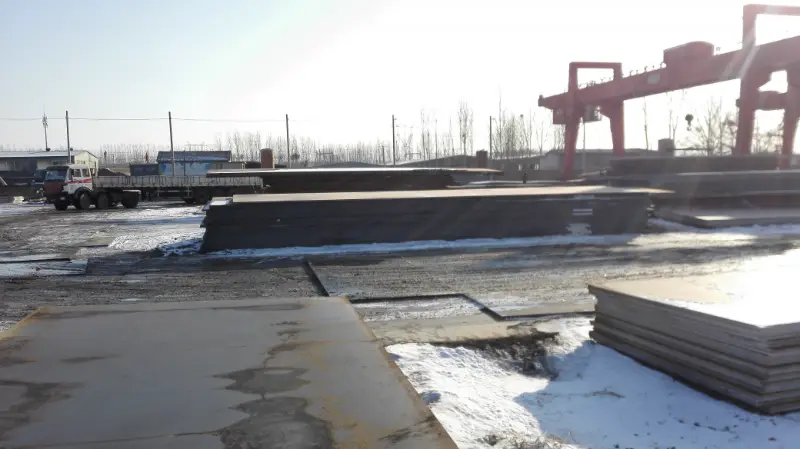
405 (S40500) Ferritic Stainless Steel
405 (S40500) Ferritic Stainless Steel - Composition, Properties & Equivalent Grades
Comprehensive data sheet for 405 (UNS S40500) ferritic stainless steel: chemical composition, mechanical & thermal properties, global equivalents, and application industries.
Hot rolling, cold rolling, annealing, pickling, cutting, forming, welding
- Phone : +8618037372205
- Email : [email protected]
- WhatsApp: Contact via Whtsapp
- WeChat: +8618037372205
405 Ferritic Stainless Steel Introduction
405 stainless steel (UNS S40500) is a ferritic grade stabilized with aluminum to improve oxidation resistance. It offers good ductility, weldability, and moderate high-temperature strength, making it suitable for applications like annealing boxes, exhaust system components, and heat exchangers. This grade cannot be hardened by heat treatment and is typically supplied in the annealed condition. It combines low cost with resistance to scaling and corrosion in mildly aggressive environments.
405 Ferritic Stainless Steel Chemical Composition
Typical chemical composition of 405 stainless steel as per ASTM A240/A240M. The aluminum addition (0.10–0.30%) enhances oxidation resistance. Values are maximum unless a range is specified.
| Element | Standard Value | Remarks |
|---|---|---|
| Carbon (C) | 0.08 max | Typical 0.06 |
| Manganese (Mn) | 1.00 max | Typical 0.50 |
| Silicon (Si) | 1.00 max | Typical 0.50 |
| Phosphorus (P) | 0.040 max | — |
| Sulfur (S) | 0.030 max | — |
| Chromium (Cr) | 11.5 – 14.5 | Key ferritic stabilizer |
| Aluminum (Al) | 0.10 – 0.30 | Enhances scaling resistance |
| Iron (Fe) | Balance | Approx. 84–88% |
405 Ferritic Stainless Steel Thermal and Electrical Physical Properties
Typical physical properties of 405 ferritic stainless steel at room temperature and elevated temperatures. These values are representative for annealed material and may vary slightly with manufacturing conditions.
| Property | Typical Value | Unit | Test Condition |
|---|---|---|---|
| Density (ρ) | 7.70 | g/cm³ | 20 °C |
| Elastic Modulus (E) | 200 | GPa | 20 °C |
| Shear Modulus (G) | 77 | GPa | 20 °C calculated |
| Poisson's Ratio (ν) | 0.27 – 0.30 | — | 20 °C |
| Thermal Expansion (α) | 10.4 | µm/m·°C | 20–100 °C |
| Thermal Expansion (α) | 11.0 | µm/m·°C | 20–300 °C |
| Thermal Expansion (α) | 11.6 | µm/m·°C | 20–500 °C |
| Thermal Conductivity (λ) | 27.0 | W/m·K | 100 °C |
| Thermal Conductivity (λ) | 28.5 | W/m·K | 500 °C |
| Specific Heat Capacity | 460 | J/kg·K | 20–100 °C |
| Electrical Resistivity (ρ_e) | 0.60 | µΩ·m | 20 °C |
405 Ferritic Stainless Steel Mechanical Properties
Room temperature mechanical properties for 405 stainless steel in the annealed condition per ASTM A240/A240M. For thicknesses ≤ 0.050 in (1.27 mm), elongation requirement is 1% lower. Bend test values apply to flat products.
| Property | Standard Requirement | Unit | Test Condition |
|---|---|---|---|
| Yield Strength (0.2% offset) | 170 min | MPa | Ambient, annealed |
| Tensile Strength | 415 min | MPa | Ambient, annealed |
| Elongation in 2 in (50.8 mm) | 20 min | % | Gauge length 2 in, thickness ≥ 0.050 in |
| Bend Test (mandrel diameter) | 1t | — | Thickness ≤ 0.1874 in (4.76 mm), 180° bend |
| Bend Test (mandrel diameter) | 2t | — | Thickness > 0.1874 to 0.50 in (12.7 mm), 180° bend |
| Hardness (typical) | ≤ 179 HBW | HBW | As annealed (informative) |
405 Ferritic Stainless Steel Fully Equivalent Material Standards & Substitute Grades
| Country/Region | Standard | Grade | Remarks |
|---|---|---|---|
| USA | ASTM A240/A240M | 405 (UNS S40500) | Original specification |
| China | GB/T 3280, GB/T 4237 | 06Cr13Al (old 0Cr13Al) | Identical chemical and mechanical limits |
| Japan | JIS G4304, JIS G4305 | SUS405 | Same composition with Al addition |
| Europe | EN 10088-2, EN 10088-3 | X6CrAl13 (1.4002) | Direct equivalent, slightly tighter Si range |
| International | ISO 15510 | X6CrAl13 (also referenced as 1.4002) | Harmonized designation |
405 Ferritic Stainless Steel Application Introduction
405 stainless steel offers a unique combination of ferritic stability, oxidation resistance, and low cost. It is primarily used where moderate corrosion and heat resistance are required, and where hardening through heat treatment is not needed. The aluminum addition promotes a tightly adhering oxide scale, improving performance in high-temperature air and combustion gas environments.
Product Applications: Stainless steel plates and sheets for welded fabrications, Coils for continuous production of automotive exhaust components, Cut-to-length blanks for stamping and deep drawing, Hot-rolled plate for high-temperature structural applications, Cold-rolled strip for precision-formed parts
Processed into products: Annealing boxes and covers, Exhaust manifold heat shields, Catalytic converter canisters, Furnace muffles and baskets, Heat exchanger baffles, Welded tubes for low-pressure steam lines, Oven cavity liners
Application industries: Automotive (exhaust systems, mufflers, catalytic converter shells), Petrochemical (pipe supports, furnace components, heat exchanger liners), Industrial heating equipment (annealing boxes, retorts, radiant tubes), Power generation (gas turbine exhaust parts, ducting), Kitchenware and catering equipment (oven liners, baking trays)
405 Ferritic Stainless Steel Similar or Substitute Stainless Steel Grades
| Country/Region | Standard | Grade | Remarks |
|---|---|---|---|
| USA | ASTM A240 | 409 (S40900) | Ti-stabilized ferritic; lower Cr (10.5-11.75%), better weldability, used in automotive exhausts |
| USA | ASTM A240 | 410S (S41008) | Low-carbon martensitic/ferritic; 11.5-13.5% Cr, no Al addition, better toughness |
| Europe | EN 10088-2 | X2CrTi12 (1.4512) | Low interstitial ferritic; similar oxidation resistance, slightly lower Cr |
| China | GB/T 3280 | 022Cr12Ti (1.4512 equivalent) | Ferritic stainless with Ti, good weldability |
Notes:
Welding: 405 is readily weldable by common methods (TIG, MIG, resistance). Filler metal matching the base composition (e.g., AWS ER405) is recommended. Preheating is not required; post-weld annealing may restore ductility.
Heat treatment: Anneal at 700–800°C followed by air cool. Avoid prolonged exposure above 650°C in service to prevent excessive grain growth.
Forming: Suitable for moderate cold forming; more extensive draws may require intermediate annealing due to work hardening.
- Share



