
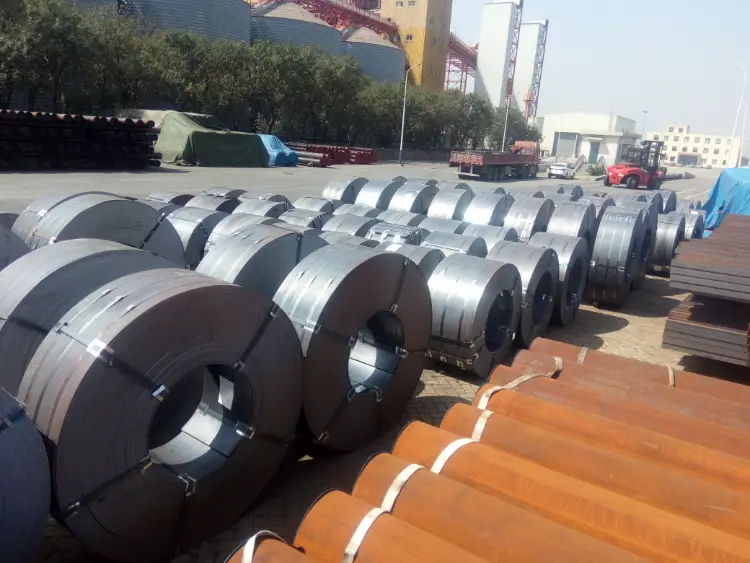
KR Grade A40 Shipbuilding Steel Coil
KR Grade A40 Shipbuilding Steel Coil - Full Material Data, Equivalents & Applications
Comprehensive material datasheet of KR Grade A40 shipbuilding steel coil: chemical composition, mechanical and physical properties, equivalent standards, similar grades, and application guidelines per KR Rules.
Hot rolling, cold rolling, leveling, shearing, slitting; normalizing (N), thermomechanical controlled processing (TMCP), welding, bending, forming, flame/plasma/laser cutting
- Phone : +8618037372205
- Email : [email protected]
- WhatsApp: Contact via Whtsapp
- WeChat: +8618037372205
KR Grade A40 Shipbuilding Steel Coil Introduction
KR Grade A40 is a high-strength hull structural steel defined in the Korean Register (KR) Rules for the Classification of Steel Ships, Part 2 Materials and Welding. It is equivalent to the IACS UR W11 grade AH40 and is used primarily in ship and offshore construction. The steel combines minimum yield strength of 390 MPa with excellent weldability and toughness at 0°C. It is typically supplied in normalized or thermo-mechanically controlled processed (TMCP) condition and is suitable for cold forming and welding without significant loss of toughness. The grade is available as coils, plates, and wide strips, making it versatile for automated cutting and forming processes.
KR Grade A40 Shipbuilding Steel Coil Chemical Composition
Typical chemical composition according to KR Rules for Grade A40 (AH40 level). Maximum limits unless a range is specified. The carbon equivalent (Ceq) is calculated using the formula: Ceq = C + Mn/6 + (Cr+Mo+V)/5 + (Ni+Cu)/15. For thicknesses up to 50 mm, Ceq typically ≤ 0.38%. Microalloying elements may be adjusted at the manufacturer's discretion to achieve required mechanical properties.
| Element | Specified Value (wt%) | Remarks |
|---|---|---|
| Carbon (C) | ≤ 0.18 | Max; |
| Silicon (Si) | ≤ 0.50 | Max; |
| Manganese (Mn) | 0.90 – 1.60 | Range depends on thickness and product form |
| Phosphorus (P) | ≤ 0.035 | Max; lower for improved toughness |
| Sulfur (S) | ≤ 0.035 | Max; lower for improved toughness |
| Copper (Cu) | ≤ 0.35 | Max; residual or intentional addition |
| Chromium (Cr) | ≤ 0.20 | Max; residual |
| Nickel (Ni) | ≤ 0.40 | Max; residual |
| Molybdenum (Mo) | ≤ 0.08 | Max; residual |
| Aluminium (Als) | ≥ 0.015 | Min; acid-soluble aluminium for grain refinement |
| Niobium (Nb) | 0.02 – 0.05 | Microalloying, typical |
| Vanadium (V) | 0.05 – 0.10 | Microalloying, typical |
| Titanium (Ti) | ≤ 0.02 | Max; optional for grain refinement |
| Carbon Equivalent (Ceq) | ≤ 0.38 (for t ≤ 50 mm) | Calculated value; controls weldability |
KR Grade A40 Shipbuilding Steel Coil Thermal, Electrical & Physical Properties
Typical physical properties for KR Grade A40 (carbon-manganese microalloyed steel) at room temperature unless stated otherwise. These values are suitable for design calculations but may vary slightly depending on exact chemistry and heat treatment condition.
| Property | Typical Value | Unit | Condition / Temperature |
|---|---|---|---|
| Density (ρ) | 7850 | kg/m³ | Room temperature |
| Modulus of Elasticity (E) | 205 | GPa | Room temperature |
| Shear Modulus (G) | 80 | GPa | Calculated |
| Poisson's Ratio (ν) | 0.29 | — | Room temperature |
| Thermal Expansion Coefficient (α) | 12.0 | 10⁻⁶/K | 20 – 100 °C |
| Thermal Conductivity (λ) | 50 | W/(m·K) | Room temperature |
| Specific Heat Capacity (cp) | 460 | J/(kg·K) | Room temperature |
| Electrical Resistivity (ρe) | 0.16 | 10⁻⁶ Ω·m | Room temperature |
| Melting Range | 1420 – 1460 | °C | Approximate |
KR Grade A40 Shipbuilding Steel Coil Mechanical Properties
Mechanical properties per KR Rules for Grade A40 in normalized or TMCP condition, tested on transverse specimens unless otherwise noted. The yield and tensile properties apply to thicknesses ≤ 50 mm. For thicker plates, slight adjustments may apply. Impact test is performed at 0 °C (KV2 ≥ 34 J longitudinal). Bending test (if specified) typically uses a mandrel diameter of 2a (a=thickness) with 180° bending without cracks.
| Property | Specified Value | Unit | Test Condition / Remark |
|---|---|---|---|
| Yield Strength (ReH) | ≥ 390 | MPa | Transverse, thickness ≤ 50 mm, room temperature |
| Tensile Strength (Rm) | 510 – 660 | MPa | Transverse, thickness ≤ 50 mm |
| Elongation (A5) | ≥ 19 | % | Gauge length 5.65√S0, transverse |
| Impact Energy (KV2) at 0 °C | ≥ 34 (longitudinal) | ≥ 24 (transverse) | J | Charpy V-notch, 10x10 mm specimen |
| Bend Test | No cracks | - | 180° bending, mandrel diameter = 2a (a=specimen thickness) |
KR Grade A40 Shipbuilding Steel Coil Fully Equivalent Grades – International Classification Society Specs
| Country / Region | Standard / Rules | Grade | Remarks |
|---|---|---|---|
| International (IACS) | IACS UR W11 | AH40 | Unified Requirement for high strength hull steel, impact 0 °C |
| South Korea (KR) | KR Rules Part 2 | A40 | Original grade; this datasheet is based on KR A40 |
| USA (ABS) | ABS Rules 2024 | AH40 | Identical chemical and mechanical requirements |
| Norway (DNV) | DNV Rules Pt.2 Ch.1 | AH40 | Same as IACS AH40 |
| UK (LR) | Lloyd's Register Rules | AH40 | Same as IACS AH40 |
| France (BV) | Bureau Veritas Rules | AH40 | Same as IACS AH40 |
| China (CCS) | CCS Rules Pt.3 | AH40 | Same as IACS AH40 |
| Japan (NK) | ClassNK Rules Pt.K | KA40 | Functionally identical, impact 0 °C |
| Italy (RINA) | RINA Rules Pt.B | AH40 | Same as IACS AH40 |
| Germany (GL/DNV) | DNV GL Rules (historical) | AH40 | Merged into DNV; same requirements |
KR Grade A40 Shipbuilding Steel Coil Application Introduction
KR Grade A40 is designed for welded structures in shipbuilding and offshore engineering where high strength, good toughness at 0 °C, and excellent weldability are required. It is suitable for both new construction and repair. The steel can be processed by cold forming, cutting, and welding using conventional shipyard practices.
Product Applications: Hull plates (bottom, side, deck, bilge), Longitudinal and transverse stiffeners, T-beams, angle bars, and bulb flats (in welded fabrication), Hatch covers and coamings, Bulkheads and tank boundaries, Offshore structural modules, Caissons and foundation structures
Processed into products: Main deck panels and insert plates, Bottom shell and inner bottom plating, Side shell frames and brackets, Web frames and floor plates in double bottom, Transverse bulkhead corrugations and flats, Deck girders and hatch side girders, Stiffener profiles (welded from strip), Connection plates and doublers, Offshore module lifting lugs and pad-eyes
Application industries: Commercial shipbuilding (container vessels, bulk carriers, tankers, Ro-Ro ships), Naval shipbuilding (auxiliary vessels), Offshore oil and gas (topsides, jackets, FPSO modules), Offshore wind (transition pieces, monopile components, substructures), Marine and port infrastructure (floating docks, pontoons, sheet piling)
KR Grade A40 Shipbuilding Steel Coil Similar / Alternative Materials – Related Standards & Grades
| Country / Region | Standard / Rules | Grade | Remarks |
|---|---|---|---|
| South Korea (KR) | KR Rules | A36 | Lower strength (yield ≥ 355 MPa), same impact temperature, used where strength demand is lighter |
| International (IACS) | IACS UR W11 | DH40 / EH40 | Same strength but with improved toughness at -20 °C (DH40) or -40 °C (EH40) |
| European Union | EN 10025-4 | S420M / S420ML | Thermomechanically rolled structural steel, yield 420 MPa; not certified for marine use by default but similar strength |
| USA | ASTM A572 / A709 | Grade 60 (415) / 65 (450) | High-strength low-alloy structural steel, approximate strength match, not directly for ship classification |
| China | GB/T 712 | AH40 | Identical to CCS AH40; direct equivalent for marine use |
Notes:
Welding: KR Grade A40 can be welded using all conventional methods (SMAW, SAW, GMAW, FCAW). Preheat and interpass temperature should follow manufacturer's recommendations based on thickness and carbon equivalent. Heat treatment: Post-weld heat treatment (PWHT) is generally not required for this grade but may be applied for thick sections or stress relieving as per shipyard specifications. Non-destructive testing: Ultrasonic testing per KR Rules or EN 10160 class S1/E1 is often specified for critical zones. Certification: Material is supplied with KR Certificate (Form 3.1) confirming compliance with the rules.
- Share



