
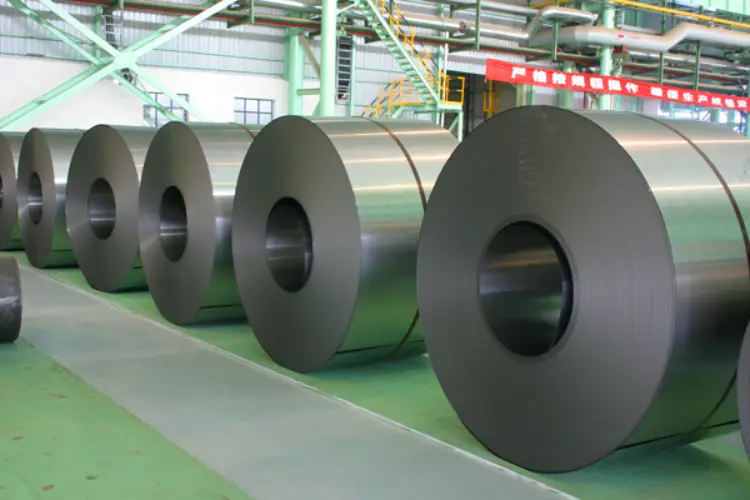
KR F36 Shipbuilding Steel Coil
KR F36 Shipbuilding Steel Coil – High-Strength Hull Structural Steel for Arctic Service
Comprehensive material data for KR F36 shipbuilding steel coil: chemical composition, mechanical properties (yield, tensile, impact at -60°C), thermal and electrical properties, equivalent grades from IACS members, similar alternative steels, and detailed application guidance for marine and offshore structures.
Welding (SMAW, SAW, GMAW), gas/plasma/laser cutting, cold and hot forming, machining, shot blasting
- Phone : +8618037372205
- Email : [email protected]
- WhatsApp: Contact via Whtsapp
- WeChat: +8618037372205
KR F36 Shipbuilding Steel Coil Introduction
KR F36 is a high-strength hull structural steel grade certified by the Korean Register of Shipping (KR), designed for welded ship and offshore structures that require guaranteed toughness at extremely low temperatures. As a thermomechanical controlled rolled (TMCP) or normalized product, it delivers a minimum yield strength of 355 MPa and minimum impact energy of 34 J at -60 °C (F-quality). This makes it suitable for critical structural members in ice-class vessels, Arctic floating platforms, and heavy offshore components. The grade fully complies with IACS UR W11 and is globally recognized.
Key features:
- Excellent low-temperature toughness down to -60 °C
- Good weldability with standard shipbuilding welding consumables
- Uniform through-thickness properties in coil and plate form
- Available in as-rolled, normalized, or TMCP delivery conditions
- Full traceability and KR certification for marine applications
KR F36 Shipbuilding Steel Coil Chemical Composition of KR F36
The chemical composition limits for KR F36 steel, according to IACS UR W11 for strength level 355 MPa with F-quality toughness. Values represent ladle analysis maxima, unless a range is given. Additional microalloying elements (Nb, V, Ti) may be used singly or in combination to achieve the required mechanical properties. The carbon equivalent (CEV) is typically controlled to ensure good weldability. Actual typical values may be tighter, agreed between manufacturer and purchaser.
| Chemical Element | Specified Value (max) | Remarks |
|---|---|---|
| Carbon, C | ≤ 0.18 % | Ladle analysis |
| Silicon, Si | ≤ 0.50 % | Ladle analysis |
| Manganese, Mn | 0.90 – 1.60 % | Ladle analysis |
| Phosphorus, P | ≤ 0.025 % | Ladle analysis |
| Sulfur, S | ≤ 0.025 % | Ladle analysis |
| Copper, Cu | ≤ 0.35 % | Residual element |
| Chromium, Cr | ≤ 0.20 % | Residual element |
| Nickel, Ni | ≤ 0.40 % | Residual element |
| Molybdenum, Mo | ≤ 0.08 % | Residual element |
| Niobium, Nb | ≤ 0.05 % | Microalloy (if used) |
| Vanadium, V | ≤ 0.10 % | Microalloy (if used) |
| Titanium, Ti | ≤ 0.02 % | Microalloy (if used) |
| Aluminum, Al (acid soluble) | ≥ 0.015 % | When required for grain refinement |
| Nb + V + Ti | ≤ 0.12 % | Sum of microalloying elements |
| Nitrogen, N | ≤ 0.012 % | Normally not specified, but controlled |
KR F36 Shipbuilding Steel Coil Thermal and Electrical Physical Properties of KR F36 Steel
The physical properties listed below are typical for carbon-manganese structural steels with ferritic-pearlitic microstructure as representative for KR F36. These values serve as engineering reference data and may vary slightly depending on the actual chemical composition, heat treatment condition, and testing temperature. Density, moduli, and thermal expansion coefficients are generally consistent within this material class.
| Property | Typical Value | Unit | Test Condition / Remarks |
|---|---|---|---|
| Density (ρ) | 7.85 | g/cm³ | At 20 °C |
| Elastic modulus (E) | 205 | GPa | At 20 °C, tensile |
| Shear modulus (G) | 80 | GPa | At 20 °C, calculated from E and ν |
| Poisson's ratio (ν) | 0.30 | — | Elastic range, at room temperature |
| Thermal expansion coefficient (α) | 11.7 | 10⁻⁶/K | Between 20°C and 100°C (mean value) |
| Thermal conductivity (λ) | 46 | W/(m·K) | At 20 °C |
| Specific heat capacity (cp) | 450 | J/(kg·K) | At 20 °C |
| Electrical resistivity (ρe) | 0.26 | μΩ·m | At 20 °C |
KR F36 Shipbuilding Steel Coil Mechanical Properties of KR F36 Steel
Mechanical properties are determined on test pieces taken transverse to the rolling direction and in accordance with KR testing procedures. Requirements are valid for thickness up to 50 mm unless otherwise indicated. Higher thickness products may show slightly reduced strength values according to the class society rules. Charpy V-notch impact tests are conducted at -60 °C for the F-grade, with an average of three specimens not less than 34 J and a single minimum of 24 J. The bend test is carried out on a bent specimen without cracking (180° bend).
| Property | Specified Value | Unit | Test Condition / Remarks |
|---|---|---|---|
| Yield strength (ReH) | ≥ 355 | MPa | Upper yield, thickness t ≤ 50 mm, transverse |
| Tensile strength (Rm) | 490 – 630 | MPa | Thickness t ≤ 50 mm, transverse |
| Elongation (A5) | ≥ 21 | % | Gauge length 5.65√S0, t ≤ 50 mm |
| Bend test (180°) | d = 3a | — | Bend diameter d, specimen thickness a, t ≤ 30 mm, no cracks |
| Charpy impact (KV) at -60 °C | ≥ 34 (avg.) / ≥ 24 (single) | J | Transverse, specimen 10×10 mm, t ≤ 50 mm |
KR F36 Shipbuilding Steel Coil Internationally Equivalent Shipbuilding Steel Grades
The following classification society grades are fully equivalent to KR F36 as they share identical chemical and mechanical requirements under IACS Unified Requirements UR W11. They are mutually acceptable for marine applications subject to individual society endorsement. All listed grades also guarantee minimum yield strength of 355 MPa and impact toughness at -60°C (or designated test temperature corresponding to F-quality).
| Country/Region | Classification Society / Standard | Equivalent Grade | Remarks |
|---|---|---|---|
| International | American Bureau of Shipping (ABS) | FH36 | IACS UR W11; F-quality -60°C impact |
| International | Bureau Veritas (BV) | FH36 | Identical strength and toughness requirements |
| International | China Classification Society (CCS) | FH36 | F-quality per CCS Rules |
| International | DNV (formerly DNV GL) | FH36 | FH36 per DNV ship rules |
| International | Lloyd's Register (LR) | FH36 | Grade FH36, LR rules |
| International | Nippon Kaiji Kyokai (ClassNK) | KF36 | NK notation for F36 |
| International | Registro Italiano Navale (RINA) | FH36 | F36 grade according to RINA |
| International | Russian Maritime Register of Shipping (RS) | F36 | F36 as per RS rules |
| International | Indian Register of Shipping (IRS) | FH36 | FH36 grade in IRS rules |
KR F36 Shipbuilding Steel Coil Application Introduction
KR F36 steel is predominantly used in the construction of ship hulls, offshore structures, and heavy-duty marine components operating in cold climate regions. Due to its guaranteed impact toughness at -60 °C, it is the material of choice for ice-strengthened ships, icebreakers, and Arctic offshore platforms. The combination of high strength, good weldability, and through-thickness integrity permits efficient design and fabrication of lightweight yet robust structures.
Processing guidelines:
- Welding: Low-hydrogen practices are mandatory; preheat and interpass temperatures typically 50–150 °C depending on thickness; CEV control ensures no hardness issues.
- Forming: Cold forming is feasible for moderate bends; hot forming should be finished above 850 °C and may be followed by normalizing if specified.
- Surface preparation: Blast cleaning to SA 2½ is standard prior to coating.
Product Applications: Ship hull plates, deck plates, shell plating, Transverse bulkheads, longitudinal stiffeners, girders, Jacket legs and braces for offshore platforms, Caisson structures, module support frames, Ice-breaker bow plates and ice belt reinforcement, Pressure vessel shells for low-temperature marine service, Offshore wind turbine monopile transition pieces (if class approval obtained)
Processed into products: Hull shell plates (bottom, side, weather decks), Longitudinal and transverse framing members, Web frames and stringers, Bulkhead panels and girders, Hatch coamings and crane pedestals, Rudder horn, skeg, and stern frame parts, Deckhouse structural parts (when required by class), Foundation plates for heavy equipment on board
Application industries: Shipbuilding (commercial, naval, and ice-class vessels), Marine and offshore engineering, Oil and gas (platforms, FPSOs, subsea templates), Renewable energy (offshore wind foundations, tidal energy structures), Heavy machinery (crane booms, mining equipment frames), Bridge construction (special marine components)
KR F36 Shipbuilding Steel Coil Similar Engineering Steels for Alternative Selection
The following structural steels offer comparable mechanical strength and low-temperature toughness but are not fully equivalent to KR F36 with respect to classification society approval or specific shipbuilding chemistry. They may be considered for non-marine applications or as alternative materials after engineering evaluation. Please note differences in impact test temperature and chemical composition restrictions.
| Country/Standard | Grade | Key Similarities | Main Differences |
|---|---|---|---|
| EN 10025-3 | S355NL | Min. yield 355 MPa, impact at -50°C (min 27 J) | Lower test temperature requirement (-50°C vs -60°C), finer grain practice |
| ASTM A572 / A572M | Grade 50 [345] (Type 1) | Yield ≥345 MPa, tensile ≥450 MPa | No guaranteed impact toughness unless ordered as supplementary; not approved for ship hull |
| ASTM A709 / A709M | Grade 50T / 50F | Yield 345 MPa, optional notch toughness | Bridge steel specification; F grade optional for fracture-critical members; different chemistry philosophy |
| JIS G 3106 | SM490YA (≥355 MPa YS) | Welded structures, min. YS 355 MPa | Impact test at 0°C or -5°C for grade A, not -60°C; toughness class must be upgraded to SM490YB (0°C) or SM490YC (-20°C) |
| GB/T 712 | F36 | Chinese shipbuilding steel F36 (CCS) | Practically equivalent to KR F36 when to CCS FH36, same IACS framework |
Notes:
- Certification: All deliveries shall be accompanied by a KR certificate stating the chemical composition, mechanical test results, and condition of supply.
- Thickness tolerance: As per KR rules or referenced standard (e.g., EN 10029 or ASTM A6).
- NDT: Ultrasonic testing per KR rules (e.g., Class A/B/C) can be specified for critical applications.
- Through-thickness properties: Z-quality (Z25, Z35) is available upon request and is tested in accordance with KR rules.
- Weldability: CEV typically ≤ 0.40% (ladle analysis) for improved weldability is recommended; actual value to be agreed.
- Storage: Coils should be stored in dry conditions to prevent pitting; apply temporary anti-corrosion protection if exposure is prolonged.
- This data sheet summarizes the main technical requirements; it does not replace the official KR material specification.
- Share



