
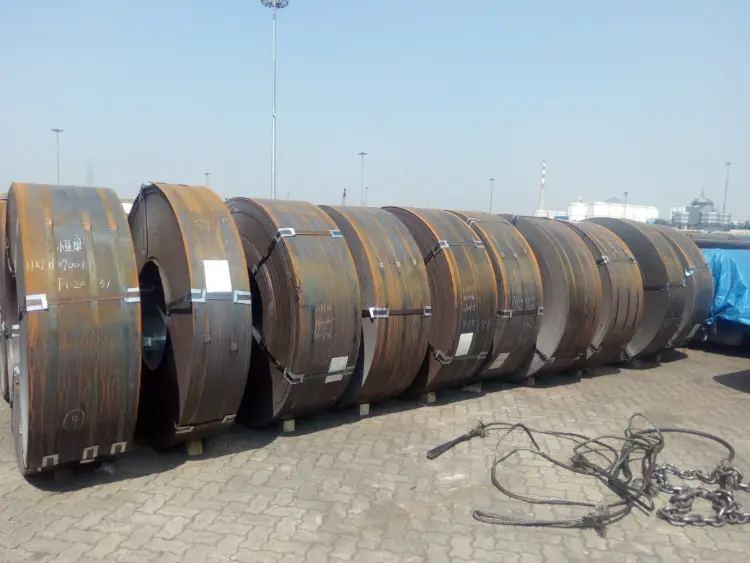
KR E36 Shipbuilding Steel Coil
KR E36 Shipbuilding Steel Coil: High-Strength Hull Structural Steel Properties & Equivalents
Comprehensive material data for KR E36 shipbuilding steel coil including chemical composition, mechanical properties, thermal and electrical physical properties, international equivalent grades, and application guidance for marine and offshore structures.
Hot rolling, thermomechanical controlled rolling (TMCP), normalizing, welding, cutting, cold forming
- Phone : +8618037372205
- Email : [email protected]
- WhatsApp: Contact via Whtsapp
- WeChat: +8618037372205
KR E36 Shipbuilding Steel Coil Introduction
KR E36 is a high-strength structural steel grade approved by the Korean Register of Shipping (KR) for the construction of ship hulls and marine structures. It belongs to the EH36 family of steels as defined by the International Association of Classification Societies (IACS), offering a minimum yield strength of 355 MPa and excellent toughness at sub-zero temperatures. The steel is designed to meet the stringent safety and durability requirements of the maritime industry.
KR E36 is produced through fully killed steelmaking processes with fine grain practice, ensuring good weldability, formability, and resistance to brittle fracture. Typically delivered in a thermomechanical controlled process (TMCP) or normalized condition, this grade provides reliable performance in critical structural applications such as hull plating, stiffeners, and offshore platform components. Its low-temperature impact toughness, tested at -40°C, makes it particularly suitable for vessels operating in Arctic or cold environments.
With a composition based on carbon-manganese with optional microalloying elements (niobium, vanadium, titanium), KR E36 achieves a balance of strength and ductility while maintaining cost-effectiveness. It can be processed by common fabrication methods including welding, cold forming, and cutting. The steel is widely used in the construction of bulk carriers, tankers, container ships, offshore wind turbine foundations, and other heavy marine equipment.
KR E36 Shipbuilding Steel Coil Chemical Composition
Chemical composition limits as specified in KR rules for EH36 grade steels intended for hull structural applications. All values are maximum unless a range or minimum is indicated. The steel is produced using fully killed fine-grain practice. Optional microalloying elements such as Nb, V, and Ti may be added to achieve required mechanical properties through grain refinement or precipitation strengthening. Aluminium is added as a deoxidizing agent and grain refiner.
| Chemical Element | Standard Value | Remarks |
|---|---|---|
| Carbon (C) | ≤0.18 | Max |
| Silicon (Si) | 0.10~0.50 | Killed steel |
| Manganese (Mn) | 0.90~1.60 | |
| Phosphorus (P) | ≤0.030 | Max |
| Sulfur (S) | ≤0.030 | Max |
| Chromium (Cr) | ≤0.20 | Optional |
| Nickel (Ni) | ≤0.40 | |
| Molybdenum (Mo) | ≤0.08 | |
| Copper (Cu) | ≤0.35 | |
| Aluminium (Al, acid soluble) | ≥0.015 | Minimum when required for grain refinement |
| Niobium (Nb) | 0.02~0.05 | Optional microalloy |
| Vanadium (V) | 0.05~0.10 | Optional microalloy |
| Titanium (Ti) | ≤0.02 | Optional microalloy |
KR E36 Shipbuilding Steel Coil Thermal and Electrical Physical Properties
The following physical properties are typical for carbon-manganese structural steels such as KR E36. These values are not specified in the KR standard but are useful for design calculations involving thermal analysis, finite element modeling, or electrical applications. The data represent average properties at room temperature unless noted otherwise and may vary slightly depending on exact composition and manufacturing process.
| Property | Standard Requirement Value | Unit | Test Condition |
|---|---|---|---|
| Density (ρ) | 7.85 | g/cm³ | At 20°C |
| Elastic Modulus (E) | 205 | GPa | At 20°C, static loading |
| Shear Modulus (G) | 80 | GPa | At 20°C |
| Poisson's Ratio (ν) | 0.30 | dimensionless | At 20°C |
| Thermal Expansion Coefficient (α) | 11.7 × 10⁻⁶ | /K | Temperature range 20°C to 100°C |
| Thermal Conductivity (λ) | 52 | W/(m·K) | At 20°C |
| Specific Heat Capacity (c) | 462 | J/(kg·K) | At 20°C |
| Electrical Resistivity (ρ_e) | 0.20 × 10⁻⁶ | Ω·m | At 20°C |
KR E36 Shipbuilding Steel Coil Mechanical Properties
Mechanical properties according to KR classification rules for EH36 shipbuilding steel. Tensile tests are performed on transverse specimens prepared from plates/coils. Impact toughness is evaluated using Charpy V-notch specimens at -40°C. The values listed are the minimum required, except for tensile strength which is given as a range. The properties are valid for plate thicknesses up to 50 mm; for thicker sections, reduced yield strength may apply. Bending test verifies formability without crack formation.
| Property | Standard Requirement Value | Unit | Test Condition |
|---|---|---|---|
| Yield Strength (ReH) | ≥355 | MPa | Transverse, plate thickness ≤50 mm |
| Tensile Strength (Rm) | 490~620 | MPa | Transverse, plate thickness ≤50 mm |
| Elongation (A5) | ≥21 | % | Transverse, gauge length 5.65√So, thickness ≤50 mm |
| Impact Energy (KV, longitudinal) | ≥34 | J | Charpy V-notch, test temperature -40°C, average of 3 specimens, thickness ≤50 mm |
| Impact Energy (KV, transverse) | ≥24 | J | Charpy V-notch, test temperature -40°C, average of 3 specimens, thickness ≤50 mm |
| Bend Test (180° bending) | d=3a (no cracks) | - | Test piece width ≥50 mm, thickness ≤50 mm |
KR E36 Shipbuilding Steel Coil Fully Equivalent Material Standards and Substitute Grades
| Country/Region | Standard | Grade | Remarks |
|---|---|---|---|
| International (IACS) | IACS UR W11 | EH36 | High-strength shipbuilding steel with yield ≥355 MPa, impact at -40°C |
| USA | ABS Rules | ABS EH36 | Identical to KR E36; approved by American Bureau of Shipping |
| Norway/Germany | DNV Rules | DNV EH36 | Det Norske Veritas, part of DNV GL (now DNV) |
| UK | LR Rules | LR EH36 | Lloyd's Register classification |
| France | BV Rules | BV EH36 | Bureau Veritas approved |
| China | CCS Rules | CCS EH36 | China Classification Society |
| Japan | NK Rules | NK KE36 | Nippon Kaiji Kyokai (ClassNK) |
| Italy | RINA Rules | RINA EH36 | Registro Italiano Navale |
| Russia | RS Rules | RS EH36 | Russian Maritime Register of Shipping |
KR E36 Shipbuilding Steel Coil Application Introduction
KR E36 steel is engineered for demanding shipbuilding and marine applications where high strength, good weldability, and excellent toughness at low temperatures are mandatory. Its compliance with KR and IACS requirements ensures acceptance by major classification societies globally. The steel is utilized in primary and secondary structural components of vessels and offshore installations, contributing to safety, service life, and reduced weight through higher strength-to-weight ratios compared to conventional mild steels.
Product Applications: Hull outer shell plating, Deck plating and stringer plates, Bulkhead and side shell stiffening, Bottom and inner bottom plates, Structural members for jack-up rigs and semi-submersibles, Heavy lift crane booms and pedestals
Processed into products: Longitudinal and transverse hull stiffeners, Frame webs and flanges, Bulkhead stiffeners and corrugated bulkheads, Rudder horns and stern frames, Hatch coamings and container cell guides, Main deck girders and foundation pads
Application industries: Shipbuilding and vessel construction (commercial and naval), Offshore oil and gas platforms and production units, Marine equipment and crane manufacturing, Offshore wind energy (turbine foundations, transition pieces), Bridge and civil engineering structures (where low-temperature toughness is critical)
KR E36 Shipbuilding Steel Coil Similar/Alternative Materials for Consideration
| Country/Region | Standard | Grade | Remarks |
|---|---|---|---|
| European Union | EN 10025-4 | S355ML | Thermomechanical rolled structural steel with minimum yield 355 MPa; excellent low-temperature toughness (KV at -50°C ≥27J). Suitable for offshore and heavy structural applications but not directly certified for ship classification. |
| USA | ASTM A572/A572M | Grade 50 [345] | High-strength low-alloy structural steel with yield strength 345 MPa. Charpy impact toughness is not mandatory unless specified. Can be used for similar structural purposes with supplementary low-temperature requirements. |
Notes:
KR E36 is produced using a fully killed fine-grained steelmaking practice. It is commonly supplied in the TMCP (thermomechanical controlled process) or normalized condition to achieve the required combination of strength and toughness. Impact testing is performed at -40°C with both longitudinal and transverse specimens as specified by KR. When welding this steel, it is important to use matching consumables and follow qualified welding procedures to preserve the mechanical properties and low-temperature notch toughness. For thicknesses up to 50 mm, post-weld heat treatment is typically not required, but for thicker sections or highly restrained joints, preheating and controlled interpass temperatures are recommended to avoid hydrogen-induced cracking. The material is also suitable for cold forming, machining, and other fabrication processes without significant loss of properties.
- Share



