
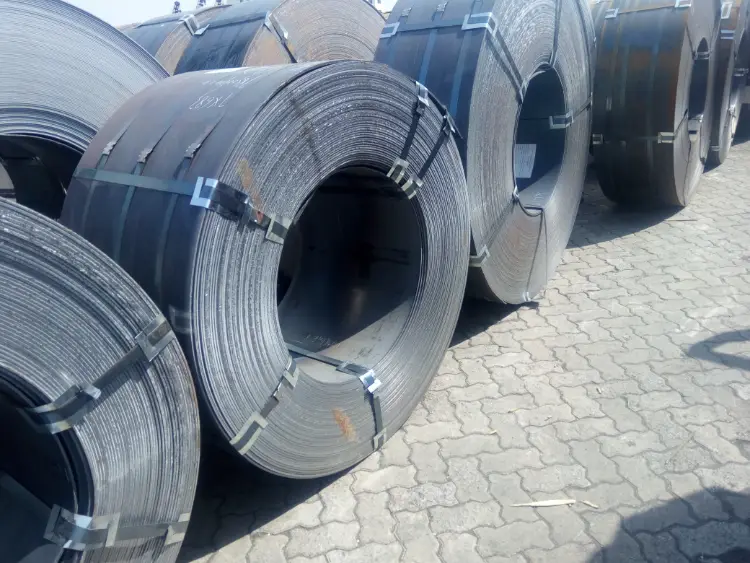
KR D36 Shipbuilding Steel Coil
KR D36 Shipbuilding Steel Coil: High Strength Hull Structural Steel for Marine Applications
Detailed material data for KR D36 steel coil, including chemical composition, mechanical properties, thermal properties, equivalent grades, and application guidance. Compliant with Korean Register of Shipping rules for shipbuilding.
Normalizing rolling, thermo-mechanical controlled processing (TMCP), normalizing, hot rolling, cold forming, welding, cutting
- Phone : +8618037372205
- Email : [email protected]
- WhatsApp: Contact via Whtsapp
- WeChat: +8618037372205
KR D36 Shipbuilding Steel Coil Introduction
KR D36 is a high strength shipbuilding structural steel grade certified by the Korean Register of Shipping (KR). It belongs to the normalized or thermo-mechanically rolled fine-grain steel group with a minimum yield strength of 355 MPa. Key features:
- Excellent weldability and cold forming properties
- Good toughness at low temperatures, with Charpy V-notch impact energy guaranteed at -20°C
- Superior resistance to brittle fracture in marine environments
- Available in coil, plate, and sheet forms for various shipbuilding components
Typically delivered in normalized, thermo-mechanically rolled, or normalized rolled condition.
KR D36 Shipbuilding Steel Coil Chemical Composition
The chemical composition of KR D36 steel is designed to ensure high strength, good weldability, and low-temperature toughness. Key elements:
- Carbon is controlled to a low level to improve weldability and avoid cold cracking
- Manganese provides strength and deoxidation
- Micro-alloying elements like Nb and V are often added for grain refinement and precipitation strengthening
- Phosphorus and sulfur are strictly limited for cleanliness
All values according to KR Rules, Part 2, Chapter 1, Section 2, Table 2.1.1 for Grade D36.
| Chemical Element | Standard Value (max, %) | Remarks |
|---|---|---|
| Carbon (C) | 0.18 | Ladle analysis; for thickness > 100 mm max 0.20% may be agreed |
| Manganese (Mn) | 0.90 - 1.60 | Typical range depends on thickness |
| Silicon (Si) | 0.10 - 0.50 | Deoxidation addition |
| Phosphorus (P) | 0.035 | Max limit for improved toughness |
| Sulfur (S) | 0.035 | Max limit for cleanliness |
| Aluminum (Al, acid soluble) | ≥ 0.015 | For grain refinement; total Al may be specified |
| Niobium (Nb) | 0.02 - 0.05 | Optional micro-alloying; may be used singly or in combination with V, Ti |
| Vanadium (V) | 0.05 - 0.10 | Optional micro-alloying |
| Titanium (Ti) | ≤ 0.02 | Optional; if used for grain refinement |
| Copper (Cu) | ≤ 0.35 | May be present if specified |
| Chromium (Cr) | ≤ 0.20 | Residual; not intentionally added |
| Nickel (Ni) | ≤ 0.40 | Residual; not intentionally added |
| Molybdenum (Mo) | ≤ 0.08 | Residual; not intentionally added |
| Nitrogen (N) | ≤ 0.009 (or 0.012 if nitrogen-binding elements) | Max; if aluminum is present, nitrogen is bound |
KR D36 Shipbuilding Steel Coil Thermal and Electrical Physical Properties
Physical properties are typical for carbon-manganese structural steels used in shipbuilding. Actual values may vary slightly depending on processing route and composition. Notes:
- Density is about 7.85 g/cm³ at room temperature
- Elastic modulus decreases with temperature
- Thermal expansion around 11–13 × 10⁻⁶/K in the range 20–100°C
- Thermal conductivity around 45–55 W/m·K at room temperature
- Electrical resistivity is typical for mild steel
These values are not part of mandatory specification but are used for design calculations.
| Property | Typical Value | Unit | Test Condition |
|---|---|---|---|
| Density (ρ) | 7.85 | g/cm³ | At 20°C |
| Elastic Modulus (E) | 205 - 210 | GPa | At 20°C |
| Shear Modulus (G) | 80 - 82 | GPa | At 20°C, estimated |
| Poisson's Ratio (ν) | 0.29 - 0.30 | — | At 20°C, elastic range |
| Thermal Expansion Coefficient (α) | 11.0 - 13.0 | 10⁻⁶/K | 20 – 100°C |
| Thermal Expansion Coefficient (α) | 12.0 - 14.0 | 10⁻⁶/K | 20 – 200°C |
| Thermal Expansion Coefficient (α) | 13.0 - 15.0 | 10⁻⁶/K | 20 – 400°C |
| Thermal Conductivity (λ) | 45 - 55 | W/m·K | At 20°C |
| Specific Heat Capacity (cp) | 460 - 500 | J/kg·K | At 20°C |
| Electrical Resistivity (ρ_e) | 0.15 - 0.25 | Ω·mm²/m | At 20°C |
KR D36 Shipbuilding Steel Coil Mechanical Properties
Mechanical properties are guaranteed for KR D36 steel in delivery condition and after manufacturing processes. Highlights:
- Minimum yield strength of 355 MPa for thicknesses up to 50 mm
- Tensile strength between 490 and 620 MPa
- Minimum elongation of 21% on gauge length 5.65√S0 for longitudinal specimens
- Charpy V-notch impact energy of at least 24 J at -20°C for longitudinal specimens
- Bending test requires no cracks after 180° bending over a mandrel diameter equal to 3×thickness
All values conform to KR Rules, Part 2, Chapter 1, Section 2.
| Property | Standard Requirement Value | Unit | Test Condition |
|---|---|---|---|
| Yield Strength (ReH) | ≥ 355 | MPa | t ≤ 50 mm, longitudinal, minimum |
| Yield Strength (ReH) | ≥ 355 | MPa | 50 < t ≤ 70 mm, longitudinal, minimum |
| Yield Strength (ReH) | ≥ 355 | MPa | 70 < t ≤ 100 mm, longitudinal, minimum |
| Tensile Strength (Rm) | 490 - 620 | MPa | t ≤ 100 mm, longitudinal |
| Elongation (A) | ≥ 21 | % | Gauge length 5.65√S0, longitudinal, t ≤ 50 mm |
| Elongation (A) | ≥ 21 | % | Gauge length 5.65√S0, transverse, t ≤ 50 mm, if agreed |
| Charpy Impact Energy (KV) | ≥ 24 (average), ≥ 17 (single) | J | Test temperature -20°C, longitudinal, V-notch, t ≤ 50 mm |
| Charpy Impact Energy (KV) | ≥ 24 (average), ≥ 17 (single) | J | Test temperature -20°C, longitudinal, V-notch, 50 < t ≤ 70 mm |
| Charpy Impact Energy (KV) | ≥ 24 (average), ≥ 17 (single) | J | Test temperature -20°C, longitudinal, V-notch, 70 < t ≤ 100 mm |
| Bending Test (Mandrel Diameter) | 3 × t | mm | Bend angle 180°, no cracks, t = specimen thickness |
KR D36 Shipbuilding Steel Coil Exactly Equivalent Material Standards and Substitutable Designations
| Country / Region | Standard | Grade | Remarks |
|---|---|---|---|
| International / IACS | IACS UR W11 | D36 | Common IACS specification for high strength hull structural steel |
| USA | ABS Rules | ABS D36 | American Bureau of Shipping equivalent |
| Norway / Germany | DNV Rules | DNV D36 | Det Norske Veritas (now DNV) equivalent |
| UK | LR Rules | LR D36 | Lloyd's Register equivalent |
| France | BV Rules | BV D36 | Bureau Veritas equivalent |
| China | CCS Rules | CCS D36 | China Classification Society equivalent |
| Japan | NK Rules | NK D36 | Nippon Kaiji Kyokai equivalent |
| Italy | RINA Rules | RINA D36 | Registro Italiano Navale equivalent |
KR D36 Shipbuilding Steel Coil Application Introduction
KR D36 steel coil is specifically designed for shipbuilding and marine construction. It is employed in critical structural components that require high strength, good weldability, and guaranteed toughness at service temperatures down to -20°C. Important considerations:
- Pre-heating is generally not required for thicknesses up to 50 mm when using low-hydrogen welding processes
- Cold forming radii should follow class guidelines (minimum bending radius ≥ 2t for transverse bends)
- Suitable for marine environment with proper corrosion protection systems
- Coil form enables efficient nesting and automated production of shipbuilding parts
Product Applications: Container ships, Bulk carriers, Tankers (oil, chemical, LNG), Passenger ships and ferries, Drilling rigs and semi-submersibles, FPSO (Floating Production Storage and Offloading) vessels, Jack-up rig legs, Offshore wind turbine transition pieces and monopiles
Processed into products: Hull shell plates (bottom, side, deck), Longitudinal stiffeners, Transverse web frames, Bulkhead plates and stiffeners, Rudders and rudder horns, Brackets and foundations, Hatch coamings and covers, Superstructure connections, Engine room framing, Sea chests and watertight enclosures
Application industries: Shipbuilding and repair, Offshore oil and gas platform construction, Marine engineering, Port machinery and equipment, Naval architecture, Renewable energy offshore structures (wind turbine foundations)
KR D36 Shipbuilding Steel Coil Similar or Approximate Alternative Material Recommendations
| Country / Region | Standard | Grade | Remarks |
|---|---|---|---|
| European Union | EN 10025-4 | S355M / S355ML | Thermo-mechanically rolled fine-grain structural steel with comparable yield strength and good weldability; ML grade offers improved low-temperature toughness down to -50°C |
| European Union | EN 10025-3 | S355N / S355NL | Normalized fine-grain steel; N for -20°C impact, NL for -50°C; suitable replacement for many structural applications |
| USA | ASTM A709 / A709M | Grade 50W (Type 2) | High-strength low-alloy structural steel with 345 MPa minimum yield; similar strength level but different toughness requirements |
| Japan | JIS G 3106 | SM490A / SM490B / SM490C | Welded structural steel with 490 MPa tensile class; C grade with 0°C impact, not direct match but often used for shipbuilding in some applications |
| International | ISO 4950-2 | Fe 355 TM / Fe 355 N | Thermo-mechanically rolled or normalized high yield strength structural steels, comparable to D36 but with slightly different certification |
| Russia | GOST 5521 | D36 (in some references) | Russian Maritime Register of Shipping may adopt similar D36 grades; check specific ship registration society requirements |
Notes:
Additional information:
- KR D36 must be produced by approved steel mills and supplied with KR surveyor's certificate (3.1 or 3.2 certificate per EN 10204).
- For thicknesses above 100 mm, special chemical composition limits and mechanical properties may need to be agreed with the classification society.
- Weldability: Carbon equivalent (CEV) is often specified (max 0.38% typically) to ensure cold cracking resistance. The formula CEV = C + Mn/6 + (Cr+Mo+V)/5 + (Ni+Cu)/15 is used.
- Corrosion allowance for marine service is usually 1.5–2.5 mm, but design life must be considered.
- Surface condition: Class A or B per KR Rules; coils are typically descaled and oiled when supplied as hot-rolled pickled and oiled product.
- Share



