
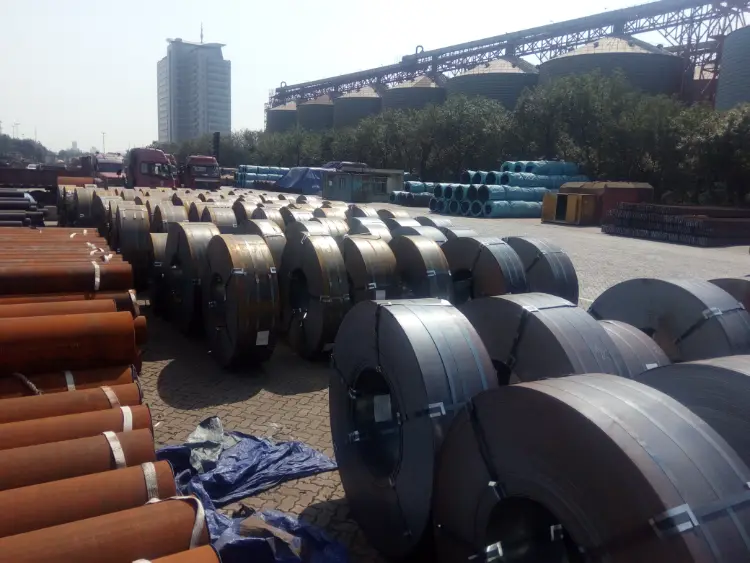
KR D40 Shipbuilding Steel Coil
KR D40 Shipbuilding Steel Coil - High Strength Marine Grade (DH40) Properties & Equivalents
Detailed material data sheet for KR D40 shipbuilding steel coil: chemical composition, mechanical and thermal properties, international equivalents, and application recommendations for marine structures.
Welding, cutting, forming, machining by common shipbuilding methods; suitable for cold bending and hot forming within controlled temperatures
- Phone : +8618037372205
- Email : [email protected]
- WhatsApp: Contact via Whtsapp
- WeChat: +8618037372205
KR D40 Shipbuilding Steel Coil Introduction
KR D40 is a high-strength shipbuilding structural steel grade certified by the Korean Register of Shipping (KR). It belongs to the D40 strength category, offering a minimum yield strength of 390 MPa in thin sections and excellent toughness at temperatures down to -20°C (D-grade). The steel is typically supplied as hot-rolled coils or plates in normalized (N) or thermomechanically controlled rolled (M) condition.
Key characteristics include:
- High strength-to-weight ratio for weight-saving hull construction
- Reliable low-temperature impact properties for cold-water operation
- Good weldability with standard shipyard practices
- Available in a wide range of thicknesses, typically up to 100 mm
- Fully compliant with IACS Unified Requirements W11 for normal and high-strength hull structural steels
KR D40 Shipbuilding Steel Coil Chemical Composition
The chemical composition of KR D40 steel is controlled to ensure the required strength and toughness. Grain-refining elements such as aluminium, niobium, vanadium, and titanium are used, either singly or in combination. The maximum nitrogen content depends on the refining additions. All values are in accordance with KR Rules, Table 2.1.2-1 for high-strength hull structural steels.
| Element | Standard Value (wt.%) | Remarks |
|---|---|---|
| C | ≤0.18 | |
| Mn | 0.90 – 1.60 | If impact properties required, Mn min. may be reduced to 0.70% by agreement |
| Si | 0.10 – 0.50 | |
| P | ≤0.035 | |
| S | ≤0.035 | |
| Al (acid soluble) | ≥0.015 | Minimum when aluminium is used as grain-refining element |
| Nb | 0.02 – 0.05 | Applicable when niobium is added |
| V | 0.05 – 0.10 | Applicable when vanadium is added |
| Ti | ≤0.02 | Applicable when titanium is added; if Al + Nb + V + Ti are all used, total grain-refining content (Al+Nb+V+Ti) ≤0.12% |
| Cu | ≤0.35 | |
| Cr | ≤0.20 | |
| Ni | ≤0.40 | |
| Mo | ≤0.08 | |
| N | ≤0.009 (≤0.012 if only Al is used) | Maximum nitrogen content when grain-refining elements other than aluminium alone are added |
KR D40 Shipbuilding Steel Coil Thermal and Electrical Physical Properties
The following physical properties are typical for high-strength shipbuilding steel and are not specified by KR Rules. Actual values may vary slightly depending on the exact chemical composition and manufacturing route. These data are useful for design calculations involving heat transfer, thermal expansion, and electrical conductivity.
| Property | Typical Value | Unit | Test Condition / Remarks |
|---|---|---|---|
| Density (ρ) | 7.85 | g/cm³ | At 20°C |
| Modulus of Elasticity (E) | 205 – 210 | GPa | Room temperature |
| Shear Modulus (G) | 80 – 85 | GPa | Approximate: G = E / [2(1+ν)] |
| Poisson's Ratio (ν) | 0.3 | - | |
| Thermal Expansion Coefficient (α) | 11.7 | 10⁻⁶/K | Mean value between 20°C and 100°C |
| Thermal Expansion Coefficient (α) | 12.4 | 10⁻⁶/K | Mean value between 20°C and 200°C |
| Thermal Conductivity (λ) | 52 | W/(m·K) | At 20°C |
| Thermal Conductivity (λ) | 50 | W/(m·K) | At 200°C |
| Specific Heat Capacity (c) | 0.47 | J/(g·K) | Room temperature |
| Electrical Resistivity (ρₑ) | 0.25 – 0.30 | μΩ·m | At 20°C |
KR D40 Shipbuilding Steel Coil Mechanical Properties
Mechanical properties are determined on test pieces taken in accordance with KR Rules. Values depend on product thickness. For thicknesses ≤50 mm, the full values apply; for thicker sections a slight reduction in yield strength and elongation is permitted. Charpy V-notch impact tests are mandatory at -20°C for D-grade. Transverse impact values are applicable when specified by the purchaser.
| Property | Standard Requirement | Unit | Test Condition / Remarks |
|---|---|---|---|
| Yield Strength (ReH) | ≥390 | MPa | Thickness t ≤ 50 mm |
| Yield Strength (ReH) | ≥390 | MPa | 50 mm < t ≤ 70 mm |
| Yield Strength (ReH) | ≥370 | MPa | 70 mm < t ≤ 100 mm |
| Tensile Strength (Rm) | 510 – 650 | MPa | All thicknesses |
| Elongation (A) | ≥20 | % | Thickness t ≤ 50 mm, gauge length 5.65√So |
| Elongation (A) | ≥19 | % | 50 mm < t ≤ 70 mm |
| Elongation (A) | ≥18 | % | 70 mm < t ≤ 100 mm |
| Bend Test (Mandrel Diameter) | d = 3a | - | t ≤ 50 mm, 180° bend, a = specimen thickness |
| Bend Test (Mandrel Diameter) | d = 4a | - | 50 mm < t ≤ 100 mm, 180° bend |
| Impact Energy (KV) Longitudinal | ≥31 (average) / ≥22 (individual) | J | Test temperature -20°C, standard specimen 10×10 mm; for smaller sub-size specimens multiply by test-specific factor |
| Impact Energy (KV) Transverse (if ordered) | ≥22 (average) / ≥15 (individual) | J | Test temperature -20°C, transverse direction for thickness ≥ 40 mm |
KR D40 Shipbuilding Steel Coil Fully Equivalent Material Standards and Substitutional Grades
| Country / Region | Standard / Classification Society | Grade | Remarks |
|---|---|---|---|
| International | IACS UR W11 | DH40 | Basis for all major classification societies |
| USA | ABS (American Bureau of Shipping) | DH40 | Direct equivalent, same strength and impact class |
| Norway / Germany | DNV (Det Norske Veritas) | D40 | D40 corresponds to DH40; approval suffix -KV may apply |
| UK | LR (Lloyd's Register) | DH40 | Fully equivalent |
| France | BV (Bureau Veritas) | DH40 | Fully equivalent |
| China | CCS (China Classification Society) | D40 | Same strength, -20°C impact, recognized equivalent |
| Japan | NK (Nippon Kaiji Kyokai) | D40 | Equivalent high-strength grade |
| Italy | RINA (Registro Italiano Navale) | D40 | Same grade definition |
KR D40 Shipbuilding Steel Coil Application Introduction
KR D40 steel coils are predominantly used in the construction of seagoing vessels and offshore structures where high strength and reliable low-temperature toughness are required. The material can be uncoiled, flattened, and cut to size before being integrated into hull assemblies by welding.
Typical applications are listed below:
Product Applications: Ship hull plates (bottom, side, deck, and shell plating), Longitudinal and transverse stiffeners, Bulkheads and tank boundary members, Hatch coamings and main structural supports, Offshore module structural frames and node sections
Processed into products: Cut and profiled hull panels and shell frames, Stiffener flats, angles, and bulb profiles, Welded T-beams and built-up sections, Brackets, gussets, and connection plates, Flanged openings and manhole reinforcements, Chocks and bollards (machined plates)
Application industries: Commercial shipbuilding (bulk carriers, tankers, container ships), Naval and defence shipbuilding (corvettes, support vessels), Offshore oil and gas platforms (jackets, topsides), Offshore wind turbine foundations (monopiles, transition pieces), Heavy marine and harbour constructions (dolphins, quay walls)
KR D40 Shipbuilding Steel Coil Similar and Comparable Substitutional Material Recommendations
| Country / Region | Standard | Grade | Remarks |
|---|---|---|---|
| Europe | EN 10025-4 | S420ML (TMCP) | Higher tensile class (420 MPa) with similar low-temperature toughness; requires classification society approval for hull construction |
| Korea | KR | DH36 | Lower yield strength (≥355 MPa) but same impact class; can be considered for less demanding structural parts |
| Russia | GOST R 52927 | D40S | Russian shipbuilding steel with comparable properties; check for local certification |
| Japan | JIS G 3106 | SM490YA/SM490YB | Structural steel with equivalent tensile strength range; not grade-specific for shipbuilding; requires additional qualification |
| Worldwide | API 2H / 2W | Grade 50 | Offshore structural steel with similar mechanical properties and low-temperature performance; alternative for non-ship structures |
Notes:
Certification: All KR D40 material must be produced at a mill approved by the Korean Register of Shipping and be accompanied by a KR inspection certificate (3.1 or 3.2 per EN 10204).
Weldability: The steel has a typical carbon equivalent (CEV) ≤ 0.38 – 0.43%, which ensures good weldability without preheat under normal conditions; however, for thick sections and low ambient temperatures, a preheat and interpass temperature control may be required.
Thickness tolerances: D40 coils are subject to the dimensional tolerances given in KR Rules, typically Class B or Class C thickness tolerances depending on application.
Surface condition: Coils may have slight mill scale; pickled and oiled surface can be supplied by agreement.
Further processing: The material can be cold-formed, machined, or hot-formed provided that the temperature does not harm the mechanical properties. Re-normalizing may be required after excessive hot forming.
- Share



