
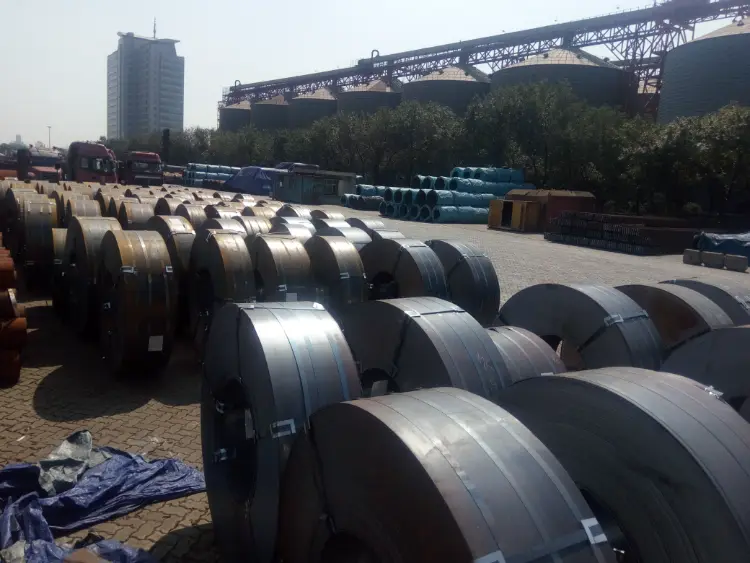
KR E40 Shipbuilding Steel Coil
KR E40 Shipbuilding Steel Coil: High-Strength & Low-Temperature Toughness for Marine Construction
Comprehensive datasheet for KR E40 shipbuilding steel coil covering chemical composition, mechanical properties, thermal performance, international equivalents, and application guidelines.
Controlled rolling (CR), normalizing (N), or thermo-mechanical controlled process (TMCP)
- Phone : +8618037372205
- Email : [email protected]
- WhatsApp: Contact via Whtsapp
- WeChat: +8618037372205
KR E40 Shipbuilding Steel Coil Introduction
KR E40 is a high-strength shipbuilding steel grade certified by the Korean Register (KR) under the Rules for the Classification of Steel Ships. It belongs to the hull structural steel family with a minimum yield strength of 390 MPa and guaranteed impact toughness at -40°C.
The steel is primarily supplied as hot-rolled coils and plates in controlled rolling or thermo-mechanical control process (TMCP) conditions, ensuring fine grain structure and excellent weldability. Its balanced chemistry with microalloying elements (Nb, V, Ti) and strict control of phosphorus and sulfur enhances toughness and resistance to brittle fracture.
- High strength-to-weight ratio for weight-sensitive marine structures
- Excellent notch toughness at sub-zero temperatures (-40°C)
- Good weldability with low carbon equivalent (CEV ≤0.40%)
- Compliant with IACS UR W11 requirements for ordinary and high-strength hull structural steels
KR E40 Shipbuilding Steel Coil Chemical Composition
The chemical composition of KR E40 steel is strictly controlled to achieve high strength and excellent low-temperature toughness. Carbon equivalent (CEV) is limited to ensure good weldability.
- C: Strengthening element, kept low for toughness
- Mn: Major solid-solution strengthener and grain refiner
- Si: Deoxidizer and strength contributor
- Microalloying elements (Nb, V, Ti) provide grain refinement and precipitation strengthening
- Aluminium is added for deoxidation and nitrogen fixation
Residual elements (Cr, Ni, Mo, Cu) are restricted to avoid adverse effects on properties.
| Chemical Element | Standard Value (wt%) | Remarks |
|---|---|---|
| Carbon (C) | ≤0.18 | Ladle analysis |
| Silicon (Si) | 0.10 – 0.50 | |
| Manganese (Mn) | 0.90 – 1.60 | |
| Phosphorus (P) | ≤0.025 | Maximum allowed |
| Sulfur (S) | ≤0.025 | Maximum allowed |
| Chromium (Cr) | ≤0.20 | Residual |
| Nickel (Ni) | ≤0.40 | Residual |
| Molybdenum (Mo) | ≤0.08 | Residual |
| Copper (Cu) | ≤0.35 | Residual |
| Aluminium (Al, acid soluble) | ≥0.015 | Grain refinement |
| Niobium (Nb) a) | 0.02 – 0.05 | Optional; singly or in combination |
| Vanadium (V) a) | 0.05 – 0.10 | Optional; singly or in combination |
| Titanium (Ti) a) | 0.007 – 0.05 | Optional; singly or in combination |
| Nitrogen (N) | ≤0.009 | If not fixed by Ti or Al |
| Carbon Equivalent (CEV) b) | ≤0.40 (typical) | For thickness ≤50 mm; CEV = C + Mn/6 + (Cr+Mo+V)/5 + (Ni+Cu)/15 |
KR E40 Shipbuilding Steel Coil Thermal & Electrical Physical Properties
The physical properties are typical for carbon-manganese structural steels and provide essential data for engineering design. These values are not part of the KR specification but are representative for grade E40 material.
- Density is used for weight estimation.
- Elastic moduli are required for structural analysis.
- Thermal expansion coefficient is important in welded structures and temperature-varying environments.
- Thermal conductivity and specific heat are relevant for heat transfer and welding distortion analyses.
| Property | Typical Value | Unit | Condition |
|---|---|---|---|
| Density (ρ) | 7850 | kg/m³ | 20°C |
| Elastic modulus (E) | 205 | GPa | 20°C |
| Shear modulus (G) | 80 | GPa | 20°C |
| Poisson's ratio (ν) | 0.3 | – | 20°C |
| Coefficient of thermal expansion (α) | 11.5 ×10⁻⁶ | /K | 20 – 100°C |
| Thermal conductivity (λ) | 50 | W/(m·K) | 20°C |
| Specific heat capacity (cp) | 460 | J/(kg·K) | 20°C |
| Electrical resistivity (ρe) | 0.2 ×10⁻⁶ | Ω·m | 20°C |
KR E40 Shipbuilding Steel Coil Mechanical Properties
Mechanical properties are determined on test pieces taken in the longitudinal direction for coils, in accordance with KR Rules. The values below apply for thicknesses ≤50 mm. Impact tests are performed on V-notch Charpy specimens at -40°C. Bending test requires 180° bending over a specified former diameter without cracking.
- Yield strength guarantees resistance to permanent deformation under load.
- High elongation ensures ductility and formability.
- Stringent Charpy impact requirements provide safety against brittle fracture in cold environments.
| Property | Standard Requirement | Unit | Test Condition |
|---|---|---|---|
| Yield strength (ReH) | ≥390 | MPa | Thickness ≤50 mm, room temperature |
| Tensile strength (Rm) | 510 – 650 | MPa | Thickness ≤50 mm, room temperature |
| Elongation (A) | ≥20 | % | Gauge length L0 = 5.65√So, thickness ≤50 mm |
| Charpy impact energy (KV, -40°C) | ≥34 (longitudinal) | J | Standard 10×10 mm V-notch specimen |
| Charpy impact energy (KV, -40°C) | ≥24 (transverse) | J | When transverse specimens specified |
| Bend test (180° bend) | d = 3t | – | Bend former diameter (d), t = specimen thickness, no cracks |
KR E40 Shipbuilding Steel Coil Fully Equivalent Material Standards & Substitutable Grades
| Country / Region | Standard / Rule | Grade | Remarks |
|---|---|---|---|
| International | IACS UR W11 | EH40 | Unified Requirement for ordinary and high strength hull structural steels |
| Korea | KR Rules Pt 2, Ch 1 | E40 | Original KR designation |
| USA | ABS Rules Pt 2, Ch 1 | EH40 | American Bureau of Shipping |
| Norway / Germany | DNV Rules Pt 2, Ch 2 | EH40 | Det Norske Veritas |
| France | BV Rules Pt 2, Ch 1 | EH40 | Bureau Veritas |
| China | CCS Rules Pt 2, Ch 1 | EH40 | China Classification Society |
| Japan | NK Rules Pt 2, Ch 1 | EH40 | Nippon Kaiji Kyokai (ClassNK) |
| UK | LR Rules Pt 2, Ch 1 | EH40 | Lloyd's Register |
| Italy | RINA Rules Pt 2, Ch 1 | EH40 | Registro Italiano Navale |
| Russia | RS Rules Pt 2, Ch 1 | EH40 | Russian Maritime Register of Shipping |
KR E40 Shipbuilding Steel Coil Application Introduction
KR E40 shipbuilding steel coil is engineered for cold and severe marine environments. Its fine grain structure and TMCP condition provide an optimal combination of strength, toughness, and weldability. The steel can be processed by hot cutting, drilling, forming, and all common welding methods.
Typical processing:
- Uncoiling, levelling, and cutting to length for plate components
- Plasma/laser cutting for complex shapes
- Cold forming of stiffeners and brackets
- Submerged arc, FCAW, and SMAW welding with low-hydrogen consumables
Product Applications: Hot-rolled steel coils (widths up to 2,500 mm, thickness 6–25 mm), Cut-to-length plates, Profiled sections (after fabrication)
Processed into products: Main deck plates and stringers, Bottom and side shell plating, Bulkhead plates and corrugations, Transverse web frames and floors, Longitudinal stiffeners and T-bars, Hatch coamings and container cell guides, Ballistrade and doubler plates
Application industries: Shipbuilding (bulk carriers, tankers, container ships, LNG carriers), Offshore oil & gas (jacket legs, helideck structures), Marine renewable energy (offshore wind turbine foundations), Naval architecture and defense (hulls, decks)
KR E40 Shipbuilding Steel Coil Similar / Alternative Material Recommendations
| Country / Region | Standard | Grade | Remarks |
|---|---|---|---|
| Europe | EN 10025-4 | S420ML | Thermomechanical rolled weldable fine grain structural steel, min. yield 420 MPa, impact -50°C (not class certified for marine) |
| China | GB/T 712 | EH40 | Shipbuilding steel grade fully equivalent to KR E40, Chinese classification society approved |
| Japan | JIS G3106 | SM490YA | Weldable structural steel, min. yield 365 MPa, impact 0°C; not a direct strength/toughness match, but may substitute in less demanding structures |
| USA | ASTM A572 / A572M | Grade 60 [415] | High strength low alloy structural steel, yield 415 MPa (Grade 60), but no low-temperature impact guarantee; not suitable for ship class applications |
| International | ISO 630-3 | S420N | Normalized structural steel, yield 420 MPa, impact -20°C; needs additional certification for marine use |
Notes:
- KR E40 steel must be produced at an approved mill and certified by a KR surveyor.
- Full traceability and marking according to KR Rules required.
- Pre-heating may be necessary for welding depending on thickness and heat input; follow approved welding procedures.
- Supplementary requirements (e.g., through-thickness properties, specific Z-test for lamellar tearing resistance) can be agreed at time of order.
- For thicknesses above 50 mm, mechanical properties may differ and should be checked against the specific rule edition.
- Share



