
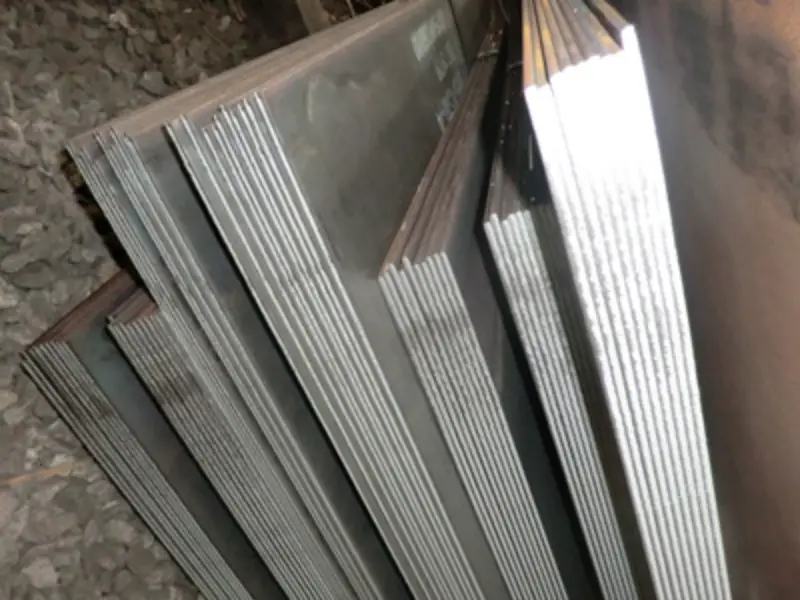
409 Stainless Steel (S40900)
S40900 (409) Ferritic Stainless Steel Plate & Coil – Full Technical Data & Equivalents
Explore in-depth technical data for 409 (S40900) ferritic stainless steel sheet, plate and coil. Includes chemical composition, mechanical strength, thermal properties, international equivalents and application guidance.
Welding, forming, stamping, bending, blanking, shearing, drawing
- Phone : +8618037372205
- Email : [email protected]
- WhatsApp: Contact via Whtsapp
- WeChat: +8618037372205
409 Stainless Steel Introduction
409 (UNS S40900) is a titanium-stabilized ferritic stainless steel designed primarily for high-temperature corrosion resistance, weldability, and formability. With a chromium content of approximately 11%, it offers moderate corrosion resistance, far exceeding that of carbon steel, while titanium additions minimize intergranular corrosion and improve as-welded ductility. The alloy is widely used in automotive exhaust systems, catalytic converters, heat exchangers, and other thin-gauge fabricated components. It can be supplied in the annealed condition with a predominantly ferritic microstructure, although some martensite may form under rapid cooling from elevated temperatures. Key characteristics include:
- Excellent oxidation resistance up to ~815°C (1500°F) in intermittent service
- Good formability for bending, blanking, and deep drawing
- Weldable by common fusion and resistance methods without post-weld annealing for many applications
- Cost-effective alternative to austenitic stainless steels in mildly corrosive environments
409 Stainless Steel Chemical Composition
Chemical composition in accordance with ASTM A240/A240M for grade 409 (UNS S40900). Titanium is added to stabilize the ferritic structure and provide resistance to sensitization. The minimum titanium content is defined as 6×(C+N) but not exceeding 0.75%. Nitrogen is typically present but not specified individually; the Ti min value accounts for total carbon plus nitrogen.
| Element | Composition (wt.%) | Remarks |
|---|---|---|
| Carbon (C) | max 0.08 | |
| Manganese (Mn) | max 1.00 | |
| Silicon (Si) | max 1.00 | |
| Phosphorus (P) | max 0.045 | |
| Sulfur (S) | max 0.030 | |
| Chromium (Cr) | 10.5 – 11.7 | |
| Nickel (Ni) | max 0.50 | |
| Titanium (Ti) | min 6×(C+N), max 0.75 | Stabilizing element; typical range 0.15 – 0.75 |
| Iron (Fe) | Balance |
409 Stainless Steel Thermal & Electrical Physical Properties
Representative physical properties for annealed 409 stainless steel. These values are typical and may vary slightly with product form and temperature. Data are derived from published technical literature for ferritic stainless steels of this type.
| Property | Typical Value | Unit | Test Conditions / Temperature |
|---|---|---|---|
| Density (ρ) | 7.73 | g/cm³ | At 20°C |
| Modulus of Elasticity (E) | 200 | GPa | At 20°C, tension |
| Shear Modulus (G) | 77 | GPa | Calculated from E and ν |
| Poisson's Ratio (ν) | 0.30 | – | At 20°C, elastic range |
| Thermal Expansion Coefficient (α) | 10.6 | ×10⁻⁶ /K | 20 – 100°C |
| Thermal Expansion Coefficient (α) | 11.4 | ×10⁻⁶ /K | 20 – 300°C |
| Thermal Expansion Coefficient (α) | 12.1 | ×10⁻⁶ /K | 20 – 500°C |
| Thermal Conductivity (λ) | 25.0 | W/m·K | At 100°C |
| Thermal Conductivity (λ) | 26.5 | W/m·K | At 500°C |
| Specific Heat Capacity | 460 | J/kg·K | At 20 – 100°C |
| Electrical Resistivity (ρₑ) | 0.60 | μΩ·m | At 20°C |
409 Stainless Steel Mechanical Properties
Mechanical properties for annealed 409 stainless steel sheet/plate at room temperature per ASTM A240/A240M. Specific requirements may vary with product thickness and condition. The bend test applies to flat-rolled products up to 1 in. (25.4 mm) thick. Hardness values are maximum limits.
| Property | Specified Value | Unit | Test Condition |
|---|---|---|---|
| Tensile Strength (Rm) | 380 min | MPa | Room temperature, transverse or longitudinal |
| Yield Strength (ReH, 0.2% offset) | 170 min | MPa | Room temperature |
| Elongation (A) | 20 min | % | In 2 in. (50 mm) gauge length; for thickness ≥ 0.040 in. (1.0 mm), or 25% for thickness < 0.040 in. |
| Hardness (HRB) | 88 max | HRB | Indicative; applicable for thickness ≥ 0.060 in. (1.5 mm) |
| Hardness (HBW) | 200 max | HB | For thickness permitting Rockwell B or Brinell test |
| Bend Test (180°) – thickness ≤ 0.180 in. (4.57 mm) | 1t | – | t = specimen thickness; no cracking when bent 180° around a diameter equal to thickness |
| Bend Test (180°) – thickness > 0.180 in. (4.57 mm) | 2t | – | Bend diameter = 2 × thickness |
409 Stainless Steel Direct Equivalent Standards & Substitutable Grades
| Country/Region | Standard | Designation | Remarks |
|---|---|---|---|
| USA | ASTM A240/A240M | 409 (S40900) | Original specification; stable ferritic grade with Ti |
| Europe | EN 10088-2 | 1.4512 (X2CrTi12) | Lower carbon (≤0.03%); otherwise chemically equivalent |
| Japan | JIS G4304 / G4305 | SUS409 | Compositionally equivalent to ASTM 409 |
| China | GB/T 20878 / GB/T 3280 | S11163 (06Cr11Ti) / 022Cr11Ti | Equivalent to 1.4512, suitable for interchange |
| International | ISO 15510 | X2CrTi12 | Corresponds to EN 1.4512 |
409 Stainless Steel Application Introduction
409 (S40900) is designed for components requiring oxidation resistance and moderate corrosion protection up to approximately 815°C (1500°F) in intermittent service. It is not intended for highly corrosive environments (e.g., chloride-rich, acidic) but excels in mildly corrosive, high-temperature oxidizing atmospheres. Its good formability and weldability make it suitable for mass-produced parts.
Product Applications: Complete exhaust systems (mufflers, resonators, pipes), Catalytic converter shells, Exhaust manifold heat shields, Thin-gauge heat exchangers, Furnace liners and burner components, Agricultural spreaders and storage bins
Processed into products: Muffler outer skins and internal baffles, Exhaust downpipes and flex couplings, Converter canisters, Exhaust flanges and brackets, Heat exchanger tubes and fins, Stamped heat shields, Welded storage hoppers
Application industries: Automotive, Commercial vehicle manufacturing, Agricultural machinery, Heat exchanger and boiler fabrication, Architectural metalwork (non-critical corrosion areas), Home appliance components (e.g., furnace parts, fire screens)
409 Stainless Steel Similar & Near-Equivalent Stainless Steels for Reference
| Country/Region | Standard | Designation | Remarks |
|---|---|---|---|
| USA | ASTM A240 | 409L (S40920) | Ultra-low carbon (≤0.03%) version of 409; better weldability, similar mechanicals |
| USA | ASTM A240 | 410 (S41000) | Martensitic stainless steel with ~12% Cr; higher strength after heat treatment, but lower oxidation resistance and poorer weldability than 409 |
| USA | ASTM A240 | 430 (S43000) | Ferritic, 16-18% Cr; superior corrosion resistance, no Ti stabilization; less suitable for high-temperature exhaust service |
| Europe | EN 10088-2 | 1.4003 (X2CrNi12) | Ferritic/martensitic 12% Cr with Ni; often used as structural stainless; slightly higher strength but Ti-free |
| Europe | EN 10088-2 | 1.4016 (X6Cr17) | Similar to 430; higher Cr, used in indoor/outdoor trim, not for high-temperature exhaust parts |
Notes:
The material is typically supplied in a bright annealed or pickled finish. For severe forming operations, intermediate annealing may be required. Although the alloy is ferritic, practical cooling rates can produce a small fraction of martensite, especially in thicker sections. The titanium stabilization prevents carbide precipitation during welding and high-temperature service, but over-stabilization can lead to embrittlement; Ti content is carefully controlled. Post-weld heat treatment is generally not necessary for thin sections, but a stress-relief anneal at 700–820°C can be applied if required. Availability: primarily hot-rolled or cold-rolled coil and sheet; plates up to 10 mm are standard.
- Share



