
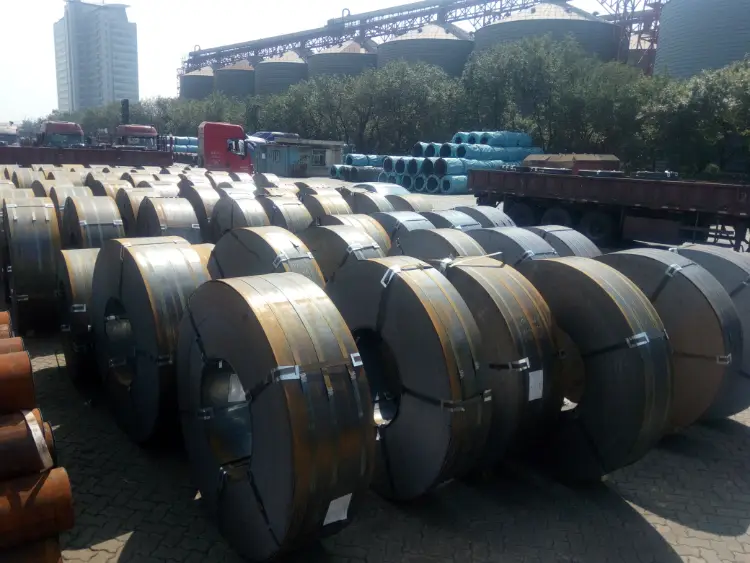
KR F40 Shipbuilding Steel Coil
KR F40 Shipbuilding Steel Coil: High-Strength Plate for Arctic & Offshore Structures
Comprehensive material data for KR F40 shipbuilding steel coil: chemical composition, mechanical properties, thermal and electrical physical properties, equivalent international grades, and application recommendations.
Welding, cold forming, hot forming, machining, gas cutting
- Phone : +8618037372205
- Email : [email protected]
- WhatsApp: Contact via Whtsapp
- WeChat: +8618037372205
KR F40 Shipbuilding Steel Coil Introduction
KR F40 is a high-strength shipbuilding structural steel grade certified by the Korean Register of Shipping (KR), intended for use in hull and offshore structures operating at extremely low temperatures. It belongs to the F-grade notch toughness class, guaranteeing a minimum impact energy of 41 J at -60 °C. With a specified minimum yield strength of 390 MPa and tensile strength in the range of 510–650 MPa, KR F40 steel is supplied as hot-rolled coils and plates, typically in normalized (N) or thermo-mechanically controlled processed (TMCP) condition. The fine-grained microstructure ensures excellent weldability and superior resistance to brittle fracture, making it suitable for ice-going vessels, Arctic offshore platforms, and cryogenic storage tanks. The low carbon equivalent (typically ≤ 0.43%) and micro-alloying additions (Nb, V, Ti) allow good weldability without compromising strength.
KR F40 Shipbuilding Steel Coil Chemical Composition
Chemical composition as per KR Rules. For thicknesses ≤ 50 mm, the ladle analysis limits are given. Fine-grain elements (Nb, V, Ti) may be added singly or in combination. The carbon equivalent (CE) shall not exceed 0.43% for general application unless otherwise agreed. The composition ensures balanced strength and weldability.
| Element | Standard Value (max unless range) | Remarks |
|---|---|---|
| C | 0.16 | |
| Si | 0.10 – 0.50 | Typical for deoxidation; lower values may be accepted for TMCP steels |
| Mn | 0.90 – 1.60 | Higher Mn for thick products subject to carbon equivalent control |
| P | 0.025 | Max |
| S | 0.025 | Max |
| Al (total) | ≥ 0.015 | Minimum total aluminum required for fine-grain practice |
| Nb | 0.02 – 0.05 | Optional; if added |
| V | 0.05 – 0.10 | Optional; if added |
| Ti | ≤ 0.02 | Optional; if added |
| Cu | ≤ 0.35 | |
| Cr | ≤ 0.20 | |
| Ni | ≤ 0.40 | |
| Mo | ≤ 0.08 | |
| N | ≤ 0.012 | Usually combined with Al and other grain-refining elements |
KR F40 Shipbuilding Steel Coil Thermal and Electrical Physical Properties
Representative physical properties for KR F40 steel at ambient temperature unless otherwise indicated. These values are not part of the classification rules but are measured for similar HSLA shipbuilding steels and can be used for design calculations. Actual values may vary slightly with exact composition and manufacturing process.
| Property | Typical Value | Unit | Test Condition / Remarks |
|---|---|---|---|
| Density (ρ) | 7.85 | g/cm³ | At 20 °C |
| Elastic Modulus (E) | 205 – 210 | GPa | At room temperature; decreases with temperature |
| Shear Modulus (G) | 80 – 81 | GPa | Calculated from E and Poisson's ratio |
| Poisson's Ratio (ν) | 0.29 – 0.30 | Elastic range | |
| Thermal Expansion Coefficient (α) | 12.0 | 10⁻⁶/K | Mean value between 20 °C and 100 °C |
| Thermal Conductivity (λ) | 48 – 52 | W/(m·K) | At 20 °C |
| Specific Heat Capacity (cp) | 460 – 480 | J/(kg·K) | At 20 °C |
| Electrical Resistivity (ρ_e) | 0.22 | μΩ·m | At room temperature, for low-alloy steels |
KR F40 Shipbuilding Steel Coil Mechanical Properties
Minimum mechanical properties according to KR Rules for F40 steel plates/coils. The values apply to transverse test pieces unless longitudinal is specified for impact test. Impact test temperature: -60 °C. For product thicker than 50 mm, the requirements may be slightly relaxed on the minimum yield strength or tested with adjusted specimens. All tensile values reported are for specimens taken from production samples.
| Property | Requirement / Typical Value | Unit | Test Condition / Remarks |
|---|---|---|---|
| Yield Strength (ReH) | ≥ 390 | MPa | Transverse, thickness ≤ 70 mm; for thk > 70 mm, min. 380 MPa |
| Tensile Strength (Rm) | 510 – 650 | MPa | Transverse, all thicknesses |
| Elongation (A) | ≥ 20 | % | Gauge length L0 = 5.65√S0, transverse, t ≤ 50 mm. For t > 50 mm, min. 19 % |
| Charpy V-notch Impact Energy (KV2) | ≥ 41 (longitudinal) | J | At -60 °C; standard specimen 10x10 mm. For subsize specimens, energy requirement is proportional to cross-section area |
| Charpy V-notch Impact Energy (KV2) | ≥ 27 (transverse) | J | At -60 °C; transverse test may be agreed |
| Bend Test | No cracks or defects; 180° bend over diameter 3t (t=plate thk) | For steel with Rm > 490 MPa, bend test is required on specimen from each heat |
KR F40 Shipbuilding Steel Coil Perfectly Equivalent Material Standards and Replaceable Grades
| Country/Region | Standard | Grade | Remarks |
|---|---|---|---|
| International / USA | ABS (American Bureau of Shipping) | ABS FH40 | F-grade (-60 °C) high-strength, same strength class |
| Norway / Germany | DNV (Det Norske Veritas) | DNV F40 | Also known as DNV NVE40 or VL F40; identical toughness and strength requirements |
| France | BV (Bureau Veritas) | BV FH40 | Equivalent low-temperature shipbuilding steel |
| UK | LR (Lloyd's Register) | LR FH40 | Corresponding grade with -60 °C impact requirement |
| Japan | NK (ClassNK) | NK F40 | Compatible grade; note that some shipyards use KF40 designation |
| Russia | RS (Russian Maritime Register) | RS F40 | Similar characteristics under RS Rules |
| China | CCS (China Classification Society) | CCS FH40 | Equivalent classification society grade |
| Italy | RINA | RINA F40 | Same strength and toughness level |
KR F40 Shipbuilding Steel Coil Application Introduction
KR F40 shipbuilding steel coil is specifically designed for critical structural applications in extreme low-temperature environments. It is primarily used where superior notch toughness at -60 °C and high strength are mandatory. The steel is supplied in either as-rolled and normalized or TMCP condition, allowing subsequent welding and fabrication without significant loss of properties. Key application sectors include:
Product Applications: Hull plates and stiffeners for icebreakers, Deck plating and web frames in Arctic service, Liquefied natural gas (LNG) tank secondary barriers, Jack-up rig legs and cantilever beams exposed to cold, Offshore module structural beams and columns
Processed into products: Longitudinal stiffeners, stringer plates, sheer strake, Bilge keel, rudder horn, stern frame, Bulkhead plating in cold cargo holds, Gusset plates and brackets in truss structures, Cold-formed stiffeners with tight bend radii
Application industries: Shipbuilding (ice-class vessels, LNG carriers, FPSO), Offshore oil & gas (Arctic platforms, subsea structures), Cryogenic storage and transportation, Port and harbor machinery, Heavy equipment for cold climate mining
KR F40 Shipbuilding Steel Coil Similar / Near-Equivalent Material Recommendations
| Country/Region | Standard | Grade | Remarks |
|---|---|---|---|
| International / USA | ABS | ABS EH40 | Slightly higher impact temperature (-40 °C vs -60 °C); otherwise chemical and mechanical properties align. Suitable for less severe cold conditions. |
| Norway | DNV | DNV E40 | Impact at -40 °C; may be used with additional testing to prove -60 °C performance. |
| Europe | EN 10025-4 | S460ML | Thermo-mechanical rolled structural steel with 460 MPa yield; -50 °C impact possible with qualification. Not a direct ship steel but can be used in offshore structures. |
| USA | ASTM A131 / A131M | Grade EH40 | ASTM shipbuilding steel EH40 (-40 °C). Not perfectly equivalent due to lower impact temperature; could be considered if reduced toughness is acceptable. |
| Japan | JIS G 3106 | SM490B / SM490C | Not a ship plate, but a general structural steel. Requires careful evaluation for marine use. |
| South Korea / International | API 2W / 2Y | Grade 50 or 60 | Offshore structural steel plates designed for low temperatures; need to confirm -60 °C impact energy specific to project. |
Notes:
Welding: Preheating is generally not required for thin sections, but low-hydrogen welding consumables are mandatory. The recommended heat input range is 1.5–3.0 kJ/mm for SAW and 0.8–2.5 kJ/mm for GMAW. Cold forming: Minimum bending radius of 3 times the plate thickness for transverse bends is recommended to avoid cracking. Ordering: When ordering KR F40 coils, the required notch toughness condition (F-grade, -60 °C) and delivery condition (e.g., TMCP) must be specified. The product is subject to survey and stamping by KR surveyors.
- Share



