
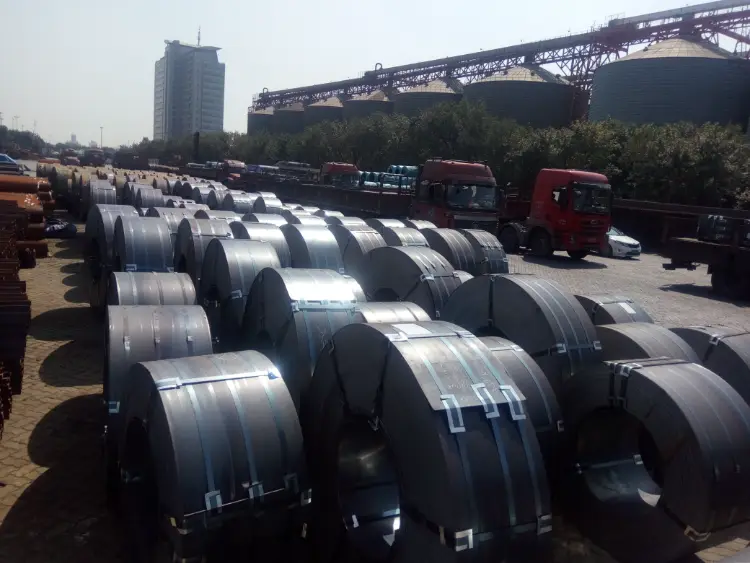
KR A47 Shipbuilding Steel Coil
KR A47 Shipbuilding Steel Coil: High-Strength Marine Grade for Offshore Structures
Comprehensive technical data for KR A47 shipbuilding steel coil, including chemical composition, mechanical properties, thermal and electrical performance, equivalent grades, and application guidelines.
Hot rolling, TMCP, normalizing, cutting, welding, forming, machining
- Phone : +8618037372205
- Email : [email protected]
- WhatsApp: Contact via Whtsapp
- WeChat: +8618037372205
KR A47 Shipbuilding Steel Coil Introduction
KR A47 is a high-strength shipbuilding steel grade approved by the Korean Register of Shipping (KR). It is designed for critical structural components in large vessels and offshore platforms, offering a minimum yield strength of 460 MPa (47 kgf/mm²). The steel exhibits excellent weldability, good toughness at low temperatures, and reliable resistance to brittle fracture, making it suitable for harsh marine environments. It is typically supplied in normalized or thermo-mechanically controlled processed (TMCP) condition, and can be produced as coils, plates, or sections. The grade is classified within the high-strength structural steel group for shipbuilding, ensuring compliance with international maritime safety standards.
KR A47 Shipbuilding Steel Coil Chemical Composition
The chemical composition of KR A47 shipbuilding steel is controlled to ensure high strength, good weldability, and low-temperature toughness. Typical ladle analysis values comply with KR rules. Microalloying elements such as niobium (Nb), vanadium (V), and titanium (Ti) may be added individually or in combination to achieve the required properties. Carbon equivalent (CEV) is usually restricted to around 0.40%–0.43% to maintain weldability.
| Element | Specified Value | Remarks |
|---|---|---|
| C (Carbon) | ≤ 0.18 | For thickness ≤ 50 mm; for thicker plates may be ≤ 0.20 |
| Si (Silicon) | 0.10 – 0.55 | Deoxidizer, contributes to strength |
| Mn (Manganese) | 0.90 – 1.70 | Enhances strength and toughness |
| P (Phosphorus) | ≤ 0.025 | Max limit for low temperature toughness |
| S (Sulfur) | ≤ 0.025 | Improves internal soundness |
| Al (Aluminum, acid soluble) | ≥ 0.015 | Grain refining, if used |
| Nb (Niobium) | 0.02 – 0.05 | Optional microalloying |
| V (Vanadium) | 0.05 – 0.10 | Optional microalloying |
| Ti (Titanium) | 0.007 – 0.05 | Optional, grain refinement |
| Cu (Copper) | ≤ 0.35 | If specified by purchaser |
| Cr (Chromium) | ≤ 0.20 | If added |
| Ni (Nickel) | ≤ 0.40 | If added |
| Mo (Molybdenum) | ≤ 0.08 | If added |
| CEV (Carbon Equivalent) | ≤ 0.43 | Typically based on IIS formula |
KR A47 Shipbuilding Steel Coil Thermal and Electrical Physical Properties
The following physical properties are typical for high-strength low-alloy shipbuilding steels similar to KR A47 at room temperature. Actual values may vary slightly depending on specific composition and processing route. Data are provided for engineering design purposes, including thermal expansion, conductivity, and electrical resistivity.
| Property | Typical Value | Unit | Test Condition / Remarks |
|---|---|---|---|
| Density (ρ) | 7.85 | g/cm³ | At 20°C |
| Elastic Modulus (E) | 205 | GPa | Room temperature |
| Shear Modulus (G) | 80 | GPa | Room temperature |
| Poisson's Ratio (ν) | 0.29 | - | Room temperature, within elastic range |
| Thermal Expansion Coefficient (α) | 11.5 – 12.5 | 10⁻⁶/K | 20–100°C range |
| Thermal Expansion Coefficient (α) | 12.5 – 13.5 | 10⁻⁶/K | 20–200°C range |
| Thermal Expansion Coefficient (α) | 13.5 – 14.5 | 10⁻⁶/K | 20–400°C range |
| Thermal Conductivity (λ) | 42 – 48 | W/(m·K) | At 20°C |
| Specific Heat Capacity (cp) | 460 – 500 | J/(kg·K) | At 20°C |
| Electrical Resistivity (ρ_e) | 0.20 – 0.25 | Ω·mm²/m | At 20°C |
KR A47 Shipbuilding Steel Coil Mechanical Properties
Mechanical properties are verified by tensile and impact testing as per KR rules. Minimum yield strength (ReH) is 460 MPa for all thickness ranges unless otherwise stated. Tensile strength (Rm) typically ranges from 570 to 720 MPa. The elongation after fracture depends on specimen type and thickness. Impact toughness values are guaranteed at specified temperatures (e.g., 0°C, -20°C, or -40°C depending on the delivery condition and suffix designation; standard A grade is tested at 0°C, while EH47 is tested at -40°C).
| Property | Specified Requirement | Unit | Condition |
|---|---|---|---|
| Yield Strength (ReH) | ≥ 460 | MPa | Transverse, thickness ≤ 100 mm |
| Tensile Strength (Rm) | 570 – 720 | MPa | Transverse, all thicknesses |
| Elongation (A5) | ≥ 17 | % | Gauge length 5.65√So, transverse |
| Elongation (A50) | ≥ 20 | % | Gauge length 50 mm, transverse |
| Bend Test (D = diameter) | No cracks | - | 180° bend, D = 3t (t ≤ 50 mm); 4t (t > 50 mm) |
| Impact Energy (KV2) at 0°C | ≥ 34 (longitudinal) / 24 (transverse) | J | Standard A-grade, 10x10 mm specimen |
| Impact Energy (KV2) at -20°C | ≥ 34 (longitudinal) / 24 (transverse) | J | For D-grade suffix if required |
| Impact Energy (KV2) at -40°C | ≥ 34 (longitudinal) / 24 (transverse) | J | For E-grade suffix; EH47 equivalent |
| Hardness | ≤ 250 | HV10 | For reference; not mandatory |
KR A47 Shipbuilding Steel Coil Completely Equivalent Material Standards and Replacement Grades
| Country/Region | Standard | Grade | Remarks |
|---|---|---|---|
| International | IACS UR W11 | AH47/EH47 | Common IACS classification for high-strength hull steel |
| USA | ASTM A131 / A131M | AH47, DH47, EH47 | Corresponding to impact test temperature levels |
| USA | ABS Rules | A47, D47, E47 | American Bureau of Shipping |
| Norway/Germany | DNV GL Rules (now DNV) | NV A47, NV D47, NV E47 | Det Norske Veritas Germanischer Lloyd |
| France | BV Rules | A47, D47, E47 | Bureau Veritas |
| UK | LR Rules | AH47, DH47, EH47 | Lloyd's Register |
| Japan | NK Rules | KA47, KD47, KE47 | Nippon Kaiji Kyokai |
| China | CCS Rules | AH47, DH47, EH47 | China Classification Society |
| Italy | RINA Rules | A47, D47, E47 | Registro Italiano Navale |
| Europe | EN 10025-6 | S460MLO (offshore) | Not fully equivalent but often substituted with supplementary requirements |
KR A47 Shipbuilding Steel Coil Application Introduction
KR A47 steel coil is specifically developed for large-scale marine and offshore structures. Its high strength-to-weight ratio reduces hull weight, improving fuel efficiency and payload capacity. The material is delivered in coil form, which is subsequently leveled and cut into plates or directly used in roll-forming processes for stiffeners and profiles. Welding procedures must follow classification society guidelines to preserve toughness and strength in heat-affected zones (HAZ). Preheating and post-weld heat treatment are typically not required for moderate thicknesses but may be needed for very thick sections (>50 mm) depending on carbon equivalent.
Product Applications: Large container ships, Bulk carriers and tankers, LNG/LPG carrier hulls, FPSO (Floating Production Storage and Offloading) units, Jack-up rig legs and spudcans, Offshore substation topsides
Processed into products: Main deck plates and stringer plates, Bottom shell and bilge plates, Longitudinal and transverse bulkheads, Web frames and floor plates, Stiffeners (T-bars, angles produced from coil), Hatch coaming and corner castings, Mooring equipment seatings, Transition pieces for wind turbine monopiles
Application industries: Shipbuilding (commercial and naval vessels), Offshore oil & gas platforms, Marine renewable energy (wind turbine foundations), Bridge and heavy civil engineering (when certified by classification societies), Container handling equipment
KR A47 Shipbuilding Steel Coil Similar / Alternative Materials with Near Properties
| Country/Region | Standard | Grade | Remarks |
|---|---|---|---|
| Europe | EN 10025-6 | S460QL / S460QL1 | Quenched and tempered structural steel; similar yield strength, but different delivery condition and toughness |
| Europe | EN 10025-4 | S460M / S460ML | Thermomechanically rolled; close match if impact and weldability requirements align |
| USA | ASTM A572/A572M | Grade 65 (450 MPa) | Slightly lower yield, but widely available; may be considered for less demanding structural parts |
| USA | ASTM A709/A709M | Grade 50W | Atmospheric corrosion resistant, yield 345 MPa, not equivalent but sometimes used in marine environments |
| Japan | JIS G 3106 | SM570 | High strength welded structural steel, yield ≥ 460 MPa, requires additional impact testing for ship use |
| China | GB/T 712 | EH47 | Chinese shipbuilding steel standard directly equivalent to KR A47 |
Notes:
Additional Information: The impact test temperature suffix (e.g., AH47 – 0°C, DH47 – -20°C, EH47 – -40°C) must be specified in the purchase order. When ordering coils, the customer should clarify whether edge trimming and specific surface treatment (shot blasting, primer) are required. The steel can be supplied with through-thickness tensile properties (Z-grade) for critical applications to prevent lamellar tearing. Ultrasonic testing is commonly performed in accordance with classification society requirements. For welding, low-hydrogen consumables matching the strength level are recommended, and heat input should be controlled to avoid grain coarsening in the HAZ.
- Share



