
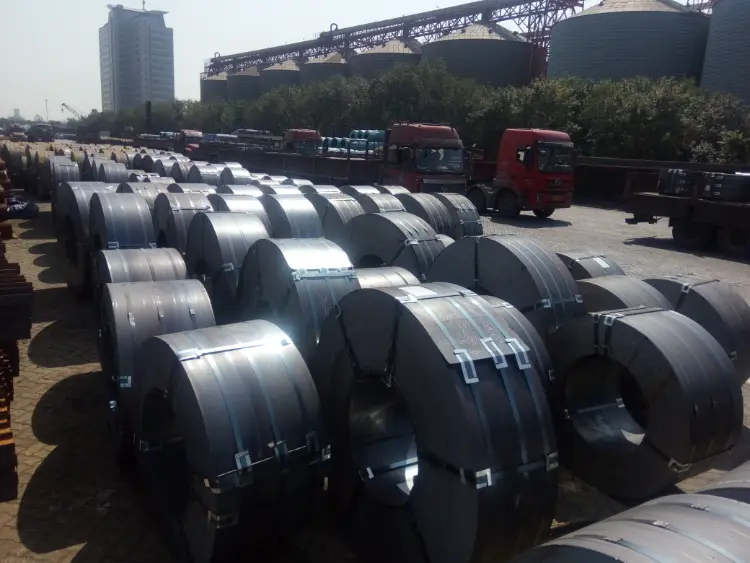
KR D47 Shipbuilding Steel Coil
KR D47 Shipbuilding Steel Coil: High Strength & Low-Temperature Toughness
Detailed material data for KR D47 shipbuilding steel coil, equivalent to IACS DH460. Includes chemical composition, mechanical properties, thermal and electrical properties, international equivalents, and application guidance.
Hot rolling, thermomechanical controlled processing (TMCP), normalizing, or quenching and tempering; suitable for cold forming, welding, and cutting.
- Phone : +8618037372205
- Email : [email protected]
- WhatsApp: Contact via Whtsapp
- WeChat: +8618037372205
KR D47 Shipbuilding Steel Coil Introduction
KR D47 is a high-strength hull structural steel coil approved by the Korean Register of Shipping (KR). It belongs to the extra-high-strength category with a minimum yield strength of 460 MPa and is designed for critical marine and offshore applications requiring superior toughness at low temperatures (-20 °C impact test). The steel is microalloyed with niobium, vanadium, and titanium to achieve fine grain refinement and excellent weldability.
- Excellent combination of strength and ductility
- Good weldability with low carbon equivalent
- Superior notch toughness at sub-zero temperatures
- Approved by major classification societies for ship and offshore structures
KR D47 Shipbuilding Steel Coil Chemical Composition
The chemical composition of KR D47 steel is designed to achieve high strength and excellent low‑temperature toughness. Controlled microalloying elements (Nb, V, Ti) provide grain refinement and precipitation strengthening, while phosphorus and sulfur are kept at very low levels to ensure cleanliness and toughness.
- Carbon equivalent (Ce) typically ≤ 0.40% for good weldability.
- Aluminum is added for deoxidation and grain size control.
| Element | Value (max or range) | Remarks |
|---|---|---|
| Carbon (C) | ≤ 0.18% | Ladle analysis |
| Manganese (Mn) | 0.90 – 1.60% | |
| Silicon (Si) | ≤ 0.55% | |
| Phosphorus (P) | ≤ 0.025% | |
| Sulfur (S) | ≤ 0.025% | |
| Aluminum (Al) | ≥ 0.020% | Acid-soluble |
| Niobium (Nb) | 0.02 – 0.05% | Microalloying |
| Vanadium (V) | ≤ 0.10% | Microalloying |
| Titanium (Ti) | ≤ 0.02% | Microalloying |
| Copper (Cu) | ≤ 0.35% | |
| Chromium (Cr) | ≤ 0.20% | |
| Nickel (Ni) | ≤ 0.40% | |
| Molybdenum (Mo) | ≤ 0.08% | |
| Nitrogen (N) | ≤ 0.012% | Not intentionally added |
KR D47 Shipbuilding Steel Coil Physical Properties
Physical constants for KR D47 are representative of low‑alloy high‑strength steels. Values are measured at 20 °C unless otherwise indicated.
- Thermal expansion data are provided over several temperature ranges for design calculations.
- Electrical resistivity is typical for microalloyed structural steels.
| Property | Typical Value | Unit | Test Condition / Temperature |
|---|---|---|---|
| Density (ρ) | 7.85 | g/cm³ | 20 °C |
| Young's Modulus (E) | 205 | GPa | 20 °C |
| Shear Modulus (G) | 79 | GPa | 20 °C (calculated) |
| Poisson's Ratio (ν) | 0.30 | — | 20 °C |
| Thermal Expansion (α) | 12.0 | 10⁻⁶ /K | 20 – 100 °C |
| Thermal Expansion (α) | 12.5 | 10⁻⁶ /K | 20 – 200 °C |
| Thermal Expansion (α) | 13.0 | 10⁻⁶ /K | 20 – 300 °C |
| Thermal Conductivity (λ) | 52 | W/(m·K) | 20 °C |
| Specific Heat Capacity | 460 | J/(kg·K) | 20 °C |
| Electrical Resistivity (ρₑ) | 0.18 | μΩ·m | 20 °C |
KR D47 Shipbuilding Steel Coil Mechanical Properties
Mechanical properties of KR D47 are guaranteed for thicknesses up to 100 mm. The steel exhibits high yield strength, excellent elongation, and consistent toughness at -20 °C. Charpy requirements apply to both longitudinal and transverse directions.
- Bend test: no cracks on 180° bending.
- All tests performed in accordance with KR rules and ISO/EN standards.
| Property | Required Value | Unit | Test Condition / Thickness |
|---|---|---|---|
| Yield Strength (ReH) | ≥ 460 | MPa | t ≤ 50 mm |
| Yield Strength (ReH) | ≥ 440 | MPa | 50 < t ≤ 70 mm |
| Yield Strength (ReH) | ≥ 420 | MPa | 70 < t ≤ 100 mm |
| Tensile Strength (Rm) | 570 – 720 | MPa | t ≤ 100 mm |
| Elongation (A) | ≥ 17 | % | t ≤ 20 mm (5.65√So gauge) |
| Elongation (A) | ≥ 16 | % | 20 < t ≤ 40 mm |
| Elongation (A) | ≥ 15 | % | 40 < t ≤ 60 mm |
| Elongation (A) | ≥ 14 | % | 60 < t ≤ 100 mm |
| Charpy V‑notch (KV₂), longitudinal | ≥ 41 (avg.) | J | -20 °C, t ≤ 50 mm |
| Charpy V‑notch (KV₂), transverse | ≥ 27 (avg.) | J | -20 °C, t ≤ 50 mm |
| Bend test (180°) | d = 3a, no cracks | — | Rm ≥ 570 MPa, all thicknesses |
KR D47 Shipbuilding Steel Coil Complete Equivalents – International Standards and Replaceable Grades
| Country / Region | Standard / Class Society | Grade / Designation | Remarks |
|---|---|---|---|
| South Korea | KR Rules | D47 (DH47) | Original approved grade |
| International (IACS) | IACS UR W11 | DH460 | Direct equivalent |
| USA / ABS | ABS Rules | DH46 | Min yield 460 MPa, D‑quality |
| Norway / DNV | DNV Rules | DH460 | Identical toughness and strength |
| UK / LR | LR Rules | DH460 | |
| France / BV | BV Rules | DH460 | |
| China / CCS | CCS Rules | DH460 | |
| Japan / NK | NK (ClassNK) Rules | KD460 | Equivalent grade |
KR D47 Shipbuilding Steel Coil Application Introduction
KR D47 steel coils are primarily intended for welded structures in shipbuilding and offshore engineering where high strength and weight savings are critical. The combination of 460 MPa yield strength and guaranteed Charpy energy at -20 °C makes it suitable for the following typical applications:
Product Applications: Container ships, Bulk carriers, Tankers (oil, chemical, LNG), FPSO hulls and topsides, Offshore wind turbine substructures
Processed into products: Hull shell plates, Longitudinal and transverse stiffeners, Decks and bottom plates, Bulkheads, Hatch coamings and crane pedestals, Structural members of offshore modules
Application industries: Shipbuilding (commercial and naval vessels), Offshore oil & gas (FPSO, platforms, jack‑up rigs), Port and harbor construction (container cranes, heavy‑lift equipment), Arctic and ice‑class vessels
KR D47 Shipbuilding Steel Coil Similar / Alternative Materials
| Country / Region | Standard | Grade | Remarks / Analysis |
|---|---|---|---|
| Europe | EN 10025-4 | S460ML | Thermomechanical rolled, min yield 460 MPa; lower toughness guarantee (‑50 °C) but not class‑approved for hull |
| IACS | IACS UR W11 | EH47 (EH460) | Higher toughness: ‑40 °C impact test; otherwise identical strength and suitable for colder service |
| IACS | IACS UR W11 | DH36 | Lower strength (min yield 355 MPa); often used where 460 MPa is not required |
| Japan | JIS G 3106 | SM570 | High‑strength structural steel, min tensile 570 MPa, but not class‑approved for ship hull |
Notes:
Welding of KR D47 requires preheating (typically 50–100 °C) for thicker sections (≥ 40 mm) to avoid cold cracking. Low‑hydrogen welding consumables matching the strength level (e.g., AWS E70‑type or equivalent) are recommended. Post‑weld heat treatment is generally not required for thicknesses up to 70 mm. For formability, minimum recommended bending radius is 2–3t at room temperature. The steel is not intended for service above 400 °C. Always consult the latest KR Rules and mill certificates for project‑specific requirements.
- Share



