
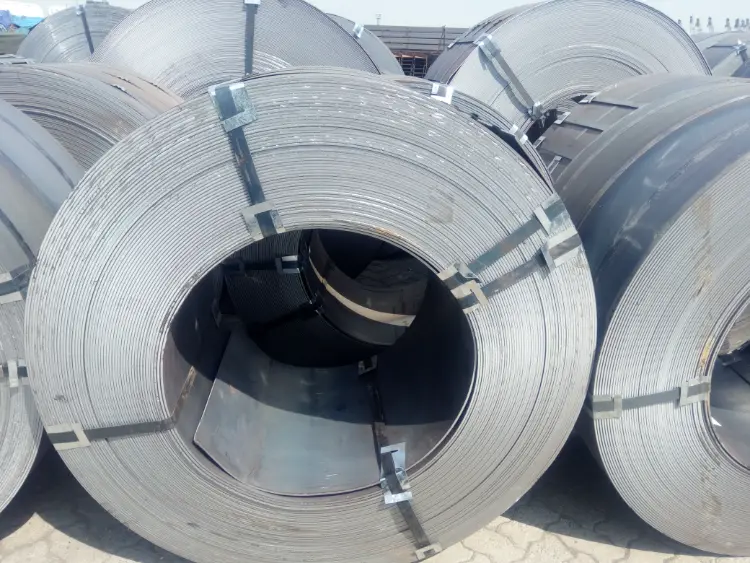
KR E47 Shipbuilding Steel Coil
KR E47 Shipbuilding Steel Coil - High-Strength Extra-Toughness Marine Grade for Arctic Service
Advanced extra-high-strength structural steel for ship hulls and offshore units, certified by Korean Register with guaranteed -40°C impact toughness.
Cutting, forming, welding (using low-hydrogen consumables), cold bending, straightening
- Phone : +8618037372205
- Email : [email protected]
- WhatsApp: Contact via Whtsapp
- WeChat: +8618037372205
KR E47 Shipbuilding Steel Coil Introduction
KR E47 is an extra-high-strength shipbuilding structural steel designated under the Korean Register rules, corresponding to the IACS UR W11 grade EH47. It exhibits minimum yield strength of 460 MPa and excellent notch toughness down to -40°C, making it suitable for hull structures, offshore platforms, and polar-class vessels. The steel is produced as hot-rolled coils with controlled thermo-mechanical processing, offering a fine-grained microstructure and good weldability. Typical delivery condition is normalized or thermo-mechanically rolled (TMCP). The grade carries the 'E' designation indicating stringent low-temperature impact property requirements, ensuring structural integrity in severe arctic and sub-arctic environments. Its high strength-to-weight ratio enables reduced scantlings and material cost in large container ships, bulk carriers, and icebreakers.
KR E47 Shipbuilding Steel Coil Chemical Composition
Chemical limits according to KR Rules for EH47 grade (IACS UR W11). Values are maximum unless a range is given. Microalloying elements such as Nb, V, Ti are added for grain refinement and precipitation strengthening. Carbon equivalent (CEV) is typically ≤0.53 for weldability.
- Values for product thickness ≤50 mm.
- Actual mill certificates may show tighter control.
| Element | Standard Value (%) | Remarks |
|---|---|---|
| Carbon (C) | ≤0.20 | Ladle analysis |
| Manganese (Mn) | 0.90 - 1.60 | Depending on thickness |
| Silicon (Si) | ≤0.55 | Deoxidation agent |
| Phosphorus (P) | ≤0.030 | For toughness |
| Sulfur (S) | ≤0.030 | For through-thickness properties |
| Aluminium (Al) total | ≥0.020 | Grain refinement |
| Niobium (Nb) | 0.02 - 0.05 | Microalloy |
| Vanadium (V) | 0.05 - 0.10 | Microalloy |
| Titanium (Ti) | 0.000 - 0.020 | Grain growth inhibitor |
| Nitrogen (N) | ≤0.012 | If sufficient Al is present |
| Copper (Cu) | ≤0.35 | Optional, can improve atmospheric corrosion resistance |
| Chromium (Cr) | ≤0.20 | Residual element |
| Nickel (Ni) | ≤0.40 | Residual element |
| Molybdenum (Mo) | ≤0.08 | Residual element |
KR E47 Shipbuilding Steel Coil Thermal and Electrical Physical Properties
These values are typical for structural steels and apply approximately to KR E47.
- Slight variations depending on exact chemical composition and heat treatment.
- Thermal expansion is important for design involving temperature changes.
- Electrical resistivity is given for reference in corrosion protection (cathodic protection) calculations.
| Property | Typical Value | Unit | Test Condition / Remarks |
|---|---|---|---|
| Density (ρ) | 7850 | kg/m³ | At 20°C |
| Young's Modulus (E) | 205 | GPa | At 20°C, static |
| Shear Modulus (G) | 80 | GPa | Calculated from E and ν |
| Poisson's Ratio (ν) | 0.3 | - | Elastic range |
| Thermal Expansion Coefficient (α) | 11.7E-6 | 1/K | Between 20°C and 100°C (average) |
| Thermal Expansion Coefficient (α) | 12.1E-6 | 1/K | Between 20°C and 200°C (average) |
| Thermal Expansion Coefficient (α) | 12.9E-6 | 1/K | Between 20°C and 300°C (average) |
| Thermal Conductivity (λ) | 50 | W/(m·K) | At 20°C |
| Thermal Conductivity (λ) | 47 | W/(m·K) | At 200°C |
| Specific Heat Capacity (c) | 460 | J/(kg·K) | At 20°C |
| Specific Heat Capacity (c) | 500 | J/(kg·K) | At 200°C |
| Electrical Resistivity (ρe) | 0.25 | μΩ·m | At 20°C |
KR E47 Shipbuilding Steel Coil Mechanical Properties
Mechanical test results as per KR Rules for thickness ≤50 mm. Tensile testing in transverse direction; impact testing on Charpy-V specimens (10×10 mm) at -40°C.
- Yield strength is specified as ReH (upper yield) or Rp0.2 if no yield phenomenon.
- Values may vary with thickness; thicker sections may have slightly lower strength.
- Bend test: 180° bending around a mandrel without cracking; typically d=3a for thickness ≤25 mm, d=4a for 25-50 mm.
| Property | Standard Requirement | Unit | Test Condition |
|---|---|---|---|
| Yield Strength (ReH) min. | 460 | MPa | Transverse, room temperature |
| Tensile Strength (Rm) | 570 - 720 | MPa | Transverse, room temperature |
| Elongation (A) after fracture, L₀=5.65√S₀, min. | 17 | % | Transverse, room temperature |
| Charpy-V Impact Energy (KV) min. longitudinal | 50 | J | -40°C, 10×10 mm specimen |
| Charpy-V Impact Energy (KV) min. transverse | 34 | J | -40°C, 10×10 mm specimen |
| Bend Test (180°) mandrel diameter | 3t (t≤25mm), 4t (25| - | No cracks or defects | |
KR E47 Shipbuilding Steel Coil Fully Equivalent Material Standards & Designations
| Country / Region | Standard / Rule | Grade / Designation | Remarks |
|---|---|---|---|
| International (IACS) | IACS UR W11 | EH47 | Unified Requirement for normal and higher strength hull structural steels |
| United States | ASTM A131 / A131M | EH47 | Standard Specification for Structural Steel for Ships |
| European Union | EN 10025-6 | S550Q/QL/QL1 (with supplementary) | Not identical; yield 550 MPa, but with impact at -40°C option can be similar |
| Germany | DIN EN 10025-6 | S550Q | Similar mechanical properties, check CEV and delivery condition |
| Japan | JIS G 3106 | SM570TMC (modified) | JIS does not have direct EH47; SM570 with toughness at -40°C can be approx. |
| China | GB/T 712 | EH47 | Identical to IACS EH47, ships and marine engineering structural steel |
| Norway/Germany (DNV) | DNV Rules Pt.2 Ch.1 | EH47 | Confirm exact properties with DNV certificate |
| United Kingdom (LR) | LR Rules Pt.1 Ch.3 | EH47 | Identical requirements |
| France (BV) | BV Rules Pt.1 Ch.2 | EH47 | Identical requirements |
KR E47 Shipbuilding Steel Coil Application Introduction
KR E47 steel coil is primarily intended for main structural members of ship hulls, especially where high strength and low-temperature toughness are essential. Its excellent weldability and formability make it a cost-effective choice for automated panel line production. The steel enables reduced section thickness compared to conventional grades, saving weight and costs while maintaining structural performance. Common use cases include ice-going vessels, large container ships with high stress areas, and critical offshore platform components.
Product Applications: Hull plates and stiffeners, Deck strips and hatch coamings, Bottom and side longitudinals, Transverse webs and frames, Bulb flats and angle sections, Offshore modules and flare booms, Ice belt strakes, Crane pedestals and heavy-lift structures
Processed into products: Longitudinal stiffeners cut from coil into strips, Web frames formed by press braking and welding, Bracket plates for structural connections, Doubler plates at stress concentration areas, Face plates for built-up girders, Hull insert plates for conversions or repairs, Foundation plates for machinery (with proper shock toughness)
Application industries: Shipbuilding (commercial and naval vessels), Offshore oil & gas platforms, Marine renewable energy (floating wind, tidal structures), Heavy engineering and bridge construction (with special approval), Polar exploration and research vessels
KR E47 Shipbuilding Steel Coil Similar / Near-Equivalent Alternatives
| Country / Region | Standard | Grade | Remarks |
|---|---|---|---|
| Europe | EN 10025-6 | S690Q | Higher strength (yield 690 MPa), but need careful welding; toughness at -40°C available on request |
| United States | ASTM A514 / A517 | Grade S (S690) | Quenched and tempered, yield 690 MPa, impact down to -40°C in some grades; good for offshore |
| Japan | JIS G 3128 | SHY 685 | High yield strength 685 MPa, low temperature toughness; used in pressure vessels and ship structures |
| South Korea | KS D 3610 | SHY 685N | Similar to SHY 685, normalized or TMCP, good weldability |
| Russia | GOST 19281 | 09G2S (09Г2С) with microalloying | Lower strength (yield ~345 MPa), but widely used; not direct substitute |
| International | API 2W Grade 60 | Grade 60 (yield 415 MPa) | For offshore structures, impact at -40°C; lower strength than EH47 |
| IACS | IACS UR W11 | FH47 | Higher toughness at -60°C, same strength level; can replace EH47 in critical applications |
Notes:
Welding considerations: Low-hydrogen welding process is mandatory. Preheating (typically 100-150°C) may be required depending on plate thickness and carbon equivalent. Post-weld heat treatment is generally not needed for TMCP grades. Certification: Material must be shipped with classification society certificates (e.g., KR, DNV, LR) as per project requirements. Surface condition: Coil surface is descaled and protected with a temporary primer. Dimension tolerances follow KR/IACS rules. Through-thickness properties: If Z-quality is required (Z35), improved sulphur control (S≤0.005%) and calcium treatment are applied, to be agreed at time of order.
- Share



