
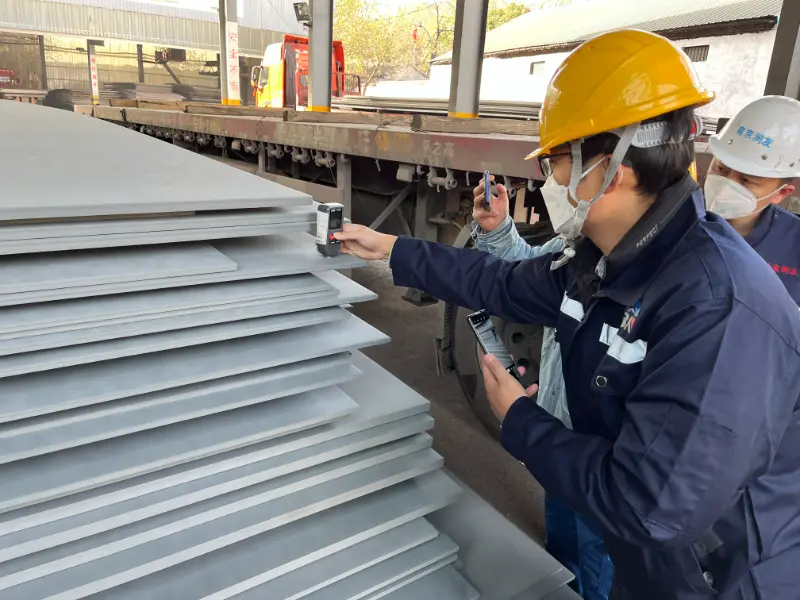
410 (S41000) Martensitic Stainless Steel Plate/Coil
410 (S41000) Martensitic Stainless Steel Plate/Coil - Properties & Applications
Comprehensive technical data for 410 (UNS S41000) stainless steel, a martensitic grade often supplied as plate or coil. Covers chemical composition, mechanical properties, thermal and electrical characteristics, equivalent grades, and application guidelines.
Annealing, Quenching, Tempering, Hot Rolling, Cold Rolling, Forging, Machining, Bending
- Phone : +8618037372205
- Email : [email protected]
- WhatsApp: Contact via Whtsapp
- WeChat: +8618037372205
410 Martensitic Stainless Steel Plate/Coil Introduction
410 stainless steel (UNS S41000) is a general-purpose martensitic chromium stainless steel capable of being hardened by heat treatment. It combines good strength, moderate corrosion resistance, and fair ductility. In the annealed condition, it exhibits a ferritic microstructure, while quenching and tempering develop a martensitic structure with increased hardness and wear resistance.
- Heat treatable to a wide range of mechanical properties
- Good resistance to atmospheric corrosion, water, and some chemicals
- Magnetic in all conditions
- Available as plate, sheet, and coil
410 Martensitic Stainless Steel Plate/Coil Chemical Composition
The chemical composition conforms to ASTM A240 requirements for 410 stainless steel. Elements are presented as maximum or range values.
- Chromium provides appropriate corrosion resistance
- Carbon content controls hardenability and strength
- Nickel is typically residual
| Element | Content (%) | Remarks |
|---|---|---|
| Carbon (C) | ≤ 0.15 | |
| Manganese (Mn) | ≤ 1.00 | |
| Phosphorus (P) | ≤ 0.040 | |
| Sulfur (S) | ≤ 0.030 | |
| Silicon (Si) | ≤ 1.00 | |
| Chromium (Cr) | 11.50 - 13.50 | |
| Nickel (Ni) | ≤ 0.75 | Residual element |
410 Martensitic Stainless Steel Plate/Coil Thermal and Electrical Physical Properties
Representative physical data for 410 stainless steel in annealed condition. These properties are essential for design calculations involving heat transfer, thermal stress, and electromagnetic effects.
- Thermal expansion is moderate compared to austenitic grades
- Good thermal conductivity relative to many stainless steels
- Magnetic permeability is high
| Property | Typical Value | Unit | Test Condition |
|---|---|---|---|
| Density (ρ) | 7.70 | g/cm³ | At 20 °C |
| Modulus of Elasticity (E) | 200 | GPa | At 20 °C |
| Shear Modulus (G) | 77 | GPa | At 20 °C |
| Poisson Ratio (ν) | 0.28 | — | At 20 °C |
| Thermal Expansion Coefficient (α) | 9.9 | µm/m·°C | 20 – 100 °C |
| Thermal Expansion Coefficient (α) | 10.4 | µm/m·°C | 20 – 200 °C |
| Thermal Expansion Coefficient (α) | 11.0 | µm/m·°C | 20 – 400 °C |
| Thermal Expansion Coefficient (α) | 11.5 | µm/m·°C | 20 – 600 °C |
| Thermal Conductivity (λ) | 24.9 | W/m·K | At 100 °C |
| Specific Heat Capacity | 460 | J/kg·K | 0 – 100 °C |
| Electrical Resistivity (ρe) | 0.57 | µΩ·m | At 20 °C |
410 Martensitic Stainless Steel Plate/Coil Mechanical Properties
Mechanical properties at room temperature in the annealed condition as per ASTM A240.
- Minimum tensile and yield requirements ensure adequate structural performance
- Elongation reflects good formability in annealed state
- Hardness limits facilitate machining and forming
| Property | Required Value | Unit | Test Condition |
|---|---|---|---|
| Yield Strength (ReH) | ≥ 205 (30) | MPa (ksi) | Annealed |
| Tensile Strength (Rm) | ≥ 450 (65) | MPa (ksi) | Annealed |
| Elongation (A) | ≥ 20 | % | In 50 mm (2 in.), annealed |
| Hardness, Brinell | ≤ 217 | HBW | Annealed |
| Hardness, Rockwell B | ≤ 96 | HRB | Annealed |
| Bend Test | 180°, d = 3.5t | Thickness ≤ 25 mm (1 in.), annealed |
410 Martensitic Stainless Steel Plate/Coil Completely Equivalent Material Standards & Substitutable Grades
| Country/Region | Standard | Grade | Remarks |
|---|---|---|---|
| USA | ASTM A240/A240M | 410 (UNS S41000) | Standard martensitic stainless steel plate/coil |
| European Union | EN 10088-2 | X12Cr13 (1.4006) | Equivalent martensitic grade |
| Germany | DIN | X12Cr13 (1.4006) | Historically equivalent |
| Japan | JIS G4304 | SUS410 | Commonly used in Asian markets |
| China | GB/T 3280 | 12Cr13 (S41010) | Comparable composition and characteristics |
| International | ISO 15510 | X12Cr13 | ISO standardized equivalent |
410 Martensitic Stainless Steel Plate/Coil Application Introduction
410 stainless steel is selected where moderate corrosion resistance and high mechanical properties obtained by heat treatment are required. It is widely used in applications that need toughness combined with wear resistance.
- Components exposed to steam, water, and mild chemicals
- Parts requiring high strength and hardness after heat treatment
- Suitable for both room and elevated temperature service up to 650 °C
Product Applications: Exhaust system components, Turbine blades and vanes, Pump and valve parts, Cutlery knives and scissors, Surgical tools, Bushings and bearings, Fasteners (bolts, nuts), Steam and gas turbine components
Processed into products: Valve seats and stems, Nozzles, Shafts and spindles, Springs, Knife blades, Butterfly valve discs, Clutch plates, Aircraft engine parts
Application industries: Automotive, Petrochemical, Power Generation, Cutlery & Kitchenware, Medical Instruments, Aerospace, General Engineering
410 Martensitic Stainless Steel Plate/Coil Similar / Substitute Material Recommendations
| Country/Region | Standard | Grade | Remarks |
|---|---|---|---|
| USA | ASTM A240 | 410S (S41008) | Low-carbon variation for improved weldability |
| USA | ASTM A240 | 420 (S42000) | Higher carbon, greater hardenability, used for cutting edges |
| USA | ASTM A582 / A240 | 416 (S41600) | Free-machining martensitic grade with sulfur addition, slightly lower corrosion resistance |
| USA | ASTM A240 | 430 (S43000) | Ferritic, non-hardenable, offers better corrosion resistance in some environments |
| USA | AMS 5604 | 17-4 PH (S17400) | Precipitation hardening martensitic stainless steel, high strength with good corrosion resistance |
Notes:
Welding: Preheating at 200–300 °C is recommended; post-weld heat treatment at 650–750 °C improves ductility. Heat Treatment: Full annealing at 815–900 °C followed by slow cooling; hardening by quenching from 925–1010 °C and tempering between 200–600 °C to adjust hardness. Machinability: Best in annealed condition; difficult in hardened state. Corrosion Warning: Not suitable for strong acids or chloride-rich environments without adequate surface finishing.
- Share



