
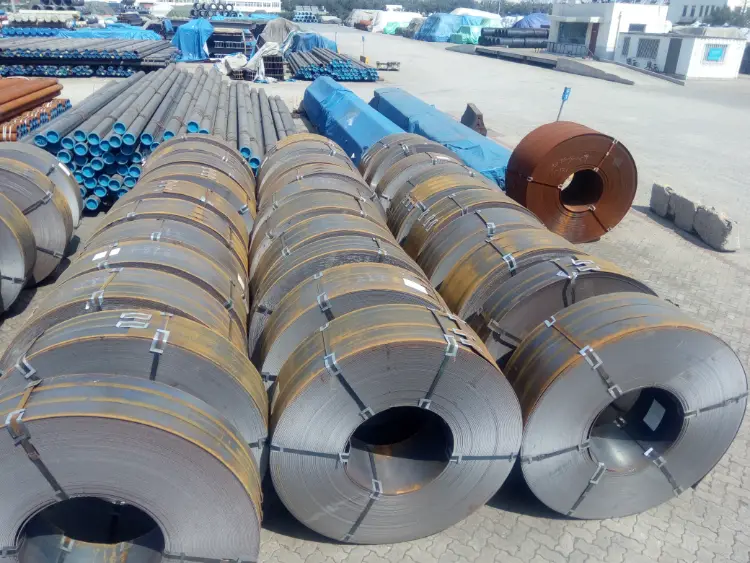
KR FH47 Shipbuilding Steel Coil
KR FH47 Shipbuilding Steel Coil: High-Strength Marine-Grade Material & International Equivalents
Complete technical profile of KR FH47 high-strength shipbuilding steel coil, widely used in ship hulls and offshore structures. Includes chemical composition, mechanical & thermal properties, global equivalents, and application guidance.
Welding, cutting, cold forming, hot forming, machining, shot blasting
- Phone : +8618037372205
- Email : [email protected]
- WhatsApp: Contact via Whtsapp
- WeChat: +8618037372205
KR FH47 Shipbuilding Steel Coil Introduction
KR FH47 is a high-strength hull structural steel grade approved by the Korean Register of Shipping (KR) under its Rules for the Classification of Ships. It belongs to the FH category, indicating stringent impact toughness at -60°C, and the 47 designation corresponds to a minimum yield strength of 460 N/mm². This steel is produced as coils and plates through thermomechanical control processing (TMCP) or normalizing, ensuring a fine-grained microstructure and excellent weldability. Typical applications include primary hull members, deck plating, bottom shells, and critical stiffeners in large container ships, bulk carriers, and offshore platforms operating in cold climates. Its balanced chemistry and mandatory Charpy V-notch testing guarantee reliable service in demanding marine environments.
KR FH47 Shipbuilding Steel Coil Chemical Composition
The chemical composition of KR FH47 complies with IACS UR W11 and KR Rules. Limits are designed to achieve the required strength, toughness, and weldability. Key elements such as Nb, V, Ti, and Al are added for grain refinement and precipitation strengthening. Low sulfur and phosphorus maximize ductility. Values are maximum unless a range is given.
| Chemical Element | Standard Value (wt%) | Remark |
|---|---|---|
| Carbon (C) | ≤0.18 | Dependent on thickness |
| Silicon (Si) | ≤0.55 | |
| Manganese (Mn) | 0.90 – 1.60 | |
| Phosphorus (P) | ≤0.025 | |
| Sulfur (S) | ≤0.025 | |
| Aluminium (Al total) | ≥0.015 | Acid soluble |
| Niobium (Nb) | ≤0.05 | |
| Vanadium (V) | ≤0.10 | |
| Titanium (Ti) | ≤0.02 | |
| Copper (Cu) | ≤0.35 | |
| Chromium (Cr) | ≤0.20 | |
| Nickel (Ni) | ≤0.40 | |
| Molybdenum (Mo) | ≤0.08 | |
| Nitrogen (N) | ≤0.009 | Not applicable if Al/Ti ratio is sufficient |
KR FH47 Shipbuilding Steel Coil Thermal & Electrical Physical Properties
Physical properties are representative for structural steels with similar density and composition. Actual values may vary slightly depending on exact chemistry and microstructure. These data assist in thermal analysis, weight calculation, and electromagnetic compatibility assessments.
| Property | Standard Value | Unit | Test Condition |
|---|---|---|---|
| Density (ρ) | ~7.85 | g/cm³ | Ambient temperature |
| Modulus of Elasticity (E) | ~205 | GPa | 20°C |
| Shear Modulus (G) | ~80 | GPa | 20°C, calculated |
| Poisson's Ratio (ν) | ~0.3 | — | Elastic range |
| Thermal Expansion Coefficient (α) | ~12.5 × 10⁻⁶ | 1/K | 20 – 100°C |
| Thermal Expansion Coefficient (α) | ~13.5 × 10⁻⁶ | 1/K | 20 – 200°C |
| Thermal Conductivity (λ) | ~42 | W/(m·K) | 20°C |
| Specific Heat Capacity | ~460 | J/(kg·K) | 20°C |
| Electrical Resistivity (ρₑ) | ~0.25 | Ω·mm²/m | 20°C |
KR FH47 Shipbuilding Steel Coil Mechanical Properties
Mechanical properties are tested per KR Rules and IACS UR W11. Transverse specimens are taken from the as-delivered condition. Values apply to thicknesses up to 100 mm. Higher thicknesses may require slight reductions in strength and elongation. Impact testing is performed on longitudinal Charpy V-notch specimens at -60°C to verify FH quality.
| Property | Standard Requirement | Unit | Test Condition |
|---|---|---|---|
| Yield Strength (ReH) | ≥460 | MPa | Transverse, thickness ≤100 mm |
| Tensile Strength (Rm) | 570 – 720 | MPa | Transverse, thickness ≤100 mm |
| Elongation (A5.65√S₀) | ≥17 | % | t ≤ 63 mm, transverse |
| Elongation (A5.65√S₀) | ≥16 | % | 63 < t ≤ 100 mm |
| Charpy V-notch Impact Energy | ≥50 (mean) | J | -60°C, longitudinal |
| Charpy V-notch Impact Energy (single minimum) | ≥40 | J | -60°C, longitudinal |
| Bend Test (180°) | Mandrel diameter 3t | — | No cracks or defects |
KR FH47 Shipbuilding Steel Coil Identical Material Standards & Substitutable Grades
| Country / Region | Standard | Grade | Remark |
|---|---|---|---|
| International | IACS UR W11 | FH47 | Unified requirement |
| USA | ABS Rules | FH47 | American Bureau of Shipping |
| France | BV Rules | FH47 | Bureau Veritas |
| Norway | DNV Rules | NV FH47 | Det Norske Veritas |
| UK | LR Rules | FH47 | Lloyd's Register |
| China | CCS Rules | FH47 | China Classification Society |
| Japan | NK Rules | FH47 | Nippon Kaiji Kyokai (ClassNK) |
| Italy | RINA Rules | FH47 | Registro Italiano Navale |
| Russia | RS Rules | FH47 | Russian Maritime Register of Shipping |
KR FH47 Shipbuilding Steel Coil Application Introduction
KR FH47 steel coils and plates are purpose-designed for heavily stressed components in marine and offshore engineering. The material's high yield strength and excellent toughness at sub-zero temperatures make it ideal for critical structural applications. Typical processing includes plasma/laser cutting, cold and hot forming, and automatic multi-pass welding. Strict control of heat input and preheat/post-weld treatments ensures weld integrity. The grade is often selected where reduced weight and increased payload are required.
Product Applications: Hull shells and bottom plating, Main deck and stringer plates, Longitudinal stiffeners and bulkheads, Transverse webs and frame structures, Offshore module support structures, Crane pedestals and jack-up leg components
Processed into products: Deeply corroded areas of ice-strengthened ships, Container cell guides and lashing bridges, Dredger bucket and cutting head parts, Rudder horns and stern frames, Mooring foundations and bollards, Transition pieces for monopile foundations
Application industries: Shipbuilding and ship repair, Offshore oil & gas platforms, Renewable energy (offshore wind turbine foundations), Naval architecture and marine engineering, Heavy civil construction (bridge components)
KR FH47 Shipbuilding Steel Coil Similar / Comparable Materials
| Country / Region | Standard | Grade | Remark |
|---|---|---|---|
| EU | EN 10025-4 | S460M/ML | Thermomechanical rolled structural steel, similar yield strength |
| EU | EN 10025-6 | S460Q/QL/QL1 | Quenched and tempered structural steel, alternative for thick sections |
| USA | ASTM A131 / A131M | FH46 (if available) | Lower strength shipbuilding grade (460 MPa yield) |
| KR | KR Rules | FH40 | Lower strength hull steel (390 MPa yield), less demanding |
| KR | KR Rules | FH51 | Higher strength hull steel (500 MPa yield), superior performance |
Notes:
KR FH47 coil/plate is often delivered with class surveyor's certificate (3.2 certification). For thicknesses above 50 mm, supplementary testing and stricter chemistries may be applied to guarantee through-thickness properties (Z-quality) according to customer requirements. When ordering, specify full dimensional program and impact test orientation. Surface conditions (shot-blasted, fully killed) and protective coatings must be agreed at enquiry stage. This material is eligible for exemption from post-weld heat treatment (PWHT) under certain conditions as defined by the KR rules.
- Share



