
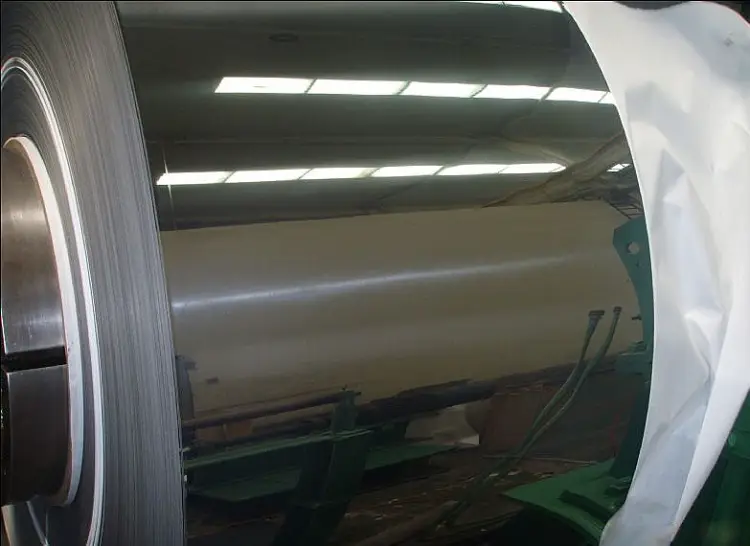
KR A51 Shipbuilding Steel Coil
KR A51 Shipbuilding Steel Coil: High-Strength Hull Structural Steel per Korean Register Rules
KR A51 is a high-strength shipbuilding structural steel governed by Korean Register of Shipping (KR) rules. With minimum yield strength of 355 MPa (51 ksi), it is widely used in marine hulls and offshore structures. This data sheet provides full chemical, mechanical, thermal and electrical properties, international equivalents, and application guidance.
Hot rolling, normalizing (N), thermomechanical rolling (M), welding, cutting, forming
- Phone : +8618037372205
- Email : [email protected]
- WhatsApp: Contact via Whtsapp
- WeChat: +8618037372205
KR A51 Shipbuilding Steel Coil Introduction
KR A51 is a high-strength hull structural steel grade specified by the Korean Register of Shipping (KR), corresponding to the yield strength category 51 ksi (355 MPa). It is supplied as coils and plates for welded construction of ships and marine structures. This normalized or thermomechanically rolled steel offers a good balance of strength, toughness, and weldability. The grade is essentially the KR equivalent of common AH36 steel, with controlled chemical composition and guaranteed impact properties at 0°C. Typical applications include deck plating, side shells, bottom shells, and stiffeners in hull structures.
KR A51 Shipbuilding Steel Coil Chemical Composition
The following chemical composition is based on the typical requirements in KR Rules Part 2, Chapter 2 for high-strength hull steels of yield strength 51 ksi (355 MPa). Values are maximum unless a range is given. Fine grain practice and microalloying elements (Nb, V, Ti) may be added at the manufacturer's discretion to achieve the required mechanical properties.
| Element | Standard Requirement (max, %) | Remarks |
|---|---|---|
| Carbon (C) | 0.18 | Ladle analysis, max value |
| Silicon (Si) | 0.10 – 0.50 | Typical range; max 0.50 |
| Manganese (Mn) | 0.90 – 1.60 | Dependent on thickness and deoxidation practice |
| Phosphorus (P) | 0.035 | Maximum for ladle analysis |
| Sulfur (S) | 0.035 | Maximum for ladle analysis |
| Aluminum (Al), total | ≥0.015 | Total aluminum required for fine grain practice, may be replaced by other grain-refining elements |
| Niobium (Nb) | 0.02 – 0.05 (typical) | Optional microalloy; when used alone or in combination to meet strength |
| Vanadium (V) | 0.05 – 0.10 (typical) | Optional microalloy |
| Titanium (Ti) | 0.007 – 0.05 (typical) | Optional microalloy |
| Chromium (Cr) | ≤0.20 | Residual; not intentionally added |
| Nickel (Ni) | ≤0.40 | Residual |
| Copper (Cu) | ≤0.35 | Residual |
| Molybdenum (Mo) | ≤0.08 | Residual |
KR A51 Shipbuilding Steel Coil Thermal and Electrical Physical Properties
These physical properties represent typical values for carbon-manganese structural steel and are provided for engineering calculations. The values are valid at room temperature unless otherwise stated. No specific KR required values exist for these properties; they conform to general steel material characteristics.
| Property | Typical Value | Unit | Test Condition |
|---|---|---|---|
| Density (ρ) | 7.85 | g/cm³ | At 20°C |
| Elastic Modulus (E) | 205 | GPa | At 20°C, tension |
| Shear Modulus (G) | 80 | GPa | Calculated from E and ν, approx. |
| Poisson's Ratio (ν) | 0.29 | - | In elastic range, 20°C |
| Thermal Expansion Coefficient (α) | 11.7 × 10⁻⁶ | K⁻¹ | Mean coefficient, 20–100°C |
| Thermal Expansion Coefficient (α) | 12.5 × 10⁻⁶ | K⁻¹ | Mean coefficient, 20–200°C |
| Thermal Expansion Coefficient (α) | 13.2 × 10⁻⁶ | K⁻¹ | Mean coefficient, 20–300°C |
| Thermal Conductivity (λ) | 51.9 | W/(m·K) | At 20°C |
| Thermal Conductivity (λ) | 49.8 | W/(m·K) | At 100°C |
| Thermal Conductivity (λ) | 47.5 | W/(m·K) | At 200°C |
| Specific Heat Capacity (cp) | 461 | J/(kg·K) | At 20–100°C |
| Electrical Resistivity (ρₑ) | 0.18 | μΩ·m | At 20°C |
KR A51 Shipbuilding Steel Coil Mechanical Properties
Mechanical properties are according to KR Rules Part 2, Chapter 2 for grade A51 (yield strength 51 ksi). Requirements vary with thickness. The values below are for typical plate thicknesses ≤ 100 mm, tested in the longitudinal direction on standard tensile and Charpy V-notch specimens. Impact test temperature is 0°C.
| Property | Standard Requirement | Unit | Test Condition |
|---|---|---|---|
| Yield Strength (ReH) | ≥ 355 | MPa | Thickness ≤ 100 mm, longitudinal |
| Yield Strength (ReH) | ≥ 355 | MPa | Thickness 100 mm < t ≤ 150 mm, longitudinal |
| Tensile Strength (Rm) | 490 – 620 | MPa | Thickness ≤ 100 mm |
| Elongation (A5) | ≥ 21 | % | Gauge length 5.65√S₀; thickness ≤ 100 mm |
| Charpy V-notch Impact Energy (KV₂) | ≥ 34 (average of 3), ≥ 24 (individual) | J | At 0°C, longitudinal direction |
| Bend Test (Bend Angle 180°, d = mandrel diameter) | d = 3a (for t ≤ 25 mm), d = 4a (for t > 25 mm) | - | No cracks; 'a' is specimen thickness |
KR A51 Shipbuilding Steel Coil Complete Equivalent Material Standards and Replaceable Grades
| Country / Region | Standard / Classification Society | Grade | Remarks |
|---|---|---|---|
| American Bureau of Shipping (ABS) | ABS Rules | AH36 | Direct equivalent; yield 51 ksi |
| DNV (Det Norske Veritas) | DNV Rules | NV A36 | Corresponds to A36 normal strength, actually NV AH36 is the equivalent high-strength; A36 is ordinary. Verified: DNV AH36 is equivalent |
| Lloyd's Register (LR) | LR Rules | AH36 | High-strength hull steel, 355 MPa yield |
| Bureau Veritas (BV) | BV Rules | AH36 | Equivalent grade for AH36 |
| China Classification Society (CCS) | CCS Rules | AH36 | Direct adoption of AH36 |
| ClassNK (Nippon Kaiji Kyokai) | NK Rules | KA36 | KA36 corresponds to AH36 |
| RINA (Registro Italiano Navale) | RINA Rules | AH36 | Equivalent high-strength hull grade |
| Korean Register (KR) | KR Rules | A51 | The reference grade itself |
KR A51 Shipbuilding Steel Coil Application Introduction
KR A51 steel coils are utilized extensively in the shipbuilding and offshore industry for high-strength structural components. Their guaranteed low-temperature impact toughness makes them suitable for cold-climate vessels. The steel can be easily welded, formed, and machined using standard methods. Normalized or thermomechanically processed delivery conditions provide consistent properties and good through-thickness ductility.
Product Applications: Hull shells (side, bottom, bilge), Main deck and strength deck plates, Transverse and longitudinal frames, Bulkheads and watertight divisions, Superstructure components, Hatch coamings and covers
Processed into products: Keel plates, Bilge strakes, Sheer strakes, Stringer plates, Breast hooks, Stiffeners (angles, flats, bulb profiles), Brackets and gussets, Crane pedestals
Application industries: Commercial shipbuilding (bulk carriers, tankers, container ships), Naval architecture, Offshore oil & gas platforms (fixed and floating structures), Barge and floating dock construction, Bridge and heavy civil structures requiring impact-tough steel
KR A51 Shipbuilding Steel Coil Similar / Near-Equivalent Material Recommendations
| Country / Region | Standard | Grade | Notes / Analysis |
|---|---|---|---|
| International (ISO) | ISO 4950-2 | AH355 (historical) | Mechanical properties comparable, but classification may differ |
| Europe (EN) | EN 10025-2 | S355J0 / S355G10 | S355J0 (yield 355 MPa, impact at 0°C) is the structural steel equivalent; S355G10 is for offshore structures, not identical to ship classification rules but close |
| USA (ASTM) | ASTM A131 / ASTM A131M | AH36 | Direct cross-reference under ASTM standard for shipbuilding |
| Japan (JIS) | JIS G3106 | SM400B / SM490A | SM400B has lower yield (245 MPa); SM490A has higher tensile but not certified by class societies; closest is JIS G3106 SM490B to A36 level. Shipbuilding steels under JIS are H-Rated (e.g., JIS G3106 SM490A) but not specific marine class |
| Russia (GOST) | GOST 5521 | 09G2S (А36 shipbuilding equivalent) | 09G2S has similar strength, but may need approval by class |
Notes:
Certification: Material must be produced by an approved manufacturer and supplied with KR inspection certificate (3.2). Welding: Use low-hydrogen procedures; preheat may be required for thick sections (>30 mm) depending on carbon equivalent (CEV typically ≤0.38% for controlled chemistry). Corrosion protection: Standard marine coatings should be applied; the steel has no intrinsic atmospheric corrosion resistance beyond ordinary carbon-manganese steel. Supplementary requirements: Z-property testing (through-thickness), ultrasonic testing, and restricted yield/tensile range can be ordered for critical applications.
- Share



