
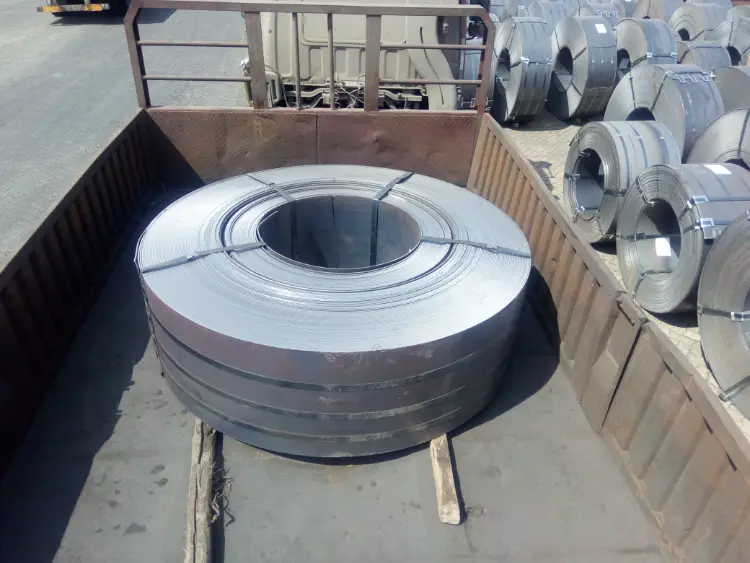
KR D51 Shipbuilding Steel Coil
KR D51 Shipbuilding Steel Coil - High-Strength Hull Structural Steel Certified by Korean Register
KR D51 is a high-strength steel grade for ship hull structures, certified by the Korean Register, with a minimum yield strength of 51 ksi (355 MPa). It is widely used in marine construction and offshore engineering due to its excellent toughness and weldability.
Hot rolling, controlled rolling, normalizing, thermo-mechanical control process (TMCP), quenching and tempering (optional)
- Phone : +8618037372205
- Email : [email protected]
- WhatsApp: Contact via Whtsapp
- WeChat: +8618037372205
KR D51 Shipbuilding Steel Coil Introduction
KR D51 is a high-strength shipbuilding steel grade under the Korean Register Rules for the Classification of Steel Ships. It corresponds to the DH36 designation in many classification societies and offers a minimum yield strength of 51 ksi (355 MPa). The material is designed for critical ship hull structures, providing a balanced combination of strength, ductility, and low-temperature toughness. Typical delivery conditions include normalized, controlled rolling, or TMCP. KR D51 is available as steel coils and plates, suitable for welding and forming operations. It meets stringent requirements for chemical composition, mechanical properties, and impact resistance, making it ideal for large ocean-going vessels, offshore platforms, and marine equipment subjected to harsh environments.
KR D51 Shipbuilding Steel Coil Chemical Composition
The chemical composition of KR D51 is tightly controlled to ensure high strength, good weldability, and excellent toughness at low temperatures. Typical limits according to IACS W11 for high-strength hull structural steels (grade DH36) are referenced. Trace elements like Nb, V, Ti, and Al are often added to refine grain structure and improve mechanical properties. All values are in weight percent.
| Chemical Element | Standard Value | Remarks |
|---|---|---|
| Carbon (C) | ≤ 0.18% | Max |
| Manganese (Mn) | 0.90 – 1.60% | |
| Silicon (Si) | ≤ 0.50% | Max |
| Phosphorus (P) | ≤ 0.035% | Max |
| Sulfur (S) | ≤ 0.035% | Max |
| Aluminum (Al, acid soluble) | ≥ 0.015% | Min, for grain refinement |
| Copper (Cu) | ≤ 0.35% | Max |
| Chromium (Cr) | ≤ 0.20% | Max |
| Nickel (Ni) | ≤ 0.40% | Max |
| Molybdenum (Mo) | ≤ 0.08% | Max |
| Niobium (Nb) | ≤ 0.05% | Optional microalloy |
| Vanadium (V) | ≤ 0.10% | Optional microalloy |
| Titanium (Ti) | ≤ 0.02% | Optional microalloy |
| Nitrogen (N) | ≤ 0.009% | Max |
KR D51 Shipbuilding Steel Coil Thermal and Electrical Physical Properties
The following physical properties are typical for high-strength low-alloy steel of this grade. They are not part of the specification but are useful for design calculations. Values may vary slightly depending on exact composition and processing. Measurements are at room temperature unless otherwise stated.
| Property | Standard Value | Unit | Test Condition |
|---|---|---|---|
| Density (ρ) | 7.85 | g/cm³ | 20°C |
| Elastic Modulus (E) | 205 | GPa | 20°C, static |
| Shear Modulus (G) | ≈ 80 | GPa | 20°C, estimated |
| Poisson's Ratio (ν) | 0.29 – 0.30 | – | 20°C |
| Thermal Expansion Coefficient (α) | 11.5 – 12.5 × 10⁻⁶ | K⁻¹ | 20–100°C |
| Thermal Expansion Coefficient (α) | 12.5 – 13.5 × 10⁻⁶ | K⁻¹ | 20–200°C |
| Thermal Conductivity (λ) | 48 – 52 | W/m·K | 20°C |
| Specific Heat Capacity (cp) | 460 – 500 | J/kg·K | 20°C |
| Electrical Resistivity (ρe) | 0.20 – 0.25 × 10⁻⁶ | Ω·m | 20°C |
KR D51 Shipbuilding Steel Coil Mechanical Properties
Mechanical properties are evaluated on test samples taken from finished steel products, typically in the longitudinal direction. Values depend on product thickness and heat treatment condition. Charpy impact tests are performed at -20°C to verify toughness. The following data represent standard requirements for KR D51 (DH36 equivalent) according to KR rules.
| Property | Required Value | Unit | Test Condition / Thickness (t) |
|---|---|---|---|
| Yield Strength (ReH) | ≥ 355 | MPa | t ≤ 50 mm |
| Yield Strength (ReH) | ≥ 345 | MPa | 50 < t ≤ 70 mm |
| Yield Strength (ReH) | ≥ 335 | MPa | 70 < t ≤ 100 mm |
| Tensile Strength (Rm) | 490 – 620 | MPa | All thicknesses |
| Elongation (A5) | ≥ 21 | % | t ≤ 50 mm, gauge length 5.65√S0 |
| Elongation (A5) | ≥ 20 | % | 50 < t ≤ 70 mm |
| Elongation (A5) | ≥ 19 | % | 70 < t ≤ 100 mm |
| Charpy Impact (KV2, longitudinal) | ≥ 34 | J | -20°C, t ≤ 50 mm |
| Charpy Impact (KV2, longitudinal) | ≥ 24 | J | -20°C, 50 < t ≤ 70 mm |
| Charpy Impact (KV2, transverse) | ≥ 24 | J | -20°C, t ≤ 50 mm |
| Charpy Impact (KV2, transverse) | ≥ 17 | J | -20°C, 50 < t ≤ 70 mm |
| Bend Test (180°) | d = 3t | – | t ≤ 35 mm, no cracks |
| Bend Test (180°) | d = 4t | – | 35 < t ≤ 50 mm, no cracks |
| Bend Test (180°) | d = 5t | – | 50 < t ≤ 100 mm, no cracks |
KR D51 Shipbuilding Steel Coil Exactly Equivalent Standards and Substitutable Grades
| Region / Society | Standard / Rule | Grade | Remarks |
|---|---|---|---|
| Korean Register | KR Rules | DH36 | Direct equivalent in KR notation |
| American Bureau of Shipping | ABS Rules | DH36 | Same strength and toughness class |
| DNV GL (Norway/Germany) | DNV GL Rules | NV D36 | Formerly DNV NV D36, identical specification |
| Lloyd's Register (UK) | LR Rules | DH36 | Equivalent high-strength grade |
| Bureau Veritas (France) | BV Rules | DH36 | Equivalent grade A/B/D/E series |
| China Classification Society | CCS Rules | DH36 | Same designation |
| Nippon Kaiji Kyokai (Japan) | NK Rules | KD36 | Identical mechanical requirements |
| Registro Italiano Navale | RINA Rules | DH36 | Equivalent high-strength steel |
| Indian Register of Shipping | IRS Rules | DH36 | Same requirements for hull steel |
KR D51 Shipbuilding Steel Coil Application Introduction
KR D51 steel coil and plates are specifically designed for the demanding conditions of marine construction. Its high strength, excellent weldability, and guaranteed low-temperature toughness make it suitable for a wide range of components in shipbuilding and offshore engineering. Typical applications include:
Product Applications: Container ships, Bulk carriers and oil tankers, LNG/LPG carriers, Offshore support vessels, Drill ships and semi-submersible rigs, Icebreakers and Arctic vessels
Processed into products: Main deck plates and bottom shell plates, Side shell plating and longitudinal stiffeners, Transverse bulkheads and web frames, Rudder horns and propeller brackets, Hatches, coamings, and deck fittings, Structural nodes and brackets for offshore platforms
Application industries: Shipbuilding (commercial and naval vessels), Offshore oil and gas platforms, Marine renewable energy (wind turbine foundations), Port and harbor construction, Heavy engineering and lifting equipment
KR D51 Shipbuilding Steel Coil Similar / Alternative Material Recommendations
| Region / Society | Standard / Rule | Grade | Remarks |
|---|---|---|---|
| Various | IACS W11 | AH36 | Same strength, impact test at 0°C (higher temperature) – less stringent; suitable for less cold environments |
| Various | IACS W11 | EH36 | Same strength, impact test at -40°C – better toughness for extreme cold; more expensive |
| Various | IACS W11 | DH40 | Higher yield strength (390 MPa), similar toughness requirements; for weight reduction or higher loads |
| Various | IACS W11 | EH40 | Yield strength 390 MPa, low-temperature toughness at -40°C; highest cost, Arctic applications |
| ASTM International | ASTM A131/A131M | DH36 | Equivalent to KR D51 under ASTM standard for shipbuilding steel |
| ISO | ISO 4995 | X70 / S460 | Structural steel with comparable strength but not certified for marine classification; use with caution |
Notes:
KR D51 is supplied with classification society certification. Welding should follow approved procedures using low-hydrogen consumables and preheating where necessary. Post-weld heat treatment is typically not required for thicknesses below 30 mm, but stress relieving may be applied for very thick sections. The steel has good corrosion resistance in marine environments but requires protective coatings for long-term service. Double-check the latest Korean Register rules for any updates to chemical or mechanical requirements.
- Share



