
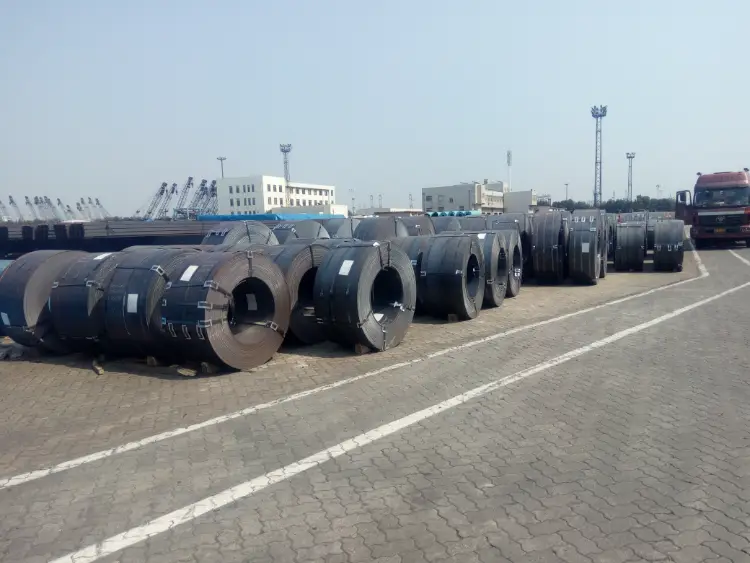
KR E51 Shipbuilding Steel Coil
KR E51 Shipbuilding Steel Coil - Premium Extra High Strength Hull Structural Steel for Demanding Marine Applications
Comprehensive technical data for KR E51 shipbuilding steel coil, an extra high strength hull structural grade according to Korean Register rules, featuring yield strength ≥510 MPa, excellent toughness at -40°C, and superior weldability; includes chemistry, mechanical & physical properties, international equivalents, and application insights.
Hot rolling, TMCP (Thermo-Mechanical Control Processing), normalizing, cold forming, welding, cutting, machining
- Phone : +8618037372205
- Email : [email protected]
- WhatsApp: Contact via Whtsapp
- WeChat: +8618037372205
KR E51 Shipbuilding Steel Coil Introduction
KR E51 is an extra high strength hull structural steel grade certified by the Korean Register (KR) of shipping, primarily supplied in coil form. It belongs to the E51 (EH51) category with a minimum yield strength of 510 MPa, designated "E" for its guaranteed impact toughness at -40°C. The steel is produced via controlled rolling and thermo-mechanical control processing (TMCP) or normalizing, ensuring a fine-grained microstructure with excellent strength-to-weight ratio, weldability, and low-temperature toughness.
- Key attributes include high tensile strength (610–770 MPa), good ductility (elongation ≥16%), and reliable Charpy V-notch impact energy (≥41 J at -40°C).
- It is widely adopted for critical hull structures in large container ships, bulk carriers, and offshore platforms where weight reduction without sacrificing safety is paramount.
- KR E51 complies with the latest KR Rules for Steel Ships, Part 2, Chapter 2, and has full equivalences across major classification societies, enabling seamless global procurement and construction.
KR E51 Shipbuilding Steel Coil Chemical Composition
The chemical composition of KR E51 steel is carefully controlled to achieve high strength and excellent weldability. Key elements such as carbon, manganese, and silicon are optimized for strengthening, while micro-alloying elements (Nb, V, Ti, Al) provide grain refinement and precipitation hardening.
- Phosphorus and sulfur are kept at low levels to ensure toughness and ductility.
- The carbon equivalent (Ceq) is limited to maximize weldability; typical TMCP supply achieves Ceq ≤ 0.40–0.43%.
- Additional residual elements (Cr, Ni, Cu, Mo) may be present from scrap but are restricted to avoid adverse effects.
| Element | Standard Value (max or range) | Remarks |
|---|---|---|
| C | ≤ 0.20 | Carbon, maximum |
| Si | ≤ 0.55 | Silicon |
| Mn | 0.90 – 1.60 | Manganese |
| P | ≤ 0.030 | Phosphorus |
| S | ≤ 0.030 | Sulphur |
| Al (acid soluble) | ≥ 0.015 | Aluminium, grain refining |
| Nb | ≤ 0.05 | Niobium, optional micro-alloy |
| V | ≤ 0.10 | Vanadium, optional micro-alloy |
| Ti | ≤ 0.05 | Titanium, optional micro-alloy |
| Cu | ≤ 0.35 | Copper, residual limit |
| Cr | ≤ 0.20 | Chromium, residual limit |
| Ni | ≤ 0.40 | Nickel, residual limit |
| Mo | ≤ 0.08 | Molybdenum, residual limit |
| N | ≤ 0.012 | Nitrogen, maximum unless bound by Al/Ti |
| Ceq | ≤ 0.43 (typical TMCP) | Carbon equivalent: C+Mn/6+(Cr+Mo+V)/5+(Ni+Cu)/15 |
KR E51 Shipbuilding Steel Coil Thermal and Electrical Physical Properties
These physical properties are typical for extra high strength structural steels and may vary slightly with temperature and microstructural condition. They are provided for design reference and not as mandatory values in the KR standard.
- Density, elastic moduli, and thermal expansion are essential for structural analysis and welding distortion calculations.
- Thermal conductivity and specific heat influence heat distribution during welding and fire resistance design.
- Electrical resistivity is relevant for corrosion protection systems.
| Property | Typical Value | Unit | Remarks / Test Condition |
|---|---|---|---|
| Density (ρ) | 7.85 | g/cm³ | At 20 °C |
| Elastic Modulus (E) | 205 | GPa | At room temperature |
| Shear Modulus (G) | 80 | GPa | Calculated from E and ν |
| Poisson's Ratio (ν) | 0.3 | — | At room temperature |
| Thermal Expansion Coefficient (α) | 12.0 | 10⁻⁶/K | Average value, 20–100 °C |
| Thermal Conductivity (λ) | 50 | W/(m·K) | At 20 °C |
| Specific Heat Capacity | 460 | J/(kg·K) | At 20 °C |
| Electrical Resistivity (ρ_e) | 0.20 | μΩ·m | At 20 °C |
KR E51 Shipbuilding Steel Coil Mechanical Properties
Mechanical properties are verified on test specimens taken from the coil in the as-delivered condition. KR E51 exhibits high yield and tensile strength, good ductility, and reliable low-temperature impact toughness.
- The properties are thickness-dependent; multiple thickness ranges are given where applicable.
- Charpy V-notch impact tests at -40°C guarantee safe performance in cold environments.
- Bend tests validate formability without cracking.
| Property | Standard Requirement Value | Unit | Test Condition / Thickness Range |
|---|---|---|---|
| Yield Strength (ReH) | ≥ 510 | MPa | t ≤ 100 mm |
| Yield Strength (ReH) | ≥ 490 | MPa | 100 mm < t ≤ 150 mm (if applicable) |
| Tensile Strength (Rm) | 610 – 770 | MPa | t ≤ 100 mm |
| Tensile Strength (Rm) | 580 – 760 | MPa | 100 mm < t ≤ 150 mm (if applicable) |
| Elongation (A) | ≥ 16 | % | t ≤ 50 mm, gauge length 5.65√So |
| Elongation (A) | ≥ 15 | % | 50 mm < t ≤ 100 mm, gauge length 5.65√So |
| Bend Test (180°) | d = 3a | — | t ≤ 25 mm, a = specimen thickness |
| Bend Test (180°) | d = 4a | — | t > 25 mm |
| Charpy Impact (KV, -40°C) | ≥ 41 (longitudinal) | J | Full-size specimen, E-grade requirement |
KR E51 Shipbuilding Steel Coil Full Equivalent Standards and Substitutable Grades
| Country / Region | Standard / Classification Society | Grade | Remarks |
|---|---|---|---|
| International | ABS (American Bureau of Shipping) | EH51 | Same extra high strength, -40°C impact |
| Norway/Germany | DNV GL (now DNV) | E51 | Identical technical requirements |
| France | BV (Bureau Veritas) | EH51 | Equivalent hull structural steel |
| UK | Lloyd's Register (LR) | EH51 | Fully interchangeable |
| China | CCS (China Classification Society) | EH51 | Direct substitute |
| Japan | NK (Nippon Kaiji Kyokai) | KEH51 | NK prefix K for NK-graded steel |
| Italy | RINA (Registro Italiano Navale) | E51 | Matching specification |
| Russia | RS (Russian Maritime Register) | E51 | Compatible grade |
KR E51 Shipbuilding Steel Coil Application Introduction
KR E51 steel coil is engineered for critical ship structures where high strength-to-weight ratio and reliable low-temperature toughness are essential. Its typical applications include:
- Main shell plating, sheer strakes, bilge strakes, and longitudinal bulkheads in ultra-large container vessels (ULCVs).
- Deck structures, strength deck longitudinals, and hatch side coamings subject to high global and local loads.
- Bottom structures and hopper plates in large bulk carriers and ore carriers where extreme bending moments occur.
- Heavy stiffeners, frames, and webs that require direct introduction of high strength for weight reduction.
- Offshore platform topside modules and hull nodes in FPSOs due to proven toughness at sub-zero temperatures.
Product Applications: Hull plates and seamless rolled profiles, Heavy-gauge coils for automated panel lines, Cut-to-length sheets for stiffeners and brackets, Fabricated beam assemblies (built-up sections)
Processed into products: Shell plates (outer hull, inner bottom), Deck plates and deck girders, Longitudinal stiffeners (bulb flats, angles), Transverse frames and web frames, Bulkhead plates and corrugated bulkheads, Hatch coamings and topside cantilevers, Foundation structures for main engines and deck machinery, Column stabilizers and pontoons for semi-submersibles
Application industries: Shipbuilding (commercial and naval), Offshore engineering (FPSO, wind turbine foundations), Marine infrastructure (docks, caissons), Heavy machinery (structural components for cranes, marine equipment)
KR E51 Shipbuilding Steel Coil Similar and Alternative High-Strength Shipbuilding Steels
| Country / Region | Standard / Classification Society | Grade | Remarks |
|---|---|---|---|
| International | Various | EH47 | Yield ≥ 460 MPa; slightly lower strength, similar toughness |
| International | Various | EH56 | Yield ≥ 550 MPa; higher strength, more careful welding needed |
| China | GB 712-2011 | EH510 | Similar yield level (510 MPa), Chinese national standard |
| Europe | EN 10025-6 | S500QL/QL1 | Quenched & tempered high yield steel; not ship-classed but similar strength |
Notes:
Welding recommendations: Use low-hydrogen consumables matching the strength level (e.g., AWS E11018M or equivalent). Preheat may be required depending on thickness and carbon equivalent; typical preheat 75–150°C for >40 mm thickness. Post-weld heat treatment is generally not required for TMCP steels. All repairs must comply with KR approved procedures. Coil edge and surface conditions should meet KR & customer requirements; mill test certificates must be provided with each shipment.
- Share



