
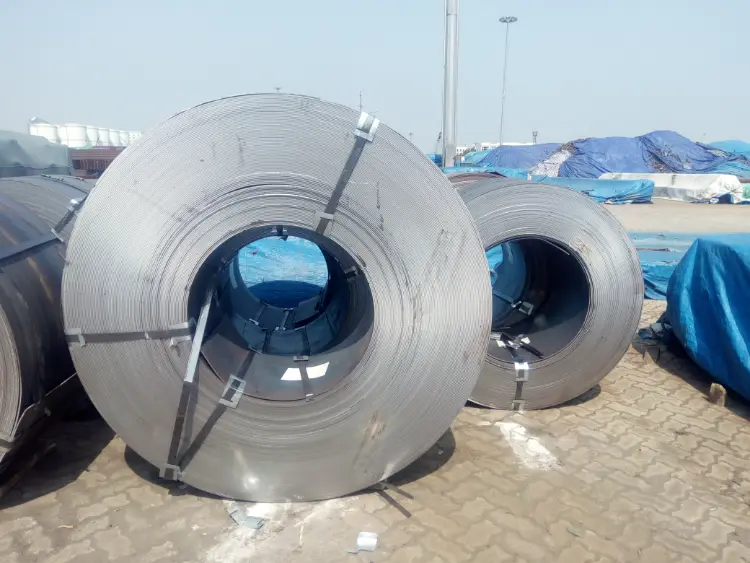
KR F51 High-Strength Shipbuilding Steel Coil
KR F51 High-Strength Shipbuilding Steel Coil: Properties, Equivalents & Applications
Explore KR F51 steel coil mechanical properties, chemical composition, physical data, international equivalents, and application guide for ship and offshore structures.
Hot rolling, TMCP, Normalizing, Quenching and Tempering (for higher thickness), Cutting, Welding, Forming
- Phone : +8618037372205
- Email : [email protected]
- WhatsApp: Contact via Whtsapp
- WeChat: +8618037372205
KR F51 High-Strength Shipbuilding Steel Coil Introduction
KR F51 is a high-strength normalized or thermo-mechanically controlled rolled (TMCP) steel grade for ship and offshore structures, regulated by the Korean Register (KR) Rules for the Classification of Steel Ships. It belongs to the family of hull structural steels with a specified minimum yield strength of 51 kgf/mm² (500 MPa). The grade is available in several toughness variants, including AH51, DH51, EH51, and FH51, with the designator indicating notch toughness at different temperatures: A (0°C), D (-20°C), E (-40°C), and F (-60°C).
- Typical delivery condition: TMCP or quenching + tempering.
- Low carbon equivalent ensures excellent weldability.
- Excellent low-temperature impact toughness, with FH51 achieving minimum 27 J at -60°C.
- Widely applied in ice-class vessels, large container ships, and Arctic offshore platforms.
This material combines high strength with good formability and ductility, meeting the demanding requirements of modern shipbuilding.
KR F51 High-Strength Shipbuilding Steel Coil Chemical Composition according to KR Rules
The chemical composition as per typical ladle analysis for EH51/FH51 grades, meeting the requirements of KR Rules Part 2. Microalloying elements such as Nb, V, and Ti are added for grain refinement and precipitation strengthening. The carbon equivalent (CEV) is controlled to ensure good weldability.
| Element | Typical Requirement (mass %) | Remarks |
|---|---|---|
| Carbon (C) | ≤0.18 | Ladle analysis, max |
| Silicon (Si) | 0.10 - 0.55 | If required by purchaser |
| Manganese (Mn) | 0.90 - 1.60 | Slightly higher for thick plates |
| Phosphorus (P) | ≤0.025 | Max |
| Sulfur (S) | ≤0.025 | Max |
| Aluminum (Al, total) | ≥0.020 | Minimum for fine grain practice |
| Niobium (Nb) | 0.02 - 0.05 | Optionally specified |
| Vanadium (V) | 0.05 - 0.10 | Optionally specified |
| Titanium (Ti) | ≤0.02 | Small additions for grain refinement |
| Chromium (Cr) | ≤0.25 | Residual or permitted addition |
| Copper (Cu) | ≤0.35 | Residual |
| Nickel (Ni) | ≤0.40 | May be added for toughness |
| Molybdenum (Mo) | ≤0.08 | Residual |
| Carbon Equivalent (CEV) | ≤0.45 (typically ≤0.43) | CEV = C+Mn/6+(Cr+Mo+V)/5+(Cu+Ni)/15 |
KR F51 High-Strength Shipbuilding Steel Coil Thermal and Electrical Physical Properties
Physical properties are typical for low-alloy structural steels of this strength class. Values may vary slightly depending on exact composition and heat treatment. Data provided for design and engineering calculations.
| Property | Typical Value | Unit | Test Condition / Remarks |
|---|---|---|---|
| Density (ρ) | 7850 | kg/m³ | At 20°C |
| Young's Modulus (E) | 210 | GPa | At 20°C |
| Shear Modulus (G) | 80 | GPa | Calculated from E and ν |
| Poisson's Ratio (ν) | 0.3 | - | Elastic range |
| Thermal Expansion Coefficient (α) | 12×10-6 | K-1 | Between 20°C and 100°C |
| Thermal Conductivity (λ) | 45 | W/(m·K) | At 20°C |
| Specific Heat Capacity | 460 | J/(kg·K) | At 20°C |
| Electrical Resistivity (ρe) | 0.20 ×10⁻⁶ | Ω·m | At 20°C |
KR F51 High-Strength Shipbuilding Steel Coil Mechanical Properties
Mechanical properties are determined in accordance with KR Rules for steels in TMCP or normalized condition. Tensile testing is performed on transverse specimens for plate products. Impact toughness values refer to standard Charpy V-notch specimens. Minimum elongation is specified for gauge length L0=5.65√S0.
| Property | Standard Requirement | Unit | Test Condition |
|---|---|---|---|
| Yield Strength (ReH) | ≥500 | MPa | Transverse, t ≤ 100 mm |
| Tensile Strength (Rm) | 610 - 770 | MPa | Transverse, all thicknesses |
| Elongation (A) | ≥16 | % | Transverse, L0=5.65√S0 |
| Bend Test (180°) | No cracks | - | Bend diameter = 3a (a=thickness), ≤50 mm |
| Impact Energy (KV2) | ≥50 (average)≥35 (individual) | J | Transverse, FH51 -60°C; EH51 -40°C |
| Through-thickness (Z) reduction of area (if ordered) | ≥35 | % | According to KR Rules Part 2, Annex Z |
KR F51 High-Strength Shipbuilding Steel Coil Completely Equivalent Material Standards and Substitute Grades
| Country / Region | Standard | Grade | Remarks |
|---|---|---|---|
| International (KR) | KR Rules Part 2 | FH51 (F51) | Approved for ice-class and Arctic service |
| American Bureau of Shipping | ABS Rules | FH50 | Comparable strength (500 MPa), toughness at -60°C |
| DNV (Norway/Germany) | DNV Rules | VL500 | For offshore structures, 500 MPa yield class |
| Lloyd's Register | LR Rules | LH50 | Special LR grade for high strength; verify toughness |
| Bureau Veritas | BV Rules | E500 | With appropriate low-temperature supplement for FH |
| China Classification Society | CCS Rules | E500 (with -60°C option) | CCS high-strength hull steel, similar mechanical requirements |
KR F51 High-Strength Shipbuilding Steel Coil Application Introduction
KR F51 steel coils are primarily intended for high-strength welded structures in the shipbuilding and offshore industries. The grade's high yield-to-tensile ratio and excellent low-temperature toughness make it suitable for critical load-bearing components in Arctic environments. Typical processing includes cutting, forming, and welding, with careful attention to pre-heating and interpass temperature control to preserve mechanical properties.
Product Applications: Hull plates and stiffeners for high-stress areas, Transverse and longitudinal bulkheads, Weather deck and bottom shell plating of ice-strengthened ships, Offshore platform topsides and jacket braces, Monopile and tripod foundations for offshore wind turbines, Hatch covers and coamings for large hatch openings
Processed into products: Frame webs and flanges (longitudinals, transversal frames), Bracket plates and stiffener connections, Crane pedestal and kingpost structures, Rudder horns and stern frames (in thicker sections), Fatigue-critical welded nodes of offshore structures, Corrugated bulkhead sections (cold-formed from coil)
Application industries: Shipbuilding (ice-class vessels, large container ships, LNG carriers), Offshore oil and gas (jacket legs, deck structures, flare booms), Renewable energy (offshore wind turbine towers, transition pieces, floating foundations), Port and harbor engineering (crane booms, heavy-lift structures), Heavy construction equipment requiring high strength-to-weight ratio
KR F51 High-Strength Shipbuilding Steel Coil Close / Similar Substitute Materials
| Country / Region | Standard | Grade | Remarks |
|---|---|---|---|
| European Union | EN 10225 | S500G2+M | Fixed offshore structures, similar strength; requires toughness verification |
| United States | ASTM A572 / A572M | Grade 65 [450 MPa] or custom Grade 70 | Lower strength; alternative for less demanding applications |
| Japan | JIS G 3106 | SM570 | Structural steel with min. 460 MPa yield; not a direct shipbuilding grade |
| ISO | ISO 630-3 / ISO 24314 | S500G2+M / F500 | Structural steels and shipbuilding; compare CE and impact temp. |
| Other high-strength ship steels | Various Class Rules | EH36, EH40, EH47 | Lower strength levels but available with similar toughness for less stringent design |
Notes:
- Welding: Low carbon equivalent (≤0.45) ensures good weldability without excessive preheat; however, recommended preheat and heat input limits according to approved welding procedures must be followed to avoid heat-affected-zone softening.
- Delivery conditions: TMCP steel should not be normalised or stress-relieved above 600°C without prior agreement to avoid loss of mechanical properties.
- Corrosion: Normal protective coatings and cathodic protection systems applicable to structural steel are suitable; no special corrosion resistance is inherent.
- Certification: Products are marked and certified according to KR Rules, including heat number, grade, and inspection body stamp.
- Availability: Typically supplied as trimmed mill edge coils or cut-to-length plates in thicknesses up to 100 mm, but thinner gauges are common for cold-formed parts.
- Share



