
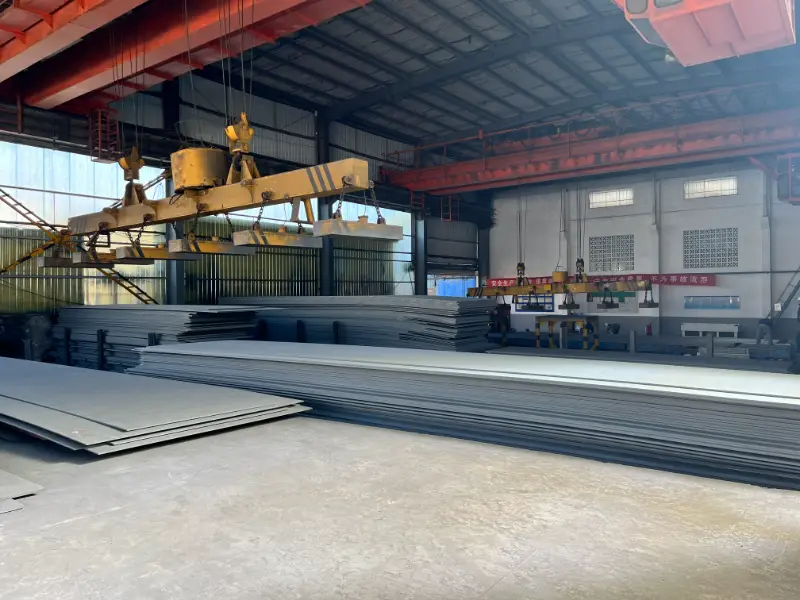
410S (UNS S41008) Ferritic Stainless Steel
410S (UNS S41008) Ferritic Stainless Steel: Low-Carbon, Weldable, Heat-Resistant Plate & Coil
Explore the properties and applications of alloy 410S (UNS S41008), a low-carbon ferritic stainless steel offering superior weldability, oxidation resistance up to 705°C, and good corrosion resistance. Ideal for petroleum, automotive, and thermal processing equipment.
Hot rolling, cold rolling, annealing, pickling, welding, forming, machining
- Phone : +8618037372205
- Email : [email protected]
- WhatsApp: Contact via Whtsapp
- WeChat: +8618037372205
410S Ferritic Stainless Steel Introduction
410S (S41008) is a low-carbon, 12% chromium ferritic stainless steel designed to provide excellent weldability while retaining the high-temperature oxidation resistance of Type 410. Unlike standard martensitic 410, the reduced carbon content (<0.08%) prevents hardening during welding, eliminating the need for post-weld heat treatment in many applications. The alloy is non-hardenable by heat treatment and exhibits a primarily ferritic microstructure in the annealed condition. Key attributes include:
- Excellent resistance to scaling and oxidation up to approximately 705°C (1300°F).
- Good ductility and formability in the annealed state.
- Weldable by most common fusion and resistance methods.
- Suitable for applications requiring moderate corrosion resistance combined with heat resistance.
Commonly supplied as plate, sheet, and coil under ASTM A240/A240M, it serves as a cost-effective alternative to higher-alloyed grades in non-severe corrosive environments.
410S Ferritic Stainless Steel Chemical Composition per ASTM A240
The ladle analysis limits for 410S (UNS S41008) stainless steel plate/sheet/coil as specified in ASTM A240/A240M. Elements not listed may be present as residuals, with Cu limited to avoid hot shortness. The controlled low carbon ensures ferritic stability and improved weldability.
| Chemical Element | Standard Value (max unless range) | Remarks |
|---|---|---|
| Carbon (C) | 0.08 max | Key control element for weldability; low C avoids martensitic hardening |
| Manganese (Mn) | 1.00 max | Austenite stabilizer; typical for deoxidation |
| Phosphorus (P) | 0.040 max | Residual element; kept low for ductility |
| Sulfur (S) | 0.030 max | Residual element; limits hot workability |
| Silicon (Si) | 1.00 max | Deoxidizer; enhances oxidation resistance |
| Chromium (Cr) | 11.5 – 13.5 | Principal ferrite stabilizer; provides oxidation and corrosion resistance |
| Nickel (Ni) | 0.60 max | Residual austenite stabilizer; low Ni promotes ferritic structure |
| Copper (Cu) | Residual (not specified) | General residual; limited to prevent hot shortness |
410S Ferritic Stainless Steel Thermal and Electrical Physical Properties
Physical properties of 410S stainless steel at room temperature and elevated temperatures, as compiled from reliable sources for the ferritic grade. These values are typical for the alloy in the annealed condition and are not part of the ASTM A240 purchase specification. They serve as engineering reference for design purposes. Thermal expansion and conductivity are critical for applications involving temperature cycling.
| Property | Typical Value | Unit | Test Condition / Temperature |
|---|---|---|---|
| Density (ρ) | 7.75 | g/cm³ | 20°C |
| Elastic Modulus (E) | 200 | GPa | 20°C, tension |
| Shear Modulus (G) | 77 | GPa | 20°C, calculated from E and ν |
| Poisson's Ratio (ν) | 0.27 | dimensionless | 20°C |
| Thermal Expansion Coefficient (α) | 10.5 | µm/m·°C | 20 – 100°C |
| Thermal Expansion Coefficient (α) | 11.0 | µm/m·°C | 20 – 315°C |
| Thermal Expansion Coefficient (α) | 11.5 | µm/m·°C | 20 – 538°C |
| Thermal Expansion Coefficient (α) | 11.9 | µm/m·°C | 20 – 650°C |
| Thermal Conductivity (λ) | 26.9 | W/m·K | 100°C |
| Thermal Conductivity (λ) | 28.0 | W/m·K | 500°C |
| Specific Heat Capacity | 460 | J/kg·K | 20°C |
| Electrical Resistivity (ρe) | 0.60 | µΩ·m | 20°C |
410S Ferritic Stainless Steel Mechanical Properties
The following mechanical property requirements apply to annealed 410S stainless steel plate, sheet, and coil at room temperature. Values are the minimum or maximum as required by the standard for material in the annealed condition. Elongation requirements may vary with thickness; the value shown is for thinner gauge material as commonly supplied. Hardness limits are given to ensure ductility.
| Property | Standard Requirement | Unit | Test Condition |
|---|---|---|---|
| Yield Strength (ReH, 0.2% offset) | ≥ 205 | MPa | Room temperature, longitudinal |
| Tensile Strength (Rm) | ≥ 415 | MPa | Room temperature, longitudinal |
| Elongation (A) in 50 mm (2 in.) | ≥ 22 | % | For thickness ≤ 3.8 mm (0.15 in.), gauge length 50 mm |
| Hardness, Rockwell B (HRB) | ≤ 89 | HRB | Converted from HB or direct indentation |
| Hardness, Brinell (HB) | ≤ 183 | HB | 10 mm ball, 3000 kg load |
410S Ferritic Stainless Steel Complete Material Equivalents and Substitution Recommendations
Internationally recognized standards and grades that are considered fully equivalent to UNS S41008 (410S) in terms of composition and mechanical properties. These can be used interchangeably for procurement and design, subject to any supplementary requirements of the respective standard.
| Country / Region | Standard | Grade | Remarks |
|---|---|---|---|
| USA | ASTM A240/A240M | 410S (UNS S41008) | Original grade; ferritic stainless steel plate/sheet |
| European Union | EN 10088-2 | 1.4000 (X6Cr13) | Identical chromium range, slightly different Si and Mn limits; generally interchangeable |
| Japan | JIS G4304 | SUS 410S | Composition and mechanical requirements align with ASTM 410S |
| China | GB/T 3280 | 06Cr13 (S11306) | Formerly 0Cr13; matches ASTM 410S chemistry |
| International | ISO 15510 | X6Cr13 | ISO designation equivalent to EN 1.4000 |
410S Ferritic Stainless Steel Application Introduction
410S is selected where moderate corrosion resistance, excellent high-temperature oxidation resistance (up to ~705°C), and good fabricability are required. Its low carbon content ensures ductile weld zones without preheating or post-weld annealing in many cases, making it cost-effective for welded assemblies.
- Not recommended for severe chloride environments or strong reducing acids.
- Performs well in oxidizing atmospheres and exhaust gases.
- Commonly used as a substitute for carbon steels or low-alloy steels when elevated temperature scaling is a concern.
Product Applications: Hot-rolled and cold-rolled plates, sheets, and coils, Welded tubes and pipes, Stamped and formed automotive exhaust mufflers, Fabricated annealing boxes and baskets, Heat exchanger stamped plates and flow channels, Oxidation-resistant baffles and supports
Processed into products: Muffler shells and internal baffles, Exhaust flanges and connectors, Catalytic converter heat shields, Furnace muffle tubes and retorts, Quench tank grids and racks, Thermal oxidizer ducting, Bolted structural supports for high-temperature service
Application industries: Petroleum refining (fractionation towers, heat exchangers, piping), Automotive (exhaust components, mufflers, catalytic converter housings), Thermal processing (annealing boxes, quench racks, furnace parts, burner nozzles), Power generation (ductwork, expansion joints), Food processing equipment (non-corrosive environments, dryers), Chemical processing (oxidation-resistant linings, conveyors)
410S Ferritic Stainless Steel Similar and Alternative Stainless Steel Grades
These grades offer comparable corrosion and heat resistance but differ in carbon content, stabilization, or alloying additions, leading to different weldability, hardenability, or cost profiles. Selection should be based on specific service conditions.
| Country / Region | Standard | Grade | Remarks |
|---|---|---|---|
| USA | ASTM A240 | 410 (UNS S41000) | Higher carbon (0.15 max); martensitic, hardenable by heat treatment, superior strength but lower weldability |
| USA | ASTM A240 | 409 (UNS S40900) | Titanium-stabilized ferritic; lower Cr (10.5-11.7%), excellent weldability, widely used in automotive exhaust |
| USA | ASTM A240 | 430 (UNS S43000) | Higher Cr (16-18%); non-hardenable ferritic, better general corrosion resistance but lower high-temperature strength |
| European Union | EN 10088-2 | 1.4512 (X2CrTi12) | Stabilized ferritic with Ti; similar Cr but better intergranular corrosion resistance after welding; use up to 800°C |
| European Union | EN 10088-2 | 1.4016 (X6Cr17) | Equivalent to 430; 17% Cr for improved corrosion, but subject to 475°C embrittlement |
Notes:
Welding: 410S can be welded with matching or slightly over-alloyed filler (e.g., AWS E/ER410 or E/ER309L for dissimilar joints). Preheat and interpass temperature should be limited to 150–200°C to avoid excessive grain growth. Post-weld heat treatment is generally not required for service below 400°C. Forming: Annealed 410S has good formability, but cold working can induce martensite at highly deformed areas; therefore, severe forming may require intermediate annealing. Heat Treatment: Annealing is performed at 750–815°C followed by air or water cooling to maximize softness and ductility. Limitations: Prolonged exposure between 400–550°C may cause 475°C embrittlement; therefore, continuous service in this range should be avoided unless the alloy is adequately stabilized (though 410S is not stabilized).
- Share



