
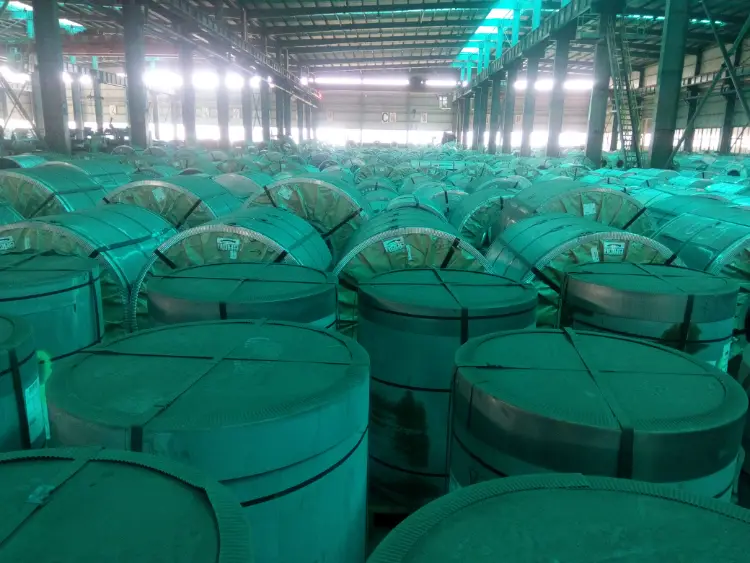
KR A56 Shipbuilding Steel Coil
KR A56 Shipbuilding Steel Coil - High-Strength Q&T Grade for Marine Structures
Detailed material data sheet for KR A56 shipbuilding steel coil, including chemical composition, mechanical properties, thermal and electrical physical properties, international equivalents, and application guidance.
Hot rolling followed by quenching and tempering (Q&T); subsequent cold forming or bending is possible with appropriate precautions
- Phone : +8618037372205
- Email : [email protected]
- WhatsApp: Contact via Whtsapp
- WeChat: +8618037372205
KR A56 Shipbuilding Steel Coil Introduction
KR A56 is an extra high-strength quenched and tempered (Q&T) structural steel grade certified by the Korean Register of Shipping (KR). It offers a minimum yield strength of 560 MPa, combined with excellent toughness and good weldability. This grade is primarily used for weight-critical hull components and offshore structures subjected to high static and dynamic loads. The steel is supplied in coil form and can be hot-rolled, descaled, and cut to length. Key advantages:
- High strength-to-weight ratio
- Reliable low-temperature impact properties
- Compliance with IACS UR W11 (Extra High Strength Steels)
- Excellent formability after Q&T processing
KR A56 Shipbuilding Steel Coil Chemical Composition
The chemical composition is strictly controlled to achieve the required mechanical properties after quench and tempering. Elements such as Nb, V, Ti, and Al are added for grain refinement and precipitation strengthening. Maximum limits for P and S ensure high cleanliness and good weldability. Values are in accordance with KR Rules adopting IACS UR W11 for grade with yield strength 550 MPa.
| Chemical Element | Standard Value | Remarks |
|---|---|---|
| Carbon (C) | ≤0.21 | Typical 0.08–0.18 |
| Silicon (Si) | ≤0.55 | Deoxidation and strengthening |
| Manganese (Mn) | 1.00–1.70 | Required for strength and toughness |
| Phosphorus (P) | ≤0.025 | Upper limit to avoid embrittlement |
| Sulfur (S) | ≤0.025 | Upper limit to improve ductility |
| Aluminum (Al total) | ≥0.020 | Grain refining |
| Niobium (Nb) | ≤0.06 | Grain refinement and precipitation hardening |
| Vanadium (V) | ≤0.10 | Optional micro-alloying |
| Titanium (Ti) | ≤0.05 | Optional; improves toughness |
| Copper (Cu) | ≤0.55 | Residual or intentional addition |
| Chromium (Cr) | ≤0.25 | Residual element |
| Nickel (Ni) | ≤0.40 | Residual element |
| Molybdenum (Mo) | ≤0.10 | Residual element |
| Nitrogen (N) | ≤0.012 | Controlled for age hardening |
KR A56 Shipbuilding Steel Coil Thermal and Electrical Physical Properties
Physical properties are representative for high-strength quenched and tempered carbon-manganese steels at room temperature unless noted otherwise. These values are useful for engineering calculations and simulations but are not mandatory specification items.
| Property | Reference Value | Unit | Test Condition / Remarks |
|---|---|---|---|
| Density (ρ) | 7.85 | g/cm³ | 20°C |
| Elastic Modulus (E) | 210 | GPa | Room temperature |
| Shear Modulus (G) | 80.8 | GPa | Calculated (E and ν) |
| Poisson's Ratio (ν) | 0.3 | – | Room temperature |
| Thermal Expansion Coefficient (α) | 12.0 × 10⁻⁶ | K⁻¹ | 20–100°C average |
| Thermal Conductivity (λ) | 45 | W/(m·K) | At 20°C |
| Specific Heat Capacity (Cp) | 460 | J/(kg·K) | At 20°C |
| Electrical Resistivity (ρₑ) | 0.20 × 10⁻⁶ | Ω·m | At 20°C |
KR A56 Shipbuilding Steel Coil Mechanical Properties
Tensile tests are performed on transverse specimens taken from the coil after final heat treatment (Q&T). Impact properties are verified at 0°C (longitudinal) as required by KR for 'A' grade designation. Minimum values apply unless a range is specified. Test condition: thickness ≤ 50 mm.
| Property | Standard Required Value | Unit | Test Condition |
|---|---|---|---|
| Yield Strength (ReH) | ≥560 | MPa | t ≤ 50 mm, transverse |
| Tensile Strength (Rm) | 670–830 | MPa | t ≤ 50 mm, transverse |
| Elongation (A) | ≥16 | % | Gauge length 5.65√So, t ≤ 50 mm |
| Impact Energy (KV) | ≥41 | J | Longitudinal, 0°C, 10×10 mm specimen |
| Impact Energy (KV) | ≥27 | J | Transverse, 0°C, 10×10 mm specimen |
| Bend Test (t ≤ 10 mm) | No cracks | – | 180° bend, mandrel diameter 3× thickness |
| Bend Test (10 < t ≤ 20 mm) | No cracks | – | 180° bend, mandrel diameter 4× thickness |
KR A56 Shipbuilding Steel Coil Completely Equivalent Material Standards and Replacement Grades
| Country / Region | Standard / Society | Grade | Remarks |
|---|---|---|---|
| USA | ABS (American Bureau of Shipping) | AH550 | Impact 0°C, identical strength class |
| Norway / Germany | DNV (Det Norske Veritas) | VL550 | Group VL, yield 550 MPa, same impact temperature |
| France | BV (Bureau Veritas) | A550 | A grade, impact 0°C |
| China | CCS (China Classification Society) | AH550 | AH grade for 0°C impact |
| UK | LR (Lloyd's Register) | AH55 | Impact 0°C, tensile range matches |
| Japan | NK (Nippon Kaiji Kyokai) | KA55 | Extra high strength steel |
| Italy | RINA (Registro Italiano Navale) | A/Y550 | Y denotes yield level 550 MPa |
| Russia | RMRS (Russian Maritime Register of Shipping) | A550 | Equivalent Q&T steel |
KR A56 Shipbuilding Steel Coil Application Introduction
KR A56 steel coil is engineered for marine and offshore applications where high strength, toughness, and weldability are essential. Its quenched and tempered condition provides a balanced combination of hardness and ductility. Typical uses:
Product Applications: Hull structural plates and stiffeners, Deck and bottom panels, Web frames and bulkhead panels, Crane booms and pedestals, Pressurized shell sections (submarines, tanks)
Processed into products: Main deck plates and stringers, Bottom longitudinals and girders, Transverse web frames, Bracket plates and connection gussets, Offshore platform leg chords, Crane pillar and slewing ring support rings
Application industries: Shipbuilding (commercial vessels, naval ships), Offshore oil & gas (platforms, jack-up rigs, FPSOs), Heavy engineering (cranes, lifting equipment, bridge structures), Port and harbor construction (pile driving, caissons)
KR A56 Shipbuilding Steel Coil Similar / Near-Equivalent Material Recommendations
| Country / Region | Standard / Society | Grade | Remarks / Comparison |
|---|---|---|---|
| South Korea / IACS | KR / IACS UR W11 | AH460 | Lower yield (460 MPa); still high strength; better formability |
| South Korea / IACS | KR / IACS UR W11 | DH550 | Same strength but impact at -20°C; better for colder environments |
| South Korea / IACS | KR / IACS UR W11 | AH620 | Higher yield (620 MPa); for extreme service loads |
| South Korea / IACS | KR / IACS UR W11 | AH36 | Lower cost; yield 355 MPa; widely used in general shipbuilding |
Notes:
Welding: KR A56 can be welded by all common arc welding processes (SMAW, SAW, GMAW, FCAW) using low-hydrogen consumables. Preheating may be required depending on plate thickness and ambient temperature. Post-weld heat treatment is generally not necessary. Delivery condition: Coils are typically supplied in the quenched and tempered state, pickled and oiled, with mill test certificates according to EN 10204 3.1 or equivalent. Tolerances on thickness, width, and flatness follow KR/IACS standards.
- Share



