
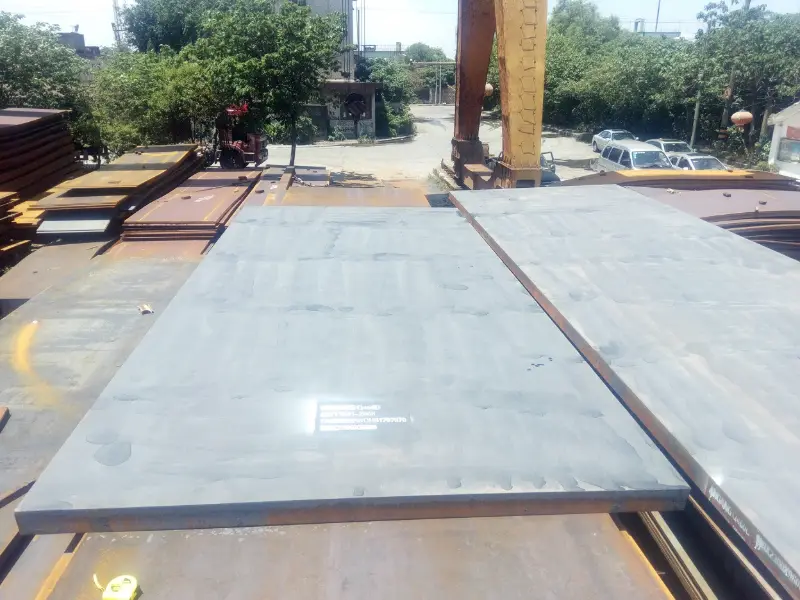
KR D56 High-Strength Shipbuilding Steel
KR D56 High-Strength Shipbuilding Steel - Properties, Equivalents & Applications
Complete material data for KR D56 shipbuilding steel, including chemical composition, mechanical properties, thermal and electrical physical properties, international equivalents, and recommended applications.
Hot rolling, thermomechanical controlled rolling (TMCP), normalizing, quenching and tempering (optional), welding, cutting, cold bending
- Phone : +8618037372205
- Email : [email protected]
- WhatsApp: Contact via Whtsapp
- WeChat: +8618037372205
KR D56 High-Strength Shipbuilding Steel Introduction
KR D56 is a high-strength structural steel grade certified by the Korean Register of Shipping (KR) for shipbuilding and offshore applications. It belongs to the higher-strength hull structural steel group with a minimum specified yield strength of 560 MPa. The 'D' designation indicates that the steel is suitable for service at temperatures down to -20°C with guaranteed impact toughness. This grade combines excellent strength with good weldability and toughness, making it ideal for critical structural components in large vessels and offshore platforms. It is typically supplied in normalized or thermo-mechanically controlled rolled (TMCP) condition, in the form of plates, coils, and sections. KR D56 conforms to the IACS Uniform Requirements (UR W11) and may have equivalent designations under other classification societies such as ABS DH56, DNV D56, LR DH56, and CCS D56.
KR D56 High-Strength Shipbuilding Steel Chemical Composition
The chemical composition of KR D56 steel is designed to provide high strength and good toughness at low temperatures. Elements like niobium, vanadium, and titanium are often added in small amounts for grain refinement and precipitation hardening. Carbon equivalent (CEV) is controlled to ensure good weldability. Typical limits are as follows:
| Element | Standard Value (%) | Remarks |
|---|---|---|
| Carbon (C) | ≤ 0.20 | |
| Silicon (Si) | 0.10 – 0.55 | |
| Manganese (Mn) | 0.90 – 1.60 | |
| Phosphorus (P) | ≤ 0.025 | |
| Sulfur (S) | ≤ 0.025 | |
| Aluminum (Al_acid-soluble) | ≥ 0.015 | Minimum acid-soluble content |
| Niobium (Nb) | ≤ 0.05 | Optional microalloy |
| Vanadium (V) | ≤ 0.10 | Optional microalloy |
| Titanium (Ti) | ≤ 0.02 | Optional microalloy |
| Nitrogen (N) | ≤ 0.012 | |
| Copper (Cu) | ≤ 0.35 | Residual/added; sum of Cu+Ni+Cr+Mo ≤ 0.80 % |
| Chromium (Cr) | ≤ 0.20 | Residual |
| Nickel (Ni) | ≤ 0.40 | Residual |
| Molybdenum (Mo) | ≤ 0.08 | Residual |
| Carbon Equivalent (CEV) | ≤ 0.43 (typical) | CEV = C + Mn/6 + (Cr+Mo+V)/5 + (Ni+Cu)/15 |
KR D56 High-Strength Shipbuilding Steel Thermal and Electrical Physical Properties
Physical properties for KR D56 are similar to other low-alloy high-strength steels. These values are typical at room temperature unless otherwise specified. They are important for design calculations involving heat transfer and structural analysis.
| Property | Standard Value | Unit | Test Condition |
|---|---|---|---|
| Density (ρ) | 7.85 | g/cm³ | at 20 °C |
| Elastic Modulus (E) | 210 | GPa | at 20 °C |
| Shear Modulus (G) | 81 | GPa | at 20 °C |
| Poisson's Ratio (ν) | 0.3 | — | at 20 °C |
| Thermal Expansion Coefficient (α) | 11.5 | 10⁻⁶/K | 20–100 °C |
| Thermal Expansion Coefficient (α) | 12.5 | 10⁻⁶/K | 20–300 °C |
| Thermal Conductivity (λ) | 50 | W/(m·K) | at 20 °C |
| Specific Heat Capacity (c_p) | 460 | J/(kg·K) | at 20 °C |
| Electrical Resistivity (ρ_e) | 0.21 | µΩ·m | at 20 °C |
KR D56 High-Strength Shipbuilding Steel Mechanical Properties
Mechanical properties for KR D56 steel are determined in accordance with KR rules and IACS UR W11. The testing is usually performed on normalized or TMCP specimens at room temperature. Yield strength (ReH), tensile strength (Rm), elongation (A), and impact energy (KV) are key indicators. Impact tests are conducted at -20 °C. Bending tests confirm ductility. Values depend on thickness range.
| Property | Standard Requirement | Unit | Test Condition / Thickness |
|---|---|---|---|
| Yield Strength (ReH) | ≥ 560 | MPa | t ≤ 50 mm |
| Yield Strength (ReH) | ≥ 525 | MPa | 50 < t ≤ 70 mm |
| Yield Strength (ReH) | ≥ 500 | MPa | 70 < t ≤ 100 mm |
| Tensile Strength (Rm) | 670 – 830 | MPa | t ≤ 100 mm |
| Elongation (A5) | ≥ 16 | % | t ≤ 50 mm |
| Elongation (A5) | ≥ 15 | % | 50 < t ≤ 70 mm |
| Elongation (A5) | ≥ 14 | % | 70 < t ≤ 100 mm |
| Charpy V-notch Impact Energy (KV2) | ≥ 31 (longitudinal) | J | at -20 °C |
| Charpy V-notch Impact Energy (KV2) | ≥ 24 (transverse) | J | at -20 °C |
| Bend Test (Bend Angle 180°) | d = 3a | — | t ≤ 25 mm; no cracks |
| Bend Test (Bend Angle 180°) | d = 4a | — | 25 < t ≤ 50 mm; no cracks |
| Bend Test (Bend Angle 180°) | d = 5a | — | 50 < t ≤ 100 mm; no cracks |
KR D56 High-Strength Shipbuilding Steel Direct Equivalent Materials – International Standards and Grades
| Country/Region | Standard | Grade | Remarks |
|---|---|---|---|
| International (IACS) | UR W11 | D56 | Base definition for classification societies |
| South Korea | KR Rules | D56 | Korean Register – original grade |
| USA | ABS Rules | DH56 | American Bureau of Shipping (increase temperature tolerance – DH56 may be -20°C or -40°C, verify) |
| Norway/Germany | DNV Rules | D56 | DNV classification – equivalent high-strength D56 |
| UK | LR Rules | DH56 | Lloyd's Register designation |
| China | CCS Rules | D56 | China Classification Society |
| France | BV Rules | D56 | Bureau Veritas |
| Italy | RINA Rules | D56 | Registro Italiano Navale |
| Japan | NK Rules | D56 | ClassNK – Nippon Kaiji Kyokai |
| Europe | EN 10225 | S560Q (similar) | Not fully identical; differs in impact test temperature; S560Q is a structural steel for offshore structures with yield 560 MPa, impact -20°C or -40°C. |
KR D56 High-Strength Shipbuilding Steel Application Introduction
KR D56 steel is primarily intended for the construction of ship hulls and offshore structures that require a combination of high strength, good toughness at sub-zero temperatures, and reliable weldability. Its properties allow for lighter structural design while maintaining safety and longevity. The steel can be processed by welding, thermal cutting, bending, and forming, following relevant fabrication guidelines.
Product Applications: Ship hull plates (deck, bottom, side shell, bulkheads), Longitudinal stiffeners and transverse frames, Deck girders and hatch coamings, Offshore platform legs and bracings, Heavy-lift crane booms and pedestals, Pressure vessels for marine service
Processed into products: Welded built-up sections (I-beams, T-beams), Curved shell plates after cold forming, Flame-cut parts for complex intersections, Stiffened panel assemblies, Flanges and brackets for structural connections
Application industries: Shipbuilding (naval and commercial vessels), Offshore oil and gas platforms (FPSOs, jackets, jack-up rigs), Marine and coastal infrastructure (docks, piers), Heavy machinery and crane manufacturing, Bridge construction (special applications)
KR D56 High-Strength Shipbuilding Steel Similar / Alternative Materials with Comparable Performance
| Country/Region | Standard | Grade | Remarks |
|---|---|---|---|
| USA | ASTM A131 / A131M | DH56 (if available) | ASTM shipbuilding steel; DH56 may not be explicitly listed but equivalent strength and toughness can be achieved with EH56 and supplemental impact requirements. |
| USA | ASTM A514 / A517 | Grade E, Grade Q | High-strength quenched and tempered structural steel plates, 690 MPa tensile, but higher strength; careful when welding. |
| Europe | EN 10025-6 | S690QL | Quenched and tempered structural steel with yield 690 MPa; higher strength; limited low-temperature toughness unless specified. |
| Europe | EN 10225 | S500G2+M (ATSM) | Offshore structural steel with yield 500 MPa; close but lower strength; suitable for less demanding applications. |
| Japan | JIS G 3106 | SM570 | Welded structural steel with yield 460–570 MPa range; comparable to D56 in terms of strength but may lack guaranteed low-temperature toughness unless with special agreement. |
Notes:
All data provided are based on KR rules and IACS UR W11. Actual values may vary based on product specification, thickness, and manufacturer's agreement. For specific design, refer to the latest KR rules and the material certificate. Welding consumables should be selected to match the high strength and toughness requirements; preheating and post-weld heat treatment may be required depending on thickness. The steel usually meets Class D (-20 °C) impact requirements; if lower temperature service is needed, Grade E56 (impact at -40 °C) should be considered.
- Share



