
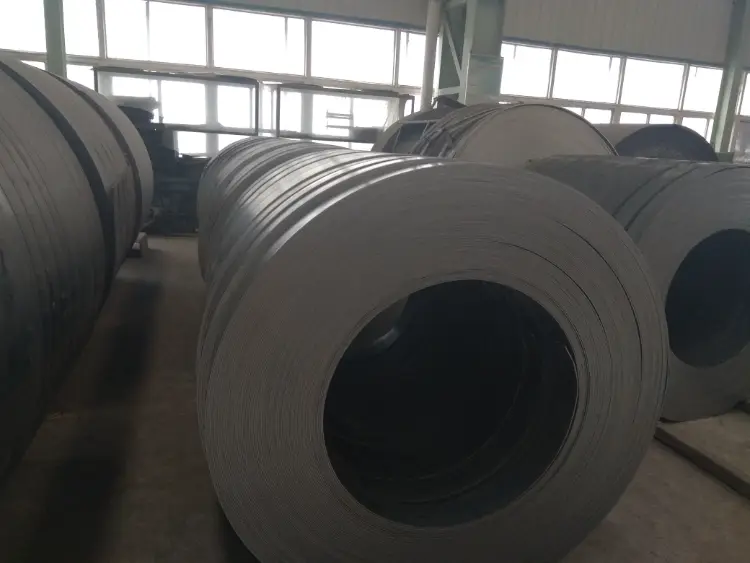
KR E56 Shipbuilding Steel Coil
KR E56 Shipbuilding Steel Coil: 560 MPa Yield Strength Marine-Grade High-Tensile Steel
Comprehensive technical data for KR E56 shipbuilding steel coil, including chemical composition, mechanical properties, thermal and electrical physical properties, equivalent grades, and application guidelines for marine and offshore structures.
Cold forming (with controlled radius), hot forming (recommended 850-950 °C, followed by re-tempering), flame cutting, welding (low-hydrogen processes, preheat typically 100-150 °C depending on thickness), machining
- Phone : +8618037372205
- Email : [email protected]
- WhatsApp: Contact via Whtsapp
- WeChat: +8618037372205
KR E56 Shipbuilding Steel Coil Introduction
KR E56 is an extra-high strength shipbuilding structural steel grade approved by the Korean Register of Shipping (KR). It delivers a minimum yield strength of 560 MPa in thicknesses up to 50 mm, with excellent toughness at low temperatures (transverse impact energy ≥ 24 J at -40 °C). The steel is supplied as normalised rolling (NR), thermomechanically controlled processed (TMCP), or quenched and tempered (QT) coils and plates, meeting the stringent requirements of IACS UR W11 for hull and offshore structures. Its very fine-grain microstructure (typically ASTM 8 or finer), refined with microalloying elements such as Nb, V and Ti, provides a superior combination of high strength, good weldability and resistance to brittle fracture. This makes E56 a preferred material for weight-critical structural members in large container vessels, ice-class ships and arctic offshore platforms, where reduced plate thickness leads to increased payload and improved fuel efficiency without compromising safety.
KR E56 Shipbuilding Steel Coil Chemical Composition
Ladle analysis limits as specified in KR Rules Table 1.3.2-2 for E56 grade (material factor k=0.73). Values for product analysis may be subject to slight permissible deviations per the standard. Residual elements are controlled to maintain weldability and low-temperature toughness.
- CEV limit: ≤ 0.43% (TMCP) or ≤ 0.47% (QT) for thickness ≤ 50 mm.
- Grain-refining elements (Al, Nb, V, Ti) are added singly or in combination to achieve the required strength and fine-grain structure.
- For thickness > 50 mm, additional microalloying or QT treatment is mandatory to meet strength targets.
| Element | Standard Value (max, %) | Notes |
|---|---|---|
| Carbon (C) | 0.18 | For QT condition, typical aim is 0.12–0.17 to ensure weldability |
| Silicon (Si) | 0.55 | Usually 0.15–0.40 for deoxidation and strength |
| Manganese (Mn) | 1.70 | Key toughening element; higher Mn content improves low-temp toughness |
| Phosphorus (P) | 0.025 | Strict limit for brittle fracture resistance |
| Sulfur (S) | 0.015 | Strict limit for ductility and lamellar tearing resistance |
| Aluminium (Al total) | min 0.015 | Acid soluble; required for fine-grain practice |
| Niobium (Nb) | 0.05 | Grain refinement and precipitation strengthening |
| Vanadium (V) | 0.10 | Precipitation strengthening in TMCP/QT products |
| Titanium (Ti) | 0.05 | Nitride formation to limit grain coarsening in HAZ |
| Nickel (Ni) | 0.40 | Improves low-temperature toughness (may be higher for arctic grades) |
| Chromium (Cr) | 0.20 | Contributes to hardenability in QT products |
| Molybdenum (Mo) | 0.08 | Optional; improves tempering resistance |
| Copper (Cu) | 0.35 | Residual element; limited to avoid hot shortness |
| Nitrogen (N) | 0.012 (0.009 if Al-fixed) | Tied up as TiN/AlN for grain size control |
| Boron (B) | 0.0005 | Only if added for enhanced hardenability; not normally resorted to |
| Sum Nb+V+Ti | 0.12 | Total microalloy limit per IACS UR W11 |
KR E56 Shipbuilding Steel Coil Thermal & Electrical Physical Properties
Physical properties correspond to a low-alloyed QT/TMCP steel with a tempered martensite/bainite microstructure. Data are representative for room temperature unless noted.
- Density is practically identical to structural carbon steels.
- Thermal expansion and thermal conductivity are crucial for welding distortion calculations and heat transfer analysis.
- Electrical resistivity may vary slightly with heat treatment condition but stays within a narrow range for this class of steel.
| Property | Reference Value | Unit | Test Condition |
|---|---|---|---|
| Density (ρ) | ~7850 | kg/m³ | 20 °C |
| Elastic modulus (E) | ~205 | GPa | 20 °C, static |
| Shear modulus (G) | ~80 | GPa | 20 °C |
| Poisson's ratio (ν) | ~0.30 | — | 20 °C |
| Thermal expansion coefficient (α) | ~11.5 × 10⁻⁶ | 1/K | 20 – 100 °C |
| Thermal expansion coefficient (α) | ~12.2 × 10⁻⁶ | 1/K | 20 – 200 °C |
| Thermal conductivity (λ) | ~42 – 45 | W/(m·K) | 20 °C |
| Thermal conductivity (λ) | ~39 – 42 | W/(m·K) | 100 °C |
| Specific heat capacity (cp) | ~460 – 500 | J/(kg·K) | 20 °C |
| Electrical resistivity (ρe) | ~0.23 – 0.27 | µΩ·m | 20 °C |
KR E56 Shipbuilding Steel Coil Mechanical Properties
Minimum specified values for transverse test pieces (unless longitudinal agreed) taken from the plate/coil in delivery condition. Data derived from KR Rules Pt.2, Ch.1, Sec.3, Table 1.3.2-2 and typical mill certificates for thickness ≤50 mm.
- Yield strength (ReH) and tensile strength (Rm) remain substantially unchanged after stress relieving (≤600°C for QT/TMCP).
- Impact values are minimum averages of three specimens (single value must be ≥70% of the minimum).
- Bend test is conducted on a flat specimen over a mandrel of specified diameter through 180° without cracking.
| Property | Standard Requirement | Unit | Test Condition |
|---|---|---|---|
| Yield Strength (ReH) | ≥ 560 | MPa | Transverse, t ≤ 50 mm, room temperature |
| Tensile Strength (Rm) | 670 – 830 | MPa | Transverse, room temperature |
| Elongation (A) | ≥ 17 | % | Gauge length 5.65√So, transverse |
| Yield-to-Tensile Ratio (ReH/Rm) | ≤ 0.90 – 0.93 (typical) | — | Estimated; no strict limit in KR rule, but often documented for plastic design |
| Bend Test (mandrel diameter) | 3a (t ≤ 25 mm) | — | 180° bend; a = specimen thickness, no cracks |
| Bend Test (mandrel diameter) | 4a (25 < t ≤ 50 mm) | — | 180° bend; a = specimen thickness |
| Charpy V-notch impact (KV2) | ≥ 34 (average) | J | Longitudinal, -40 °C |
| Charpy V-notch impact (KV2) | ≥ 24 (average) | J | Transverse, -40 °C (if ordered transverse) |
KR E56 Shipbuilding Steel Coil Fully Equivalent Material Standards & Substitutable Grades
| Country/Region | Standard | Grade | Remarks |
|---|---|---|---|
| South Korea / International | KR Rules | E56 | Original grade; QT or TMCP |
| European Union | EN 10025-6 | S690QL (1.8928) / S690QL1 | QL for -40 °C (min 27–30 J); QL1 for -60 °C; thickness dependent |
| United States | ASTM A514 / A517 | Grade F (or H) | Quenched & tempered plate; impact values may need separate agreement to match -40 °C |
| China | GB/T 712 | Q690E | E690 (yield ≥ 690 MPa) with -40 °C impact; close mechanical equivalent |
| Japan | JIS G 3128 | SHY685NS-F | High strength steel for welded structures; cryogenic toughness class F (-40 °C) |
| IACS (Global) | Unified Requirement W11 | E56 | All member societies: ABS E56, BV E56, CCS E56, DNV E560, LR E56, NK KE56, RINA E56, RS E56 |
KR E56 Shipbuilding Steel Coil Application Introduction
KR E56 steel is specifically designed for high-strength welded structures in the shipbuilding and offshore sectors. Its high yield-to-weight ratio and excellent weldability enable weight reduction without sacrificing structural integrity. Common fabrication operations include plate cutting, panel line assembly (SAW/MAG welding), forming of curved shell plates, and subsequent stress relieving. For severe arctic environments, the material can be ordered with supplementary requirements such as Z-quality (through-thickness properties) or crack-tip-opening-displacement (CTOD) tests.
Product Applications: Hull shell plates and stiffeners, Deck plates and longitudinal girders, Hatch coaming and coaming stays, Ice belt reinforcement insert plates, Heavy-duty crane jib chords and lattice members, Jack-up rig leg chords and racks (after induction hardening)
Processed into products: Bottom shell plating in high-stress areas, Transverse web frames, Main deck stringer plates, Container cell guide beams, Transition pieces for monopile foundations, Welded tubular joints in jacket structures, Padeyes and ear plates for lifting operations
Application industries: Shipbuilding (container ships, bulk carriers, tankers, LNG carriers, ice-class vessels), Offshore oil & gas (jacket legs, deck structures, flare booms, cantilever beams), Marine renewable energy (offshore wind turbine transition pieces, subsea templates), Port & harbour equipment (quayside crane booms, heavy-lift spreader beams), Defence & naval (hull plates for frigates and support vessels)
KR E56 Shipbuilding Steel Coil Similar / Comparable Substitute Materials
| Country/Region | Standard | Grade | Remarks |
|---|---|---|---|
| European Union | EN 10025-6 | S690Q | Impact requirement at 0 °C; less stringent toughness than E56 |
| European Union | EN 10025-6 | S690QL1 | Better low-temperature toughness (-60 °C); can replace E56 if FH56 needed |
| European Union | EN 10149-2 | S700MC | Thermomechanically rolled HSLA steel (yield 700 MPa); for cold forming; not identical in toughness or thickness range |
| South Korea | KR Rules | AH56 / DH56 / FH56 | Same alloy system; only Charpy test temperature differs (0 / -20 / -60 °C respectively) |
| United States | ASTM A514 | Grade Q | Similar strength but modified chemistry for weather resistance; impact toughness may be lower at -40 °C |
| Worldwide | API 2W / 2Y | Grade 70 / 70W | For offshore structures; strength territory overlaps but specification includes through-thickness properties (Z-grade) typically |
Notes:
Welding considerations: Preheat (100–150 °C) and interpass temperature control (<250 °C) are recommended to avoid hydrogen cracking. Use low-hydrogen consumables (AWS A5.5 E11018M or equivalent) matched to the tensile strength. Post-weld heat treatment (PWHT) is generally not required for TMCP products below 50 mm, but may be applied at 550–600 °C to reduce residual stress.
Certification: All KR E56 products are supplied with inspection certificate 3.1 or 3.2 per EN 10204, including chemical analysis, tensile test, impact test and NDE (UT). The material complies with the EU-Med/UK-MED certification if required.
Fatigue performance: Typical fatigue threshold (ΔKth) of the weld heat-affected zone is in the range of 80–100 MPa√m; design S–N curves in accordance with IIW recommendations or classification society rules (e.g., FAT 100 for the parent metal).
- Share



