
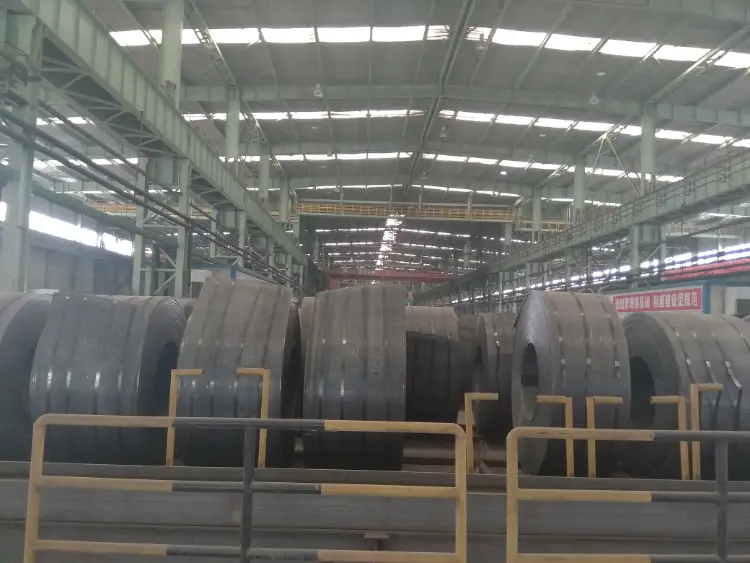
KR F56 Shipbuilding Steel Coil
KR F56 Shipbuilding Steel Coil: Ultra-High Strength Plate for Arctic-Grade Marine Structures
Comprehensive data sheet for KR F56 shipbuilding steel coil, including chemical composition, mechanical and physical properties, equivalent grades from all major IACS classification societies, and application guidance for extreme marine environments.
TMCP (Thermo-Mechanical Controlled Processing), Quenching and Tempering (Q&T), cold forming, welding, cutting
- Phone : +8618037372205
- Email : [email protected]
- WhatsApp: Contact via Whtsapp
- WeChat: +8618037372205
KR F56 Shipbuilding Steel Coil Introduction
KR F56 is a high-strength hull structural steel grade certified by the Korean Register (KR) under the FH56 category, with a minimum yield strength of 550 MPa. It is designed for critical applications in large, modern ships and offshore structures operating in severe cold climates, offering exceptional toughness at -60 °C. Typically produced by thermo-mechanical controlled processing (TMCP) or quenching and tempering (Q&T), the steel combines high strength with good weldability and formability. Key characteristics include:
- Yield strength ≥ 550 MPa for thicknesses up to 100 mm
- Tensile strength in the range 680–820 MPa
- Minimum Charpy V-notch impact energy of 27 J at -60 °C (transverse)
- Excellent cold-bending performance (180° bend over 3t)
- Stringent control of micro-alloying elements for fine grain structure
KR F56 Shipbuilding Steel Coil Chemical Composition
Chemical composition limits according to KR Rules Part 2, Ch.1, Sec.2, Table 2.1.2-1 for FH56 grade (560 MPa class). The steel is micro-alloyed with Nb, V and Ti to achieve fine grain refinement and precipitation strengthening.
- Carbon equivalent (Ceq) and weldability index Pcm are controlled according to agreed formulas.
- When the thickness exceeds certain limits, the maximum value of some elements may be reduced to ensure weldability.
| Element | Specified Value (max %) | Remarks |
|---|---|---|
| C (Carbon) | 0.18 | max |
| Si (Silicon) | 0.55 | max |
| Mn (Manganese) | 0.90 – 1.60 | typical range |
| P (Phosphorus) | 0.035 | max |
| S (Sulfur) | 0.035 | max |
| Al (Acid soluble) | ≥0.015 | minimum for grain refinement |
| Nb (Niobium) | 0.02 – 0.05 | micro-alloy; typically 0.03 |
| V (Vanadium) | 0.05 – 0.10 | micro-alloy |
| Ti (Titanium) | 0.007 – 0.05 | micro-alloy; also used for deoxidation |
| Ni (Nickel) | 0.40 | max |
| Cr (Chromium) | 0.20 | max |
| Mo (Molybdenum) | 0.08 | max |
| Cu (Copper) | 0.35 | max |
| N (Nitrogen) | 0.012 | max (if V is present, higher N may be allowed but requires V/N ≥ 4:1) |
KR F56 Shipbuilding Steel Coil Thermal and Electrical Physical Properties
These physical constants are representative of low-carbon micro-alloyed steel in the TMCP or Q&T condition and are not part of the KR specification. They may vary slightly with processing and test temperature.
- Density is given for 20 °C; for weight calculations, 7.85 g/cm³ is commonly used.
- Thermal expansion coefficient is an average between 20–100 °C.
- Thermal conductivity and electrical resistivity are typical at room temperature.
| Property | Typical Value | Unit | Test Condition |
|---|---|---|---|
| Density (ρ) | 7.85 | g/cm³ | at 20 °C |
| Elastic modulus (E) | 205 | GPa | at 20 °C |
| Shear modulus (G) | 80 | GPa | at 20 °C |
| Poisson's ratio (ν) | 0.3 | – | at 20 °C |
| Thermal expansion coefficient (α) | 11.5 × 10⁻⁶ | K⁻¹ | 20 – 100 °C |
| Thermal conductivity (λ) | 40 | W/(m·K) | at 20 °C |
| Specific heat capacity (cₚ) | 460 | J/(kg·K) | at 20 °C |
| Electrical resistivity (ρₑ) | 0.25 | µΩ·m | at 20 °C |
KR F56 Shipbuilding Steel Coil Mechanical Properties
Mechanical properties are evaluated on transverse test pieces unless otherwise specified. Yield strength, tensile strength and elongation apply to thicknesses up to 100 mm. Charpy V-notch impact test at -60 °C is mandatory for F-grade designation.
- For thicker products (>100 mm), properties shall be specially agreed.
- Bend test: 180° bending over a former with diameter equal to 3 times the specimen thickness (3a); no cracks or defects are allowed on the outer surface.
| Property | Required Value | Unit | Test Condition / Thickness |
|---|---|---|---|
| Yield strength (ReH) | ≥ 550 | MPa | t ≤ 100 mm, transverse |
| Tensile strength (Rm) | 680 – 820 | MPa | t ≤ 100 mm, transverse |
| Elongation (A5, gauge length = 5.65√S₀) | ≥ 16 | % | t ≤ 50 mm, transverse |
| Elongation (A5) | ≥ 16 | % | 50 < t ≤ 70 mm, transverse |
| Elongation (A5) | ≥ 16 | % | 70 < t ≤ 100 mm, transverse |
| Charpy V-notch impact (KV₂) | ≥ 27 (individual); ≥ 34 (average) | J | at -60 °C, transverse, 10×10 mm specimen |
| Bending test (bending angle 180°) | no cracks | – | d = 3a (a = specimen thickness), t ≤ 100 mm |
KR F56 Shipbuilding Steel Coil Fully Equivalent Material Standards and Replaceable Grades
| Country / Region | Standard / Classification Society | Grade | Remarks |
|---|---|---|---|
| International (IACS) | IACS UR W11 | FH56 | Uniform requirement for high strength hull structural steel |
| USA | ABS (American Bureau of Shipping) | FH56 | Identical grade under ABS Rules |
| Norway / Germany | DNV GL (now DNV) | FH56 | Identical grade under DNV Ship Rules |
| UK | Lloyd's Register (LR) | FH56 | Identical grade under LR Rules |
| France | Bureau Veritas (BV) | FH56 | Identical grade under BV Rules |
| China | China Classification Society (CCS) | FH56 | Identical grade under CCS Rules |
| Japan | Nippon Kaiji Kyokai (ClassNK) | FH56 | Identical grade under NK Rules |
| Italy | RINA | FH56 | Identical grade under RINA Rules |
| Russia | Russian Maritime Register (RS) | FH56 | Identical grade under RS Rules |
KR F56 Shipbuilding Steel Coil Application Introduction
KR F56 steel is engineered for the most demanding structural parts of modern vessels, where high strength, low weight, and excellent low-temperature toughness are essential. It is typically delivered in the as-rolled TMCP or quenched and tempered condition, ready for precise cutting, cold forming, and welding.
- Due to its high yield ratio, cold forming requires careful consideration of springback and minimum bending radii.
- Welding processes must use appropriately matched filler metals and preheating/interpass temperature controls; low-hydrogen practices are strongly recommended.
- The steel is fully compliant with the International Maritime Organization (IMO) performance standards for hull construction.
Product Applications: Large container ships (especially high-strength deck and side shells), Bulk carriers and ore carriers (hatch coaming and top-side tanks), Crude oil tankers (Sheer strake and deck longitudinals), LNG / LPG carriers (structural members requiring high fatigue resistance), Icebreakers and ice-strengthened vessels (hull plating in ice belt regions), Semi-submersible rigs and jack-up platforms (legs and primary structure), Monopile and transition pieces for offshore wind turbines
Processed into products: Sheer strake (uppermost hull plating), Bilge strake (curved transition between bottom and side shell), Deck stringer plate, Hatch coaming girders, Longitudinal stiffeners in high-stress areas, Bottom plating in fore and aft peak tanks, Bracket plates connecting main frames, Fatigue-critical details in FPSO turret systems
Application industries: Shipbuilding (commercial and naval), Offshore oil & gas platforms, Renewable energy offshore structures (wind turbine foundations), Heavy lifting and transport equipment (ship-to-shore cranes), Pressure vessels for marine service
KR F56 Shipbuilding Steel Coil Similar / Comparable Substitute Materials
| Country / Region | Standard | Grade | Remarks |
|---|---|---|---|
| Europe | EN 10025-6 | S550Q / S550QL / S550QL1 | Quenched and tempered structural steels with min. yield 550 MPa; not specifically for shipbuilding; approval by classification society required for marine use. |
| Europe | EN 10225 | S500G10 +T M | Weldable structural steels for fixed offshore structures; yield ≥ 500 MPa at thickness ≤ 50 mm, good toughness; can be considered for offshore applications with additional certification. |
| USA | ASTM A514 / A514M | Grade B (yield ≥ 690 MPa) or Grade H | High-yield-strength quenched and tempered alloy steel plates; strength level higher; not directly substitutable without engineering assessment. |
| China | GB/T 712 | FH56 | Chinese national standard for shipbuilding steel; identical designation, properties aligned with IACS UR W11. |
Notes:
Welding considerations: Carbon equivalent (Ceq) typically ≤ 0.43% and cold cracking sensitivity index Pcm ≤ 0.23% for thicknesses up to 50 mm; stricter limits may apply for thicker material. Preheating temperature, interpass temperature, and post-weld heat treatment shall be in accordance with the shipyard's approved welding procedure specification (WPS). Surface condition: Plates are normally supplied with a shop primer (e.g., zinc silicate) to a dry film thickness of 15–25 µm, unless otherwise specified. Certification: All plates are marked with the KR stamp and accompanied by a 3.1 inspection certificate per EN 10204, including ladle analysis, mechanical test results, and non-destructive ultrasonic testing if required by thickness.
- Share



